One Sport Voice Concluding Summer Thoughts About Sport

Where did summer go? As a new school year begins tomorrow, I’d like to share a few things I’ve been thinking about over the summer.

1. After giving parent and coach workshops this summer, I’m more convinced that ALL coaches and ALL parents should attend research-based educational workshops that help them create a positive climate for youth athletes. Schools, athletic associations and club teams have to mandate attendance, otherwise the folks who show up are predominately the choir. Anything less than a mandatory attendance policy is not effective in creating the kind of change needed to ensure that sport is done right.

rural-road2. More research is needed on the issues that arise in sport for rural communities. Nearly all of our youth sport research includes suburban or urban communities. Very few researchers have focused on issues particular to rural communities and sport participation. I can only think of the Women’s Sport Foundation report Go Out And Play: Youth Sports in America by Sabo & Veliz (October, 2008) that includes data about rural kids and sports. After giving workshops in a small Minnesota community—with NO stoplights—I learned small rural communities have many of the same issues as their city counterparts, but I think unique issues exist. I talked with parents and coaches, many of whom approached me with stories of sport gone wrong and told me their stories with misty eyes, pain, frustration, and helplessness.

3. While in an antique store this summer I found James Michener’s book Sports in America written in 1976. He details the state of female, youth, collegiate and pro sport in the US (among other topics) just a few years after the passage of Title IX. It was a very interesting read and my take away was–The more things change, the more they stay the same, and some of the issues we think are “new”—such as the professionalization of youth sport—have been problematic for over 30 years.

So as I start the new school year, the focus of my work is ever sharper. Stay tuned for many new blogs that incorporate additional summer musings!

Has (Women’s) Tennis Gone to the Dogs?

The U.S. Open Tennis Tournament starts tomorrow. After reading “Pets Are the Portable Part of a Tennis Player’s Entourage” in the August 30, 2009 New York Times online, I winced internally. Even before reading the story, I thought to myself, “I bet this story is all about dogs owned by female professional tennis players.” I read the story waiting and hoping that just one male player with a furry canine tournament companion would be mentioned. Nada. So it left me with many questions.Tennis, Anyone_

Owning a dog is an equal opportunity activity, so why does it appear that only women players have dogs as part of their entourage? The NYT article offers some explanations that are predictable such as companionship, relieves boredom, dogs don’t care if you win or lose their tails always wag, and dogs calm nerves and ease stress to name a few. But the doggie gender gap in pro tennis seems odd to me.

Are male tennis players dog haters? Are the women pros more lonely on tour than the men, therefore travel with dogs to ease the solitary life of tennis travel? Neither of these explanations seem likely or realistic. Do male players in reality travel with dogs but this is not a “media worthy” story? What does it say if a male travels with a dog verses a female player? A dog is an appropriate companion for women but not males? If females have a doggie buddy does it make them appear more feminine? Therefore if a male player had a little Poodle or Yorkie, it might not be perceived as manly–would his competitive nature be called into question? But male players could have a Pitbull or German Shepard or even a Yellow Lab, but I get that traveling with a small dog is much easier and cost effective. Facetiousness aside, why are the dogs of female pro tennis players newsworthy on the eve of a Grand Slam? Is there no other news in women’s tennis? Does coverage of dogs marginalize female players’ athleticism? Does it make them appear less serious and more frivolous…likening them to celebutante Paris Hilton? Does it somehow further construct a brand of femininity that is marketable? What do you think?

Besides news that (women’s) tennis has gone to the dogs, be sure to keep your critical eye on how the media covers two players who have something in common–their parents! Kim Clijsters returns after a two year maternity leave and Roger Federer is a new father of twins. Which player will we hear more “parent talk” about and more discussion of how parenthood affects one’s tennis performance? Any guesses?

note: picture from Free Dog Wallpapers.

Helping Lead the U.S. to Better Health?

health appleFor those who may not know, here in the U.S. we have a President’s Council for Physical Fitness and Sport. This group according to the government website “is an advisory committee of volunteer citizens who advise the President through the Secretary of Health and Human Services about physical activity, fitness, and sports in America.” Many of my Kinesiology colleagues have served on the PCPFS council and its Science Board. It is an honor to be asked to serve this prestigious group. The PCPFS puts out many informative publications, research digests and other pieces that can be downloaded free on the PCPFS website.

Historically, the Executive Director is someone who is well respected and academically trained in sport science yet understands how to apply and implement research-based best practices to improve the health, nutrition and well being. President Obama has recently named the new Executive Director: Sergio Rojas (for his bio click here and here). No disrespect to Mr. Rojas, but is he qualified? With a BA in Psychology from Loyola, I couldn’t help but think this rings of Chicago-based nepotism.

With the health of US citizens in the forefront of the national debate on health care reform, the alarming incidence of childhood obesity in US children, low rates of physical activity, and the fact that pressure to meet No Child Left Behind standards has basically ensured that physical education is stripped from school curricula despite rising evidence that physical activity increases cognitive functioning and classroom achievement, some of many health issues that face our nation, the PCPFS needs a strong and informed leader. I doubt that Rojas is the guy to help move these issues in the right direction, I hope I’m wrong.

picture from Institute of Health Economics

A Shirt for Girls?

twisted TweeOk, so school is about to start up and I’m feverishly trying to whittle down the “to do” list, therefore haven’t had as much time to blog. BUT….I saw this over Twitter and had to share it as the most ridiculous, sexualizing, exploitative “shirt” made specifically for infants and preschool girls I’ve seen in a long time—perhaps EV-ER! The maker of Twisted Twee is a woman and the advertising tag line for the shirt is “something for the evening!” I’m speechless.

Note: Imagine a similar trouser concept for boys that would be equally offensive…but I didn’t see that in Suzi Warren’s line.

Part 3 (yes 3!): Clarifying the Myth About Exercise

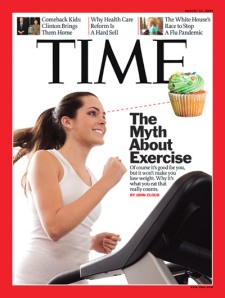
I can’t promise this won’t be the last, but TIME’s front page coverage—a usually reputable and fair minded news source—of “The Myth About Exercise” still has me thinking.

I have a few more thoughts on this matter after reading some responses to the “Myth” article in TIME’s Letters to the Editor.

In the Aug. 31, 2009 issue, TIME published The President of the American College of Sports Medicine (ACSM), James Pivarnik’s, letter to the editor in which he calls out the uneven and untrue reporting in The Myth About Exercise article. The ACSM also published a position statement motivated by the TIME article, in which experts within the ACSM took “strong exception to assertions that exercise can inhibit weight loss by over-stimulating the appetite.” In the position st

What struck me about Pivarnik’s letter was the irony.

How many people read Pivarnik’s letter compared to the millions who read the “Myth” article? The expert, scientific perspective gets 50 words buried on p.6, while the “Myth” story gets front cover exposure, and multiple page, full color feature coverage. Even if you didn’t read the article, you might of read the headline while standing in line at the grocery store—which might be enough to create misinformed perspectives.The exposure of a TIME cover story cannot be underestimated—a major weekly news magazine tells the public what is newsworthy, valued, important….and true (even when the “truth” is skewed, misinterpreted by a journalist, or just plain NOT true).

Sex Testing “Idiocy”

Following South African Caster Semenya’s 800m win at the Track & Field (IAAF) World Championships, a storm of opinions and commentary erupted over her subsequent sex testing/gender verification.

Some of the best I’ve seen is The Nation piece written by Dave Zirin and Sherry Wolf, an MSNBC video exposing the “Twisted, Sexist, Racist, & Heteronormative” Track & Field History, and two blogs by After Atlanta (here and here).

One sport sociology colleague on Facebook asked pertaining to most of the existing media coverage…”Are we in the 1950’s?” As Zirin and Wolf write, this issue is a “minefield of sexism and homophobia”….but thankfully the critical perspective has emerged.

Part II: Clarifying the Myth About Exercise

If you didn’t read the TIME magazine cover article which stated that exercise is basically a waste of time and doesn’t help people lose weight, my blog critique of the article, or the very insightful comments of blog readers (particularly Jenny Evans, Performance Coach & Human Catalyst), here is your second chance.

To add to this critique is another piece, Why Time Magazine is Wrong About Working Out, written by David Zinczenko, the editor-in-chief of Men’s Health magazine and the editorial director of Women’s Health magazine.

Sensationalistic journalism about health, weight loss, and exercise abounds, which distorts and misinterprets research and further confuses consumers, which is why I decided to add a Part II.

Clarifying “The Myth About Exercise”

TIME Cover_myth about exercise Every Saturday I look forward to the TIME magazine in my mail. I know I can read it all online, but there is something satisfying about print media. As someone trained in sport science (aka, Kinesiology) this week’s cover story by John Cloud “The Myth About Exercise” intrigued me. After reading it, I was more than surprised, a bit irritated, and wondered if this wasn’t just more sensationalistic journalism. The premise of the article was based on “some recent studies” that found exercise does not help one lose weight or isn’t as important as we’ve been led to believe.

What?! Have we been lied to all these years? A friend who regularly works out read the article and promptly said, “THAT was depressing and made me never want to work out again.” I wondered how many others were thinking similar thoughts.

The TIME article, based in part on the findings of ONE clinical trial, found that in a group of 464 overweight women assigned to four conditions—women who exercised did not lose significantly more weight than those who did not exercise…and some women in each of the four conditions gained weight.

Dr. Timothy Church, Chair of Health Wisdom at LSU and lead author of the clinical trial, outlines the process of exactly how exercise might psychologically work against us:
1. exercise stimulates hunger
2. when we exercise we often “reward” ourselves with food [see my blog post about this issue in youth sport]
…or both. My astute friend mentioned previously, pointed out this premise assumes that those who don’t exercise don’t reward themselves with food.

Cloud offers an additional explanation based on another study with UK children he’d written about earlier this year
3. One might be more sedentary during non-exercise times than if one didn’t exercise at all

At first read, these findings and the TIME article may be perceived as a green light to bolster couch potato status, and only pay attention to what you eat–and this is dangerous. Exercise matters…but more importantly researchers have demonstrated movement matters!

Weight management is a simple energy equation: energy in (food) < energy out (exercise + energy expended daily to move about, live, & breathe) = maintain or lose weight.

If you take in more than you expend, you gain weight. Given that our metabolism slows 10% every decade (i.e., meaning you burn 10% less calories/energy), even if you ate exactly the same as you did as a teenager…you’d gain weight. True, exercise is only HALF of the equation, but a still needed half.

With billions of dollars tied up in the health and diet industry and new products and advice generated daily, I’ve joked for years that I’m going to write a one-page best seller—Move More, Eat in Moderation (© 2009 nmlavoi). Alas, I fear this would not be a best-seller nor make me enough money to become a full time blogger….Americans want the easy route, the quick fix, and watching what you eat and factoring movement into one’s daily plan takes a bit of effort.

TAKE HOME: The research cited in the TIME article is mostly one-sided, although it does raise some interesting questions. Many other researchers have found that exercise/movement IS important, can lead to a host of positive outcomes, and can provide a buffer to chronic diseases associated with obesity. This is a perfect example of why a critical perspective can be valuable….so…off the couch!

To promote healthy eating, and active living in a society in which obesity rates continue to grow, attention to both is critical. This well-placed article in a well known weekly magazine may do more fan the flame of weight loss mythology, than help.

p.s. The tired gendered cliché of “woman running for something sweet” on the cover did not escape notice

UPDATE 8/10/2009: To prove my point about sensationalist health journalism, today a University of Minnesota colleague Gary Schwitzer, a longtime health journalist “sounded the alarm this week after analyzing hundreds of medical news reports from the past three years” in an article in The New York Post.

The IOC and (the Lack Of) Gender Equity

600px-Olympic_rings_square.svgI read two well written and illuminating pieces yesterday that outlined the many ways in which the International Olympic Committee (IOC) appears not to support female athletes and gender equity. I thought I would share them here in case you didn’t see them.

Under Rogge, women’s sports are getting short shrift in Olympics, by USA Columnist Christine Brennan.

To walk the walk about supporting women, IOC must pick softball for 2016, by Chicago Tribune reporter Philip Hersh