Access free educational materials for espnW Nine for IX films

I recently had the opportunity to work in collaboration with espnW to develop discussion guides for the Emmy-nominated Nine for IX film series.

Nine for IX premiered June 18, 2013, as part of ESPN’s celebration of the 40th anniversary of Title IX. Inspired by the 40th anniversary of Title IX, ESPN Films and espnW produced nine documentary films about women in sports, told through the lens of female filmmakers. Nine for IX Films are a collection of remarkable stories that offer teachable moments and powerful lessons in the history of sports. .

The Nine for IX Knowledge Center is a free resource available to institutions, organizations, administrators, professors, coaches, and students who want to lead thoughtful and engaging discussions around key themes in the films. The Knowledge Center provides discussion guides for each film, film posters, and a sign-up form to receive the Nine for IX DVD set, all free of charge. The Knowledge Center is a tool that goes beyond the entertainment value of the films and leverages the rich educational content of the embedded lessons and messages within the films.

The discussion guides generate thought-provoking discussion topics around key themes and issues present in the films such as gender equality, intersectionality, identity politics, sport and politics, social class, racism, and sexism, along with issues related to sport psychology, sports media coverage, sports marketing, and sports as a vehicle for developing role models. Each unique guide contains Key Concepts, Discussion Questions, Additional Readings and Additional Activities.

I wrote a specific guide for coaches for The 99ers, a film about the 1999 Women’s World Cup Championship team, that coaches can use as a team building activity and to discuss what it takes to develop performance excellence and a positive team culture.
To access the free materials, including obtaining a free DVD box set of the Nine for IX film series, discussion guides, and posters visit the espnW Nine for IX Knowledge Center.

Sexism, Misogyny, & Violence Toward Women: The Role of Sport

Recent events in sport and outside of sport (i.e., Elliot Rodger) have given visibility in clear and stomach turning ways to the fact that girls and women face sexism, misogyny and sexual and domestic violence at alarming rates. Lately blatant acts of derisiveness against women have been numerous, or perhaps they promoted more dramatically by the media. I hope these events and others provide a real and critical turning point in bringing awareness and dialogue about how to reduce all these offensive behaviors directed at and onto women….especially in and through sport.

  • Donald Sterling, (former, but contested) NBA owner of the clippers, was sanctioned by the league for racist comments but his long history of sexism and sexual harassment largely went without sanction.
  • UK Premiere League CEO Richard Scudamore so far has escaped sanction for his sexist commentary in a string of emails exposed by a former personal assistant.
  • NFL star Ray Rice was caught on hotel video cameras dragging his then fiance (now wife) from an elevator after he punched her unconscious. In an embarrassing press conference where he tried to save face, he never apologized TO his wife yet she acknowledged her role in contributing to the incident. The Ravens perpetuated and minimized the culture of violence against women by live tweeting from the Rice press conference that constructed a “feel good narrative of personal redemption”  without having to really address the problem with their star or their organizational complicity to victimizing the victim. Rice’s sanction is TBD, but I will predict it will be minimal.
  • Florida State QB Jameis Winston and the alleged case of rape against him in which he was acquitted sent a terrible and damaging message to young women who dare to accuse popular star athletes of sexual violence.
  • The rape case against high school football players in Steubenville, Ohio is also a not too distant occurrence.

Sexism is such a common part of women’s lives, many do not realize they experience it daily, and females who experience more egregious behaviors from men often take blame for their own victimization (just ask Janay Palmer). The incidents above and countless others that involve men in positions of power in sport and star athletes in the most popular and televised men’s sports, highlight the uphill battle that all girls and women face when battling sexism, misogyny and violence toward them and their sisters. Sport is one of the most powerful social institutions and when men in sport exhibit egregious behavior toward women and are not punished, it not only tells young men this is an expected part of being a male athlete, but it communicates to women and girls that being victimized, belittled, objectified and powerless is a normal part of womanhood.
What do all these men have in common?…..power.

Whether that power is personal, professional, social, economic, or expertise-based (or all of the above) when it is used and enacted in a “power-over” way, the result for women and girls is often negative. Public apologies for egregious, boorish and/or illegal behavior of men in sport toward women should not be sufficient, but is often used to erase collective memory and the “Restart” button is pushed. Violence toward women is not funny or something to be joked about (like it was in a recent Texas bar sign which read–“I like my beer like I like my violence. Domestic.”). Female fans, parents with daughters, men with wives or anyone that cares about the treatment of women should be appalled that such behaviors go unpunished as it creates a culture of violence and mistreatment toward ALL women and girls.

Many have argued that sexism is the last “ism” to be seriously confronted and conquered, and I would agree. However, until there are more women in positions of power in sport, men are held accountable in real ways for their damaging behavior, boys are taught that “being a real man” isn’t related to violence, domination and physicality on or off the field, society takes sexism and violence against women seriously (such as the recent White House campaign NotAlone.gov) and we stop hero worship of male athletes in “the Big 4” sports, this is unlikely to change. But that doesn’t mean we shouldn’t try.

With the death of Maya Angelou who wrote:

“I’m a woman
Phenomenally.
Phenomenal woman,
That’s me.”

If we lived in a world where all girls and women believed and embraced the sentiment of your poem and all males respected and treated women as equals, the world would be a better place.

3 “Must Reads” on Hot Topics in Sport

Gratuitous "hot dog" picture.
Gratuitous “hot dog” picture.

Here are 3 pieces everyone should read/watch/listen to, which reflect 3 areas of research I frequently write about and are currently HOT TOPICSsport parents,  women in sport coaching, and media portrayals of female athletes.

9217_458093160902533_113102254_n1. The Problem for Sports Parents: Overspending, a Wall Street Journal piece that outlines the more parents spend on a child’s “sport career”, the more pressure the child may feel. You can also listen to a radio show on this topic out of Boston. While you’re at it, read a Boston Globe article titled “How parents are ruining youth sports: Adults should remember what athletics are really about”

2.  Basketball’s Double Standard, by espnW writer Kate Fagan is about the barriers and 57673_nak_tns_tennis_tennis02_041413fdiscrimination that women coaches face in college basketball, and how women coaching men’s teams seems laughable to most ADs. You can see just how bad the numbers are pertaining to the percentage of women head coaches of women’s teams at “big time” institutions by clicking here.

April 2014 Golf Digest cover photo

3. Watch Dr. Caroline Heldman’s TED talk titled “The Sexy Lie” which is helps dispel the “sex sells” myth. In my research at the Tucker Center for Research on Girls & Women in Sport, we are amassing evidence to help dispel and challenge the myth that “sex sells women’s sport.” You can watch our documentary on this topic “Media Coverage & Female Athletes” free online.

Basketball & Brackets Matter: The Case for a Perfect Women’s Bracket Challenge

The 2014 March Madness NCAA D-I basketball brackets for the men and women are now set. Teams are anxiously awaiting play. I love March Madness, but I am awaiting something different….word from Warren Buffett. I have tweeted Mr. Buffett (@WarrenBuffett) and Quicken (@quickenloans) to inquire if they were going to also offer a “perfect women’s bracket” contest, as they are offering a $$BILLION dollars$$ for a perfect men’s bracket. No reply.bb moneyball

It isn’t that I want two chances of winning a BILLION dollars (No one is going to win, the odds are 1 in 9 quintillion), it is the message being communicated by offering only a men’s bracket and who benefits from this “perfect bracket” challenge that is the problem.

Women’s sport and female athletes are continuously striving against minimal media coverage to be taken seriously and lauded for their athleticism (to go more in depth on this topic, watch a new documentary on “Media Coverage and Female Athletes”). By offering only a perfect men’s bracket challenge, Buffett & Co. are reinforcing the idea that men’s sport and male athletes are more talented, important, valued, and worthy.

Offering a perfect women’s bracket could of been a win-win and is a missed opportunity:

1. Quicken could have potentially garnered more new home loan clients (which is their goal!), and Buffett could of possibly made more profit (no one is sure exactly what his deal is with Quicken, but it isn’t $0!).

2. It would communicate in equal ways that women’s sport is and female athletes are worthy, valued, exciting and deserving.

3.It might have also inadvertently or directly increased interest in women’s basketball—especially in a demographic that is typically deemed “uninterested” (18-35 year old males).

Why does interest matter? “Lack of interest” by males, who are coveted by sport marketers and sport editors, is used as proof and proxy that “everyone” is uninterested in women’s sport–a statement that is completely false (not all young men are uninterested in women’s sport, and outside that demographic women’s sport fans abound!). Lack of interest is often used as a reason for not promoting or covering women’s sport. Many people are very interested in women’s sport, and particularly women’s college basketball as evidenced by increasing attendance, steady ESPN viewership, and expansion of women’s game coverage. Creating hype around the women’s bracket by offering $1B is a perfect way to bring in new fans, generate interest, and communicate the value inherent in women’s sport, some of which would likely be sustained because “they” (i.e., new fans) would watch, monitor brackets, and see that women’s teams are also exciting and talented!

People love March Madness and love to fill out brackets. College basketball and brackets matter. Placing more value (literally) on the men’s bracket, communicates what and who is valued and worthy, as well as who and what is not.

Football Bowl Winners…A Slightly Different Approach

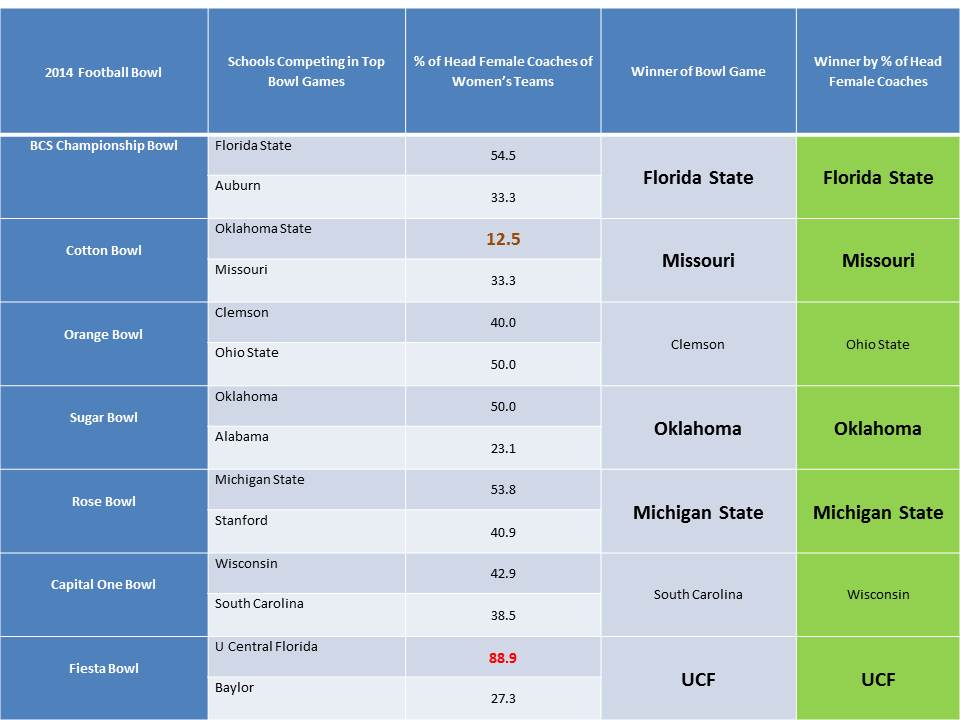
Now that the 2013-14 Football Bowl Series has come to a close and winners declared, I am posting bowl winners based on a slightly different approach.

The winners of 7 arguably most prestigious bowls in this graphic (click on it to make it larger) are based on the institution’s commitment to gender equity in its hiring of women head coaches for women’s teams for 2013-14.

One Sport Voice Bowl Winners 2014

So if you are a fan of Ohio State and Wisconsin…you have something to cheer about, even though your teams lost their bowl game, your institutions have a higher percentage of female head coaches (FHC) of women’s teams than did your opponents!

Sorry Florida State (54.5%)… yes you beat Auburn (33.3%) both on the field and by % of FHC and even though they didn’t play in the title game, University of Central Florida is the real National Champion as 8 of 9 (88.9%) of their women’s teams are coached by women head coaches! Well done UCF!

Oklahoma State, you lost to Missouri (33.3%) both on the field and in % of female head coaches, but you are the winner the Toilet Bowl as only ONE of 8 (12.5%) of your women’s teams are coached by a woman…you can do better, A LOT better! However OK State to be fair, in 2012-13 NONE (0%, ZERO) of your women’s teams were coached by women, so you are moving in the right direction!

This data is taken from 2014 Women in College Coaching Report Card. (note: UCF is not included in the sample, but data was calculated separately from the UCF Athletics Web site)

RELEASED: New Reports on Women College Coaches

Did you know that in the 40+ years after the passage of Title IX, female sport participation is at an all-time high but the percentage of women coaching women at the collegiate level has declined from 90+% in 1974 to near an all-time low today of 40%? While the number of collegiate coaching opportunities is also at a record high, only 20% of all college coaching positions for men’s and women’s teams are filled by women.

T2012-13_women-coaches-reportoday we (meaning the Tucker Center & the Alliance of Women Coaches) released a research series, 2 report cards and infographic on the status of women college coaches at 76 of the biggest NCAA D-I athletics programs. This work is the culmination of many people’s efforts. The purpose of this initiative is to increase the number of women in the coaching profession, generate awareness, and hold institutions accountable. I hope you will check out the reports and infographic and read the article Christine Brennan wrote in USA Today about the report.

Here are some key take-aways from the reports:

  • As the position became more visible and arguably powerful from graduate assistants, to assistant coaches, to head coaches, women occupied those positions less frequently.
  • In one academic year the percentage of women head coaches declined from 40.2% to 39.6%
  • Only ONE school, Cincinnati at 80%, was awarded an A for the percent of women head coacheswcr_2013-14_infographic
  • An equal number of schools got above average grades of A’s and B’s as got F’s (11 each). To see which schools passed and failed, or where your school stacked up, click on the infographic.
  • Two sports had 100% female head coaches (field hockey, synchronized swimming) while five sports had ZERO (0%) (water polo, bowling, skiing,, sailing, squash)
  • The B1G Ten (46.1%) conference had the most female head coaches of the 6 conferences we examined (ACC, Big East, Big 12, SEC, PAC 12), the SEC had the lowest (33.3%)wcr_2013-14_head-coaches
  • 66 of 886 head coach positions turned over from 2012-13 to 2013-14. Out of those 66 positions 74.2% of all coach vacancies were filled by men resulting in a net gain of five head male coaches, thus the decline in the percentage of women head coaches.
  • 7 schools increased the % of female head coaches in one academic year, while 13 decreased.

To read more about why this research matters, grading criteria, methodology and more specifics on processes go to the reports.

Female Coaches in High School Sports: Data Released

You don’t need to look far or drill down very deep in a Google Search on ‘female coaches’ to find out two facts.

1. Female coaches at all competitive levels have declined since Title IX passed in 1972
2. Female coaches are the minority in almost every workplace

Many are familiar with the longitudinal work of Vivian Acosta and Linda Carpenter, who have tracked the number of females in positions of power in intercollegiate athletics for the past 35 years. Based on their data we know that in 1972 over 90% of female college athletes were coached by women, and in 2012 that number is near an all time low at 42.9%.   To date a similar nationwide analysis for high school sports did not exist.Colleague Cindra Kamphoff, PhD and I decided to change that by analyzing a 2010 national data set of high school coaches we obtained from a reputable coaching directory. Some interesting, but not surprising, patterns emerged. Here are three key findings:

Slide141. 27% of all high school head coaches are female

2. Females coached of girls’ teams (39.6%) more often than boys’ teams (7.5%)Slide16

3. In basketball, the most popular** high school sport (and therefore the most visible, prestigious, important, valued, and known) females coached girls’ (28.1%) teams more often than boys’ (0.2%) teams.

Based on the data, female head coaches are often statistical tokens (<15% of a workforce) and marginalized (i.e., assigned to coach the less important and visible teams) in high school athletics. Tokens often experience or are subjected to scrutiny, pressure to over-perform to gain credibility, discrimination, harassment, and a host of negative workplace outcomes, and this is supported in the vast literature on barriers and support for female coaches which I’ve previously written about on this blog.

**most popular as indicated by the National Federation of High Schools

NOTE: Complete and refined analysis will continue. Please note these numbers represent a 3-5% variance, are not exact, but provide an initial picture into power, leadership, and high school sports.