Football Bowl Winners…A Slightly Different Approach

Now that the 2013-14 Football Bowl Series has come to a close and winners declared, I am posting bowl winners based on a slightly different approach.

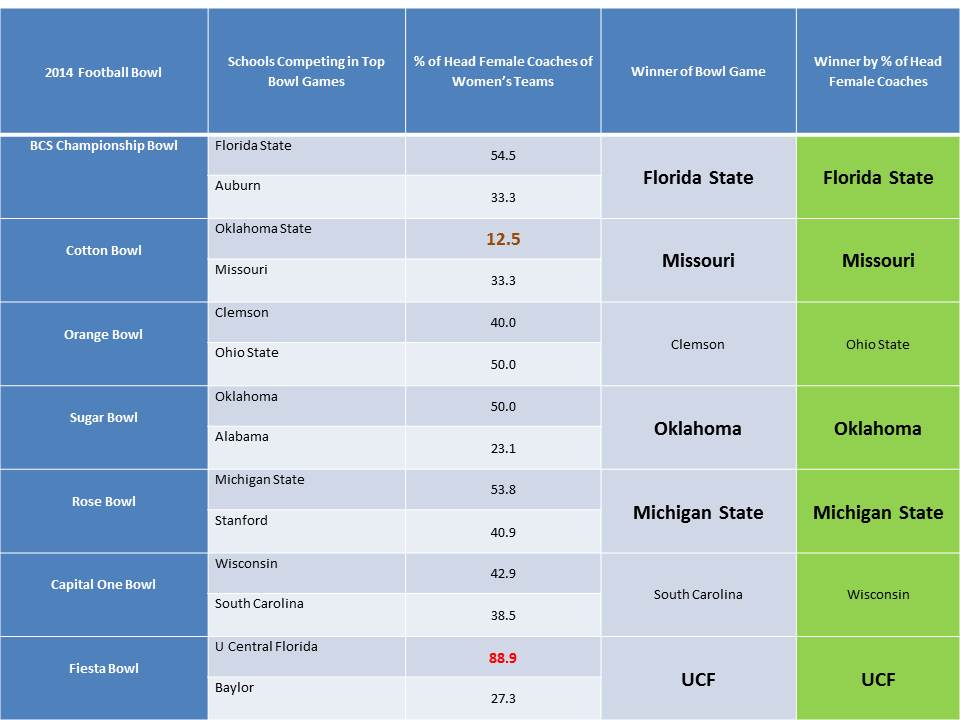
The winners of 7 arguably most prestigious bowls in this graphic (click on it to make it larger) are based on the institution’s commitment to gender equity in its hiring of women head coaches for women’s teams for 2013-14.

One Sport Voice Bowl Winners 2014

So if you are a fan of Ohio State and Wisconsin…you have something to cheer about, even though your teams lost their bowl game, your institutions have a higher percentage of female head coaches (FHC) of women’s teams than did your opponents!

Sorry Florida State (54.5%)… yes you beat Auburn (33.3%) both on the field and by % of FHC and even though they didn’t play in the title game, University of Central Florida is the real National Champion as 8 of 9 (88.9%) of their women’s teams are coached by women head coaches! Well done UCF!

Oklahoma State, you lost to Missouri (33.3%) both on the field and in % of female head coaches, but you are the winner the Toilet Bowl as only ONE of 8 (12.5%) of your women’s teams are coached by a woman…you can do better, A LOT better! However OK State to be fair, in 2012-13 NONE (0%, ZERO) of your women’s teams were coached by women, so you are moving in the right direction!

This data is taken from 2014 Women in College Coaching Report Card. (note: UCF is not included in the sample, but data was calculated separately from the UCF Athletics Web site)

RELEASED: New Reports on Women College Coaches

Did you know that in the 40+ years after the passage of Title IX, female sport participation is at an all-time high but the percentage of women coaching women at the collegiate level has declined from 90+% in 1974 to near an all-time low today of 40%? While the number of collegiate coaching opportunities is also at a record high, only 20% of all college coaching positions for men’s and women’s teams are filled by women.

T2012-13_women-coaches-reportoday we (meaning the Tucker Center & the Alliance of Women Coaches) released a research series, 2 report cards and infographic on the status of women college coaches at 76 of the biggest NCAA D-I athletics programs. This work is the culmination of many people’s efforts. The purpose of this initiative is to increase the number of women in the coaching profession, generate awareness, and hold institutions accountable. I hope you will check out the reports and infographic and read the article Christine Brennan wrote in USA Today about the report.

Here are some key take-aways from the reports:

  • As the position became more visible and arguably powerful from graduate assistants, to assistant coaches, to head coaches, women occupied those positions less frequently.
  • In one academic year the percentage of women head coaches declined from 40.2% to 39.6%
  • Only ONE school, Cincinnati at 80%, was awarded an A for the percent of women head coacheswcr_2013-14_infographic
  • An equal number of schools got above average grades of A’s and B’s as got F’s (11 each). To see which schools passed and failed, or where your school stacked up, click on the infographic.
  • Two sports had 100% female head coaches (field hockey, synchronized swimming) while five sports had ZERO (0%) (water polo, bowling, skiing,, sailing, squash)
  • The B1G Ten (46.1%) conference had the most female head coaches of the 6 conferences we examined (ACC, Big East, Big 12, SEC, PAC 12), the SEC had the lowest (33.3%)wcr_2013-14_head-coaches
  • 66 of 886 head coach positions turned over from 2012-13 to 2013-14. Out of those 66 positions 74.2% of all coach vacancies were filled by men resulting in a net gain of five head male coaches, thus the decline in the percentage of women head coaches.
  • 7 schools increased the % of female head coaches in one academic year, while 13 decreased.

To read more about why this research matters, grading criteria, methodology and more specifics on processes go to the reports.

Old School Coaching Has No Place

March Madness takes on a whole new meaning when you watch this Outside the Lines video about the Rutgers head men’s basketball coach, Mike Rice. I find this video hard to watch and appalling. What is more appalling is that Rice has not been fired for his abusive behavior and sexist and homophobic language (update 4/3/2013 Rice has been fired). This type of old school coaching behavior should be just that…Old School.Old_School

Coaches have the responsibility to treat their athletes with respect and care, as human beings, not just as cogs in the performance machine. I think you can learn a lot about a coach by watching him/her on the sidelines and by listening to what he/she says.

What is the demeanor of the coach? How do they act under pressure in the most contested moments? How do they act when they are winning versus losing? Are their athletes paying attention in the huddle and looking engaged? Do the athletes look like they are listening to the coach intently or blowing him/her off with disregard? What is the body language and facial expressions of the athletes and of the coach? How are the assistant coaches involved in the game? How does the head coach treat the assistant coaches? How does the coach treat the officials? How does the coach react to mistakes by athletes? How does the coach explain losses and wins? Do the athletes embrace the coach after wins and seek him/her out after losses?

If you watched the OTL video and Google Image search Mike Rice it will paint a picture of what a coach should not do and look like.

On the contrary, last night I watched the Cal Bears Women’s Basketball Head Coach Lindsay Gottlieb, coach her team to their first-ever NCAA Final Four last night with grace.  I was impressed by this young coach. She didn’t yell or act abusively toward athletes, officials or assistants. She coached. Her Google Image Search tells a very different picture of teaching, calmness under pressure, care, fun, enjoyment, pride…what coaching should look like.

I hope that the New School and face of coaching begins to look much more like Gottlieb and others like her, and that taxpayers who pay the HIGH salaries of coaches like Rice become outraged and less tolerant of abusive behavior toward young people.

updates:

The Scarcity of Female Coaches-Part III

This week marks the 40th anniversary of Title IX. Currently I’m out in Denver for the NCAA Women Coaches Academy (run by the Alliance of Women Coaches) and in the next room is the NCAA/NACWAA Institute for Administrative Advancement where in both rooms the current and future generation of coaches and athletic administrators are being empowered. Seeing this group of women is inspiring and motivates me to continue the work I do to help them in part to succeed and stay in sport careers. Unfortunately they need a lot of support to do so.

As I was getting ready this morning I caught part of the ESPN Outside the Lines piece on “Coaching Conundrum” as to why there is a scarcity of female coaches. The ESPN crew had been out in Atlanta filming at the Alliance of Women Coaches annual Huddle in last May. While the ESPN piece is great for raising awareness about the scarcity of female coaches, it only scratched the surface of this complex question. An espnW piece on “The Glass Wall” is a much more in depth treatment female coaches.

I have written previously about this issue (Part 2  here and Part 1 here), but I want to elaborate a bit more on the eve of the Title IX anniversary.

The barriers for female coaches reside at four levels.

1. Individual (perception of lack of competence or confidence, choose not to coach, perception of time commitment to fulfill role)

2. Interpersonal (family & domestic commitments, lack of support from administration, negative recruiting from colleagues)

3. Organizational (lack of opportunity for professional development, lack of family-friendly policies, limited opportunities for advancement, lack of female role models in positions of power)

4. Societal-Cultural. This is the level that rarely gets discussed, is the hardest to change, and has to do with stereotypes of women, gender and leadership. The traits of effective leadership we mostly highly value in US society align with a male/masculine leadership style. If women don’t adopt or conform to this style (firm, authoritarian, assertive, loud, in control, competitive) they are perceived to be incompetent and weak. If they do adopt this style, the are often labeled a bitch because she is not conforming to a stereotypical female leadership style (caring, quiet, nurturing, passive, collaborative). The key here is that the association with gender and leadership is constructed and arbitrary, but has a dramatic effect on the careers of female coaches. If those in positions of power are mostly men (and they are!) and they are not aware of their own uncritical acceptance of leadership beliefs, and largely believe that male coaches are more competent than females…this will result in most likely a male being hired into the position. The result?–The current structure of sport and male power does not get challenged and females remain marginalized and in the minority, and because men continue to dominant the sport landscape and occupy the most important positions, society at large continues to believe that men are inherently more competent to coach.

Effective leadership is not gendered. Being competent, knowledgeable, facilitating optimal performance, treating people with care and respect, being organized, communicating well, are not inherent to males or females.

Female coaches need a voice in the sport landscape that is dominated by men. Be part of the critical mass and join the Alliance of Women Coaches.

Look for a full length article I wrote with a graduate student on this topic coming out in July 2012 in the inaugural issue of Sports Coaching Review titled “Barriers and support for female coaches: An ecological model.”
Augusta National: When “Tradition” = Justified Discrimination

I’ve been following the story of IBM CEO Virginia Rometty and the Augusta National green jacket/membership controversy.

In short, IBM is a long time sponsor of The Masters golf tournament, held at Augusta National Golf Club which bans women from membership. Traditionally, the CEO of IBM dons the champion “green jacket” and is given a club membership. Not this year. Instead of changing their rules to allow Rometty a green jacket and membership, the men in power at Augusta chose to continue their “tradition” of discrimination. In addition, IBM remained silent.

Dr. Martha Burk wrote a great column in Women’s e-News titled “To IBM: Women Saw That” about why this matters. She writes, “Much of the argument centered on whether the club had the “right to remain private” (translate “engage in discrimination at will”).”

Burk makes two great points.

1. This is not about golf, it is about power relationships.

2. IBM’s silence endorses the gender discrimination against their female CEO

Ironically as I write this blog I’m listening to Alice Eagly, PhD (Kellogg School of Management, Northwestern University) co-author of Through the Labyrinth: The Truth About How Women Become Leaders on NPR and President Obama is holding the White House Forum on Women in the Economy.


In terms of gender equality, It is clear that IBM, Augusta National have missed a key opportunity and left the putt short.

Even more ironic is the headline of a Washington Times story titledThe Masters 2012: IBM’s Virginia Rometty overshadows Tiger Woods” as if to suggest it is incredulous that a female could and IS taking the spot light away from a male.

Given the Saudi’s just announced they would send ZERO females to the summer London 2012 Olympics, which is a rule violation of the IOC, we shall see if the IOC & Jacques Rogge (himself not a picture of advocating for gender equality) bans Saudi Arabia from the games. Any bets?