
March Madness! Visible Women Head Coaches

Here is a different twist on March Madness 2015.

It is pure Madness! (in a good way) that:

  1. the ESPN coverage of the NCAA D-I women’s basketball tournament is well produced so that we can actually SEE these amazing female athletes and their coaches
  2. a majority of the head coaches of women’s basketball are women. In the Women in College Coaching Research Series, 62.8% of head coaches of women’s basketball in the 86 “big time” NCAA D-I schools (many of which are in the tournament) are women.

Based on the 2014-15 data in the Women in College Coaching Research Series, I took the remaining 2015 Sweet 16 teams and filled out the bracket based on the percent of women’s teams at that institution which had a female head coach (see Figure 1). With that data, Maryland and Florida State would be Co-National NCAA D-I Champions (coached by Brenda Frese and Sue Semrau respectively), due to the fact 54.5% of all their women’s teams at both institutions are coached by a woman head coach. Madness!
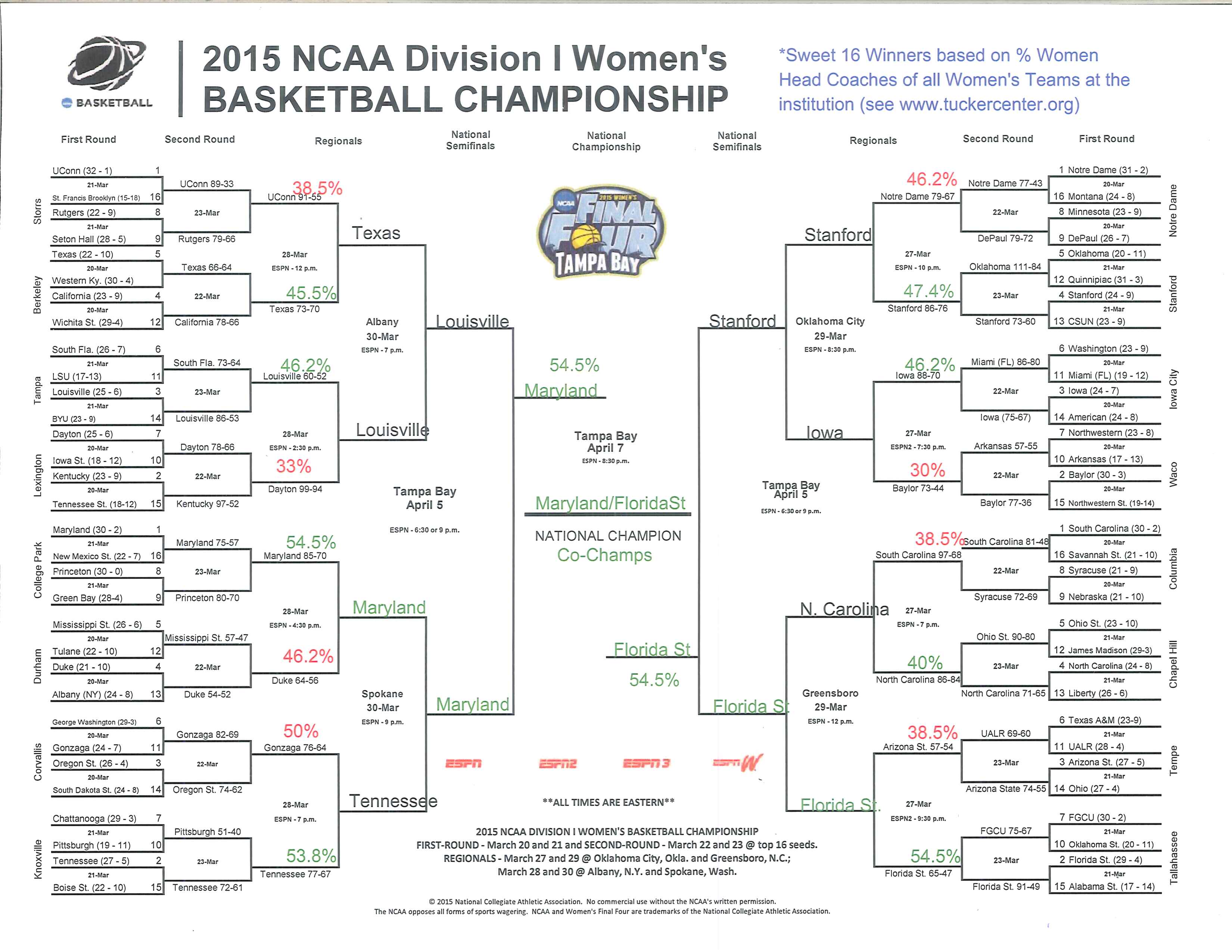
2015 WBB sweet 16 bracket
Figure 1. 2015 Women’s NCAA D-I Winner by Percent of Women Head Coaches of Women’s Teams by Institution


Madness! Of note, 13 of the Sweet 16 women’s teams (81.3%) have a female head coach–that is an over-representation of women head coaches for the best teams in the nation, than are found in women’s D-I basketball in general, given the stat I stated before (62.8%). The Sweet 16 stat is a really interesting stat in that 29 of 64 teams (45.3%) in the full bracket are coached by a female head coach. Based on the data, it appears the female head coaches are proportionately outperforming their male coaching colleagues and are represented in a larger percentage in the Sweet 16, than the initial pool of women coaches in the bracket. More Madness!

And there are many other competent women head coaches represented in earlier rounds, such as Princeton coach Courtney Banghart, whose undefeated 31-0 team lost to Maryland in a hard fought game which was written about by USA Today columnist Christine Brennan.

To break the tie and declare a national champion, we (thanks Marnie Kinnaird!) looked at the gender composition of the coaching staffs for the Sweet 16 women’s basketball teams (see Figure 2 below).

We weighted the score by position, if a woman occupied the position a school earned the following points: Head Coach = 3pts, Associate (Head) Coach = 2pts, Assistant Coach = 1pt. Males in any position earned zero points. We counted only 4 coaching positions for each institution (except for UNC who had 5).

Based on the data in Figure 2, Notre Dame and Arizona State tied for the “win” with 8pts each (due to the fact both programs have 2 Associate Coaches, which are weighted more heavily than an Assistant Coach, therefore giving them the lead), and Stanford and Iowa tied for second place with 7pts each. Notwithstanding Notre Dame, Arizona State, Stanford and Iowa share an interesting stat–the coaching staff is comprised of all women.

Meaning 4 of the Sweet 16 teams (25%) are coached by all women–prime examples of women mentoring women. Madness! 

2015 Gender Composition of Coaching Staff for Women's Sweet 16 Women's Basketball  Teams
Figure 2. 2015 Gender Composition of Coaching Staff for Women’s Sweet 16 Women’s Basketball Teams


This data did not break the Co-National Champs tie…both Maryland & Florida State had 5pts! (mini madness!)

Seeing powerful, successful female role models, athletes and coaches, on TV matters!

It provides proof that women can be successful at the highest levels in the coaching profession. It provides visibility to young girls and women who aspire to play college athletics and who may aspire to continue following their love and passion in sport by coaching. It provides evidence and gives boys and young men a picture that women can be, and are, leaders. So thanks to ESPN and espnW for providing excellent coverage, content and production value, so that these amazing women athletes and their coaches can be seen for the role models they are. So here’s to more Madness!

p.s.-If you have an idea on how to break the tie between Maryland and Florida State, tweet me @DrSportPsych


Women in “Big Time” College Coaching Positions–Report Released

To honor National Girls and Women in Sport Day, I decided to release the annual Women in College Coaching Report Card. This research series is a collaboration between the Tucker Center for Research on Girls & Women in Sport at the University of Minnesota, and the Alliance of Women Coaches.

We gave espnW’s Kate Fagan the exclusive first-run story in which she summarizes some of the key findings-Women Coaching Women? Big-Time Schools Grade Out Terribly.2014-15_wcr-group

You can download the 2014-15 Head Coaches of Women’s Teams report and the accompanying infographic free of charge.

Here are the 2014-15 data I think are important and noteworthy.

  • The percentage of head coaches of women’s teams increased .6% from last year (net gain of +6 female coaches out of 969) to 40.2%
  • Two schools (Cincinnati & U Central Florida) out of 86 were awarded A’s (70-100% women head coaches = A)
  • An equal number of schools (n=11) got As and Bs as got Fs
  • The percentage of institutions receiving Fs has increased every year (0-24% = F)
    • 2012-13: 10.5%, 2013-14: 11.8%, 2014-15: 12.9%
  • One school had zero female head coaches (Xavier)
  • Field hockey had 100% female head coaches, water polo and alpine skiing had 0%
  • None of the 7 “big time” conferences in our sample were awarded an A or B.
  • 85 head coaching positions turned over from last year,  61% of the time a male was hired to replace the outgoing coach.

Take home messages.

Overall, in the three years we have done the report no remarkable gains or losses in the percentage of women head coaches of women’s teams in the biggest college athletics programs have been realized. In fact the percentage in this year’s report 2014-15 is the exact same as it was in the first year of the report in 2012-13. So depending on how one looks at the data, the glass can be half full or half empty. We aren’t gaining ground, but we also are not losing more ground. Based on the data, whether we look at conference, sport or institution, a great deal of room for improvement exists in terms of hiring women head coaches at the institutions that are most visible in the sport media landscape and culturally valued for their athletics.

This data is important given what some scholars are calling “college athletics’ war on women coaches” as it provides a mechanism of accountability at the institutional level, stimulates awareness, generates dialogue, and perhaps creates social change on the scarcity of women head coaches and why that matters for athletes, coaches, institutions and coaching organizations.

To read more about the historic decline of women in the coaching profession, why women coaches matter and why diversity in the workplace matters, read our past reports here and here. To read my other blogs about women in sport coaching, a topic a frequently write about, click here.


Shannon Miller Gets Fired: A Troubling Development for Women Coaches

Some of you may not know who Shannon Miller is, but those of us in The State of Hockey (Minnesota) do. Shannon Miller was a highly successful women’s hockey coach at University of Minnesota-Duluth where her teams have won five NCAA championships, she developed 28 current and former Olympians, and amassed a .713 winning percentage. I say “was” because on 12/16/2014 Miller was fired in the middle of her season (her contract was not renewed for 2015-16) because she got paid too much. Miller was the highest paid women’s hockey coach in the country at $215,000, largely because she is one of the best. Miller’s counterpart, the head men’s hockey coach at UMD makes $235,000, and still has his job.

In a story posted on MPR Athletic Director Josh Berlo was quoted as saying, “She established a winning program, raised it to the highest level of competition and sustained a national championship tradition over the last 15 years. Today’s decision about Shannon’s contract was an immensely difficult and financially driven decision. Unfortunately, UMD Athletics is not in a position to sustain the current salary levels of our women’s hockey coaching staff.”

hockey_puckLet me point out a few things about Berlo’s decision that just don’t add up.

1. First it is public knowledge that UMD is “in serious financial trouble” and faces $5M+ budget shortfall. Is saving $45,000 by firing Miller really going to make a significant difference? They have to pay a new coach. Minnesota’s highly successful head women’s hockey coach Brad Frost makes $170,000 and in this article the salaries of Miller’s male colleagues are stated.  Miller was willing, but not given the option, to take a pay cut. In sum, her firing is really not about money.

2. If it were about money, let’s look at the Equity in Athletic Data Analysis (EADA numbers) for UMD that clearly show that there is significantly more money being spent on the men’s hockey team, compared to the women’s team. In fact, the budget for men’s hockey is $533,322 (including coach salaries) and for the women that figure is $259,732. That is a $275,590 difference in favor of the men’s hockey team.

3. In all my research on coaches, I have NEVER heard of a male coach of any sport being fired because he was paid “too much.” In fact, if you look at salary comparisons of coaches for men’s teams and coaches of women’s teams (some of which are men), the pay gap is staggering, especially when you factor in football coach salaries. (EADA, 2012).

4. There are very few head women’s hockey coaches that are female in the most visible prominent programs, Miller was one of the few left. Based on 2014-15 data for my Women in College Coaching Report Card (being released Feb. 4, 2015) there are very few (n=8) women’s hockey programs in the “Big 7” NCAA-I conferences, and only one of those programs is headed by a woman. Therefore, only 12.5% of premiere women’s hockey programs are coached by women. In my report card, hockey earns an “F” for the percentage of women’s teams coached by women and adds to the trend that the percentage of women head coaches have been in a steady decline (~40%) since the passage of Title IX in 1972 when over 90% of female athletes were coached by women.

It is well documented in my own research, and of my colleagues, that women coaches face a number of barriers and double standards that preclude women from entering the coaching profession, impede career advancement, and lead to women burning out and quitting the profession. The firing of Miller and the reasons given are a game changer and new “barrier” for women coaches.

It communicates to women that even if you do your job well, win, coach with integrity, are beloved by your players, well respected by your peers, turn out Champions and Olympians, are paid well for your expertise, make a long term commitment to the community, institution, and program, that you can be fired under the guise of “financial reasons” while your male colleague with less success and a greater salary, remains.

If this issue concerns you, become involved in the Alliance of Women Coaches.

note: I amended this post 5pm 12/17/14 to reflect an inaccuracy that I wrote in an earlier version of this post. Miller’s contract is not being renewed and she will continue coaching through the 2014-15 season. What I wrote earlier made it seem that she was terminated immediately. I will say however on a related note, that being notified of a non-renewal in the middle of the season is not a common approach.

note 2: The best posts I’ve read on this topic are by colleagues Pat Griffin, College Athletics’ War on Women Coaches, where she summarizes some recent discrimination lawsuits filed on behalf of women in athletics. Kris Newhall’s post on the Title IX blog is also very good, What should we take from Miller’s firing?


What I Love & Dislike about Coverage of Mo’ne Davis

Mo'ne Davis
Mo’ne Davis

I LOVE and DISLIKE that 13-year old Philadelphia-based pitcher Mo’ne Davis is creating a stir in the 2014 Little League World Series (LLWS).

LOVE: It is creating awareness that girls can and do play baseball, and can pitch and play successfully against boys. Davis is throwing like a girl–athletic, competent, knowledgeable, competitive.

DISLIKE: Lots of girls outperform boys every day in a variety of sports and it shouldn’t be a big deal and certainly not create a national media event…it should be common knowledge. At 11-13 years-old (the age of LLWS players), developmentally girls are usually ahead of or similar to most boys in height, weight, strength, speed and power. Thus it makes sense Mo’ne and other girls can “hang with the boys” or outperform them. As colleague, Olympian, and Women’s Sport Foundation advocacy director Nancy Hogshead Makar posted: “Way to go Mo’ne Davis! At the same time, there’s too much awe and disbelief that a girl can be a truly outstanding athlete – Especially pre-puberty, where there are very few physical differences. If you’re “AMAZED” – you need to see a lot more female athletes.”

LOVE: The public gets to SEE Davis pitch/bat/field, and SEE her on the cover of Sports Illustrated. Being seen on two of the biggest sports media conglomerates–ESPN and SI--matters. Being seen communicates what is relevant, important and valued. Davis provides visible proof of a performance continuum in sport and communicates positive messages to young girls about athleticism that transcend gender.

LOVE: Mo’ne Davis has become a role model for both girls and boys alike.

DISLIKE: I don’t think children in any sport should be on ESPN at all. Period. It is exploitation pure and simple. It teaches and sends children the wrong message about what sport should be about. If you’ve watched any of the LLWS, it doesn’t take long for the kids to find the camera trained on them and catch them looking into the camera…instead of focusing on the game at hand. It creates scrutiny and pressure on youth athletes, a pressure that not many youth are equipped to cope with yet. How would you like your failures to be broadcast on national TV when you were 12 yrs old? In addition, it is rumored that Davis signed gear is being sold for big money…none of which will benefit HER (else her future college athletic eligibility be nullified).

LOVE:  I think it is really cool that Davis appears on the cover of Sports Illustrated, and is also the first Little Leaguer to appear on the cover. Groundbreaking! I like that she is portrayed in action, in her uniform and on the field…markers that communicate athleticism and competence. I love that the coverage of her has increased interest in (record TV ratings, long lines for tickets, merchandise sales, stories written about) and respect for young female athletes.

DISLIKE: ESPN rarely covers girls’ and women’s sport (See this study) and Sports Illustrated rarely puts females on the cover (Go to SI covers and count for yourself! or read one of numerous studies about it) and when they do females are sexualized rather than portrayed as serious athletes, but now that showing Davis will increase ratings and sales she is hyped and promoted. Seems like more exploitation. (Note: it would be really distasteful to sexualize a 13 year old on the SI cover!)

The popularity and hype around Mo’ne Davis is complicated. Images of her are both empowering and transformative, but can also be read as exploitative and regressive. This is what makes sport such an interesting context to examine. What do think?


Access free educational materials for espnW Nine for IX films

I recently had the opportunity to work in collaboration with espnW to develop discussion guides for the Emmy-nominated Nine for IX film series.

Nine for IX premiered June 18, 2013, as part of ESPN’s celebration of the 40th anniversary of Title IX. Inspired by the 40th anniversary of Title IX, ESPN Films and espnW produced nine documentary films about women in sports, told through the lens of female filmmakers. Nine for IX Films are a collection of remarkable stories that offer teachable moments and powerful lessons in the history of sports. .

The Nine for IX Knowledge Center is a free resource available to institutions, organizations, administrators, professors, coaches, and students who want to lead thoughtful and engaging discussions around key themes in the films. The Knowledge Center provides discussion guides for each film, film posters, and a sign-up form to receive the Nine for IX DVD set, all free of charge. The Knowledge Center is a tool that goes beyond the entertainment value of the films and leverages the rich educational content of the embedded lessons and messages within the films.

The discussion guides generate thought-provoking discussion topics around key themes and issues present in the films such as gender equality, intersectionality, identity politics, sport and politics, social class, racism, and sexism, along with issues related to sport psychology, sports media coverage, sports marketing, and sports as a vehicle for developing role models. Each unique guide contains Key Concepts, Discussion Questions, Additional Readings and Additional Activities.

I wrote a specific guide for coaches for The 99ers, a film about the 1999 Women’s World Cup Championship team, that coaches can use as a team building activity and to discuss what it takes to develop performance excellence and a positive team culture.
To access the free materials, including obtaining a free DVD box set of the Nine for IX film series, discussion guides, and posters visit the espnW Nine for IX Knowledge Center.

3 “Must Reads” on Hot Topics in Sport

Gratuitous "hot dog" picture.
Gratuitous “hot dog” picture.

Here are 3 pieces everyone should read/watch/listen to, which reflect 3 areas of research I frequently write about and are currently HOT TOPICSsport parents,  women in sport coaching, and media portrayals of female athletes.

9217_458093160902533_113102254_n1. The Problem for Sports Parents: Overspending, a Wall Street Journal piece that outlines the more parents spend on a child’s “sport career”, the more pressure the child may feel. You can also listen to a radio show on this topic out of Boston. While you’re at it, read a Boston Globe article titled “How parents are ruining youth sports: Adults should remember what athletics are really about”

2.  Basketball’s Double Standard, by espnW writer Kate Fagan is about the barriers and 57673_nak_tns_tennis_tennis02_041413fdiscrimination that women coaches face in college basketball, and how women coaching men’s teams seems laughable to most ADs. You can see just how bad the numbers are pertaining to the percentage of women head coaches of women’s teams at “big time” institutions by clicking here.

April 2014 Golf Digest cover photo

3. Watch Dr. Caroline Heldman’s TED talk titled “The Sexy Lie” which is helps dispel the “sex sells” myth. In my research at the Tucker Center for Research on Girls & Women in Sport, we are amassing evidence to help dispel and challenge the myth that “sex sells women’s sport.” You can watch our documentary on this topic “Media Coverage & Female Athletes” free online.

Basketball & Brackets Matter: The Case for a Perfect Women’s Bracket Challenge

The 2014 March Madness NCAA D-I basketball brackets for the men and women are now set. Teams are anxiously awaiting play. I love March Madness, but I am awaiting something different….word from Warren Buffett. I have tweeted Mr. Buffett (@WarrenBuffett) and Quicken (@quickenloans) to inquire if they were going to also offer a “perfect women’s bracket” contest, as they are offering a $$BILLION dollars$$ for a perfect men’s bracket. No reply.bb moneyball

It isn’t that I want two chances of winning a BILLION dollars (No one is going to win, the odds are 1 in 9 quintillion), it is the message being communicated by offering only a men’s bracket and who benefits from this “perfect bracket” challenge that is the problem.

Women’s sport and female athletes are continuously striving against minimal media coverage to be taken seriously and lauded for their athleticism (to go more in depth on this topic, watch a new documentary on “Media Coverage and Female Athletes”). By offering only a perfect men’s bracket challenge, Buffett & Co. are reinforcing the idea that men’s sport and male athletes are more talented, important, valued, and worthy.

Offering a perfect women’s bracket could of been a win-win and is a missed opportunity:

1. Quicken could have potentially garnered more new home loan clients (which is their goal!), and Buffett could of possibly made more profit (no one is sure exactly what his deal is with Quicken, but it isn’t $0!).

2. It would communicate in equal ways that women’s sport is and female athletes are worthy, valued, exciting and deserving.

3.It might have also inadvertently or directly increased interest in women’s basketball—especially in a demographic that is typically deemed “uninterested” (18-35 year old males).

Why does interest matter? “Lack of interest” by males, who are coveted by sport marketers and sport editors, is used as proof and proxy that “everyone” is uninterested in women’s sport–a statement that is completely false (not all young men are uninterested in women’s sport, and outside that demographic women’s sport fans abound!). Lack of interest is often used as a reason for not promoting or covering women’s sport. Many people are very interested in women’s sport, and particularly women’s college basketball as evidenced by increasing attendance, steady ESPN viewership, and expansion of women’s game coverage. Creating hype around the women’s bracket by offering $1B is a perfect way to bring in new fans, generate interest, and communicate the value inherent in women’s sport, some of which would likely be sustained because “they” (i.e., new fans) would watch, monitor brackets, and see that women’s teams are also exciting and talented!

People love March Madness and love to fill out brackets. College basketball and brackets matter. Placing more value (literally) on the men’s bracket, communicates what and who is valued and worthy, as well as who and what is not.

RELEASED: New Reports on Women College Coaches

Did you know that in the 40+ years after the passage of Title IX, female sport participation is at an all-time high but the percentage of women coaching women at the collegiate level has declined from 90+% in 1974 to near an all-time low today of 40%? While the number of collegiate coaching opportunities is also at a record high, only 20% of all college coaching positions for men’s and women’s teams are filled by women.

T2012-13_women-coaches-reportoday we (meaning the Tucker Center & the Alliance of Women Coaches) released a research series, 2 report cards and infographic on the status of women college coaches at 76 of the biggest NCAA D-I athletics programs. This work is the culmination of many people’s efforts. The purpose of this initiative is to increase the number of women in the coaching profession, generate awareness, and hold institutions accountable. I hope you will check out the reports and infographic and read the article Christine Brennan wrote in USA Today about the report.

Here are some key take-aways from the reports:

  • As the position became more visible and arguably powerful from graduate assistants, to assistant coaches, to head coaches, women occupied those positions less frequently.
  • In one academic year the percentage of women head coaches declined from 40.2% to 39.6%
  • Only ONE school, Cincinnati at 80%, was awarded an A for the percent of women head coacheswcr_2013-14_infographic
  • An equal number of schools got above average grades of A’s and B’s as got F’s (11 each). To see which schools passed and failed, or where your school stacked up, click on the infographic.
  • Two sports had 100% female head coaches (field hockey, synchronized swimming) while five sports had ZERO (0%) (water polo, bowling, skiing,, sailing, squash)
  • The B1G Ten (46.1%) conference had the most female head coaches of the 6 conferences we examined (ACC, Big East, Big 12, SEC, PAC 12), the SEC had the lowest (33.3%)wcr_2013-14_head-coaches
  • 66 of 886 head coach positions turned over from 2012-13 to 2013-14. Out of those 66 positions 74.2% of all coach vacancies were filled by men resulting in a net gain of five head male coaches, thus the decline in the percentage of women head coaches.
  • 7 schools increased the % of female head coaches in one academic year, while 13 decreased.

To read more about why this research matters, grading criteria, methodology and more specifics on processes go to the reports.