
Since I still have social media on the brain this week, and have been reading the discussion about social media and its impact on women’s sport on The Tucker Center blog…Thanks to ASC, I came across this story on SportsAgentBlog.com about how not to use Twitter. This is precisely how social media can be detrimental to athletes. While this example involves a male college football player, it won’t be too long before we have an example of a female athlete getting into hot water over an inappropriate Tweet about her coach. Wait for it…..
Social Media & NFL on the Brain
 Given the upcoming Tucker Center Distinguished Lecture on social media and women’s sports I’m helping plan, I’ve had social media on the brain. Here a few interesting tidbits I thought to share:
1. Did You Know 4.0 (video on YouTube produced in conjunction with the Third Annual Media Convergence Forum). This is a very cool piece (thanks to ASC!).
2. Blogs about social media and women’ sport on the NEW Tucker Center blog. The first is an intro piece written by TC staff about social media and why it matters to women’s sports, followed by Dave Zirin’s piece on Double Standards.
3. Marie Hardin, contributing panelist for the TC Distinguished Lecture posted a Sports, Media & Society blog today about the topic. Look for her guest TC blog in the next day!
 LATE ADDITION: Speaking of brains, a just colleague sent an interesting piece over the NASSS listserv from GQ. The story is on the NFL, brain trauma, concussions and cover up. As my colleague explained it, “Good insight as well on the commodification of athletes and institutional denials of medical conditions.”
update: ESPN.com ran a story this week on the higher incidence of dementia in NFL players compared to the general population.
Update October 13, 2009: Malcolm Gladwell, author of The Tipping Point and Blink, wrote a piece for The New Yorker titled, Offensive Play: How different are dogfighting and football? Great read.
Weekend Gender Observations
 This past weekend I traveled back to Notre Dame (ND) for the Michigan State football game. I go back every other year to catch a game and see former colleagues. While I was there I observed a few things I had to share related to how females are marginalized and gender is (re)produced in subtle and not to subtle ways. Here are the Top 5:
1. On Friday morning I played golf at the beautiful links style ND Warren Golf Course. When I worked at ND I would decide to golf after work and show up at the course and be assigned a tee time with a group that had room for one more. Mostly I played with all men. As we stood on the tee box, I would invariable get “advice” from one or more of the men on how to play, how to hit a drive etc….They would tee off first, and then we’d go up to the “Ladies Tees” where I would hit. When I play frequnetly I can hit a 200 yard drive which often surpasses some of the mens’ drives. After that I didn’t get any more advice. I wondered, do men give other men advice on the first tee? Why do men feel compelled to give females paternalistic advice on how to play golf when they have no idea how skilled she may or may not be?
2. One of the traditions of ND football is the Friday night pep rally. While at the pep rally, a distinguished alum and former NFL player was challenging the crowd to cheer loudly for the Irish. He said he was told to keep it “PC”. He told the crowd they should stand the whole game to show support. He then told the players to be tough and not let Michigan State control the game in “their house.” He said if the players wanted to be weak and soft he told them, “You should go to school across the street” (meaning attend the all-women’s sister school St. Mary’s College). To my surprise, a few people in the crowd booed him.
3. While wandering around campus I came across the 2008-09 ND men’s & women’s basketball schedule posters (see picture).  Given the research on portrayals of female athletes we have conducted in the Tucker Center, I noticed immediately that ALL the male athletes were in uniform, in action, and on the court. Some of the female athletes were in uniform, in action, and on the court but the dominant image was the “team shot.” These two posters convey very different messages about athletic competence.
4. On my way home I was checking Facebook and email on my phone when I saw a Facebook post that read: “Eagirls v. New Orleans“…meaning the Eagles were playing the New Orleans Saints. This person felt the Eagles were not playing well, which meant they were playing like girls.
5. Last but not least and related to #1 above…I wandered into an airport book store to find a new book to read on the way home. I came across a book written by man titled, Act Like a Lady, Think Like a Man. I was curious so I picked it up. I’d encourage you to take a look at the table of contents, depending on your perspective you’ll find it infuriating, entertaining or informative.
I think these example speak for themselves. Comments?
See & Hear Game Footage of the LFL Now!
 “Serious” game footage of “beautiful football” from the Lingerie Football League replete with (sexist) commentary of male sportscasters now available! (Scroll down about half a page to the video section and click on “Week 1: Chicago v. Miami Highlights”)
Social Media & Sport Apologies
Discussion in the Tucker Center this morning was very lively around the topic of Serena Williams’ U.S. Open semifinal outburst, fine, and subsequent apology via her blog and Twitter account (also see picture here).

I have a few other thoughts on Williams’ ill-timed and ill-fated outburst.
1. From a sport psychology perspective one cannot control the calls made by the umpire or referee, regardless of if a “bad” call occurs on match point or the first point of the match. Let it go. An athlete can only control his/her reaction to the call. This particular reaction showed a lack of mental toughness. In her blog Williams wrote, “We all learn from experiences both good and bad. I will learn and grow from this, and be a better person as a result.” I’m sure it will also make her an even better competitor than she already is.
2. How has social media changed the way athletes interact with fans and the media? Even though Serena lost control of her emotions on the court, she took control of her “brand” off the court by quickly posting apologies using social media tools. It left us wondering if these tools existed when John McEnroe was in the heyday of his outbursts (which were much more frequent, prolonged and arguably egregious), would he of used social media to apologize? (NOTE: In a Google search for “John McEnroe apologizes” I found one result for apologizing for bad behavior, and one story of an apology for bad play.)
3. Then it got me thinking how race and gender intersect with the outburst issue. Do we expect female athletes to apologize more frequently than we do male athletes? We certainly expect female athletes to act “ladylike”, refrain from grunting loudly, not throw tantrums or have outbursts. How much of the criticism leveled against Serena Williams has to do with the fact she is African American? Would the public react similarly if the outburst came from a White female tennis player–for example Maria Sharapova? After perusing one of my favorite blogs–After Atalanta–it seems I am not the only one who noticed or is thinking about these issues. What do you think?
The ‘New’ Look of Caster Semenya
Much has been written about the controversy regarding the sex verification testing of Caster Semenya following the IAAF Championships in August 2009 (to read more go here, here, here, here, & here).
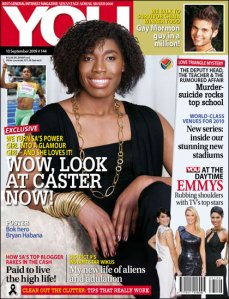 Given all Semenya has endured, I can’t say I was surprised (albeit saddened) to see an article today titled, “Embattled track star Caster Semenya gets new coach, new look” which also featured the cover of You magazine (pictured here).
It also got me thinking…When a man outperforms his competition by a large margin—such as sprinter Usain Bolt for example—no one asks “Is he really a man?” No one says, “He is so fast, he might be a woman. He should be tested.” But when a woman wins by a lot—such as sprinter Caster Semenya—her sex is immediately questioned, “Is she really a woman?” This appears to be a clear example of marginalizing female athletic performance, homophobia, and sexism. Unfortunately Semenya’s ‘new’ look is not a new phenomenon for female athletes who have fallen under scrutiny as a result of outstanding sport performances.

One Sport Voice Concluding Summer Thoughts About Sport
Where did summer go? As a new school year begins tomorrow, I’d like to share a few things I’ve been thinking about over the summer.
1. After giving parent and coach workshops this summer, I’m more convinced that ALL coaches and ALL parents should attend research-based educational workshops that help them create a positive climate for youth athletes. Schools, athletic associations and club teams have to mandate attendance, otherwise the folks who show up are predominately the choir. Anything less than a mandatory attendance policy is not effective in creating the kind of change needed to ensure that sport is done right.
 2. More research is needed on the issues that arise in sport for rural communities. Nearly all of our youth sport research includes suburban or urban communities. Very few researchers have focused on issues particular to rural communities and sport participation. I can only think of the Women’s Sport Foundation report Go Out And Play: Youth Sports in America by Sabo & Veliz (October, 2008) that includes data about rural kids and sports. After giving workshops in a small Minnesota community—with NO stoplights—I learned small rural communities have many of the same issues as their city counterparts, but I think unique issues exist. I talked with parents and coaches, many of whom approached me with stories of sport gone wrong and told me their stories with misty eyes, pain, frustration, and helplessness.
3. While in an antique store this summer I found James Michener’s book Sports in America written in 1976. He details the state of female, youth, collegiate and pro sport in the US (among other topics) just a few years after the passage of Title IX. It was a very interesting read and my take away was–The more things change, the more they stay the same, and some of the issues we think are “new”—such as the professionalization of youth sport—have been problematic for over 30 years.
So as I start the new school year, the focus of my work is ever sharper. Stay tuned for many new blogs that incorporate additional summer musings!
Has (Women’s) Tennis Gone to the Dogs?
The U.S. Open Tennis Tournament starts tomorrow. After reading “Pets Are the Portable Part of a Tennis Player’s Entourage” in the August 30, 2009 New York Times online, I winced internally. Even before reading the story, I thought to myself, “I bet this story is all about dogs owned by female professional tennis players.” I read the story waiting and hoping that just one male player with a furry canine tournament companion would be mentioned. Nada. So it left me with many questions.
Owning a dog is an equal opportunity activity, so why does it appear that only women players have dogs as part of their entourage? The NYT article offers some explanations that are predictable such as companionship, relieves boredom, dogs don’t care if you win or lose their tails always wag, and dogs calm nerves and ease stress to name a few. But the doggie gender gap in pro tennis seems odd to me.
Are male tennis players dog haters? Are the women pros more lonely on tour than the men, therefore travel with dogs to ease the solitary life of tennis travel? Neither of these explanations seem likely or realistic. Do male players in reality travel with dogs but this is not a “media worthy” story? What does it say if a male travels with a dog verses a female player? A dog is an appropriate companion for women but not males? If females have a doggie buddy does it make them appear more feminine? Therefore if a male player had a little Poodle or Yorkie, it might not be perceived as manly–would his competitive nature be called into question? But male players could have a Pitbull or German Shepard or even a Yellow Lab, but I get that traveling with a small dog is much easier and cost effective. Facetiousness aside, why are the dogs of female pro tennis players newsworthy on the eve of a Grand Slam? Is there no other news in women’s tennis? Does coverage of dogs marginalize female players’ athleticism? Does it make them appear less serious and more frivolous…likening them to celebutante Paris Hilton? Does it somehow further construct a brand of femininity that is marketable? What do you think?
Besides news that (women’s) tennis has gone to the dogs, be sure to keep your critical eye on how the media covers two players who have something in common–their parents! Kim Clijsters returns after a two year maternity leave and Roger Federer is a new father of twins. Which player will we hear more “parent talk” about and more discussion of how parenthood affects one’s tennis performance? Any guesses?
note: picture from Free Dog Wallpapers.
Sex Testing “Idiocy”
Following South African Caster Semenya’s 800m win at the Track & Field (IAAF) World Championships, a storm of opinions and commentary erupted over her subsequent sex testing/gender verification.
Some of the best I’ve seen is The Nation piece written by Dave Zirin and Sherry Wolf, an MSNBC video exposing the “Twisted, Sexist, Racist, & Heteronormative” Track & Field History, and two blogs by After Atlanta (here and here).
One sport sociology colleague on Facebook asked pertaining to most of the existing media coverage…”Are we in the 1950’s?” As Zirin and Wolf write, this issue is a “minefield of sexism and homophobia”….but thankfully the critical perspective has emerged.
The IOC and (the Lack Of) Gender Equity
 I read two well written and illuminating pieces yesterday that outlined the many ways in which the International Olympic Committee (IOC) appears not to support female athletes and gender equity. I thought I would share them here in case you didn’t see them.
Under Rogge, women’s sports are getting short shrift in Olympics, by USA Columnist Christine Brennan.
To walk the walk about supporting women, IOC must pick softball for 2016, by Chicago Tribune reporter Philip Hersh
 One Sport Voice