Social Media for Female Athletes as Contested Terrain

imblanced scaleCurrently I’m at the North American Society for the Sociology of Sport (NASSS) in Ottawa. I’ve heard A LOT of great research and ideas that much head is spinning a bit.  I was in a session today that crystallized some thoughts about social media and women’s sports, and the dialogue that is occuring. Social media is a contested terrain-meaning that it is a site where struggle is occurring on many levels. Some of the issues that have arisen during the dialogue happening in many places (like here, here, and here) encompasses such questions as:  Who will control social media? Who decides? Is social media good or bad for women’s sports? I have some additional thoughts, albeit jumbled, I’ll add here to add to the conversation.

Social media is both good and bad, both positive and negative. It challenges and reproduces gender stereotypes. It allows female athletes and advocates of women’s sport to control the message and it is also a residual of traditional media (meaning social media has converged with traditional sport media…like ESPN channel and its social media correlate ESPN.com so therefore it really is not different). Social media is a space to promote women’s sport in the abasence of traditional media coverage and it is a site of unedited and unmediated backlash towards women’s sports. It is a powerful tool to promte women’s sports and also a tool that can hinder its progress.

Discussing social media in binary terms of good/bad erases the fact that women’s sports are forced to turn to and use social media as a way to promote themselves and their sport because of the lack of coverage in mainstream media. I think that is the bigger issue.  How can we tap into more progressive notions and mobilize ourselves to create social change–both in mainstream and social media.

However, this notion is predicated on the idea that everyone involved in women’s sports is on the same page. This is just not true. Diverse viewpoints  fosters rich dialogue and how issues are taken up varies,  for example: “Serena on the cover of ESPN magazine is beautiful” to “Serena is setting back women’s sport”.

Here is my question: Is it possible to create social change and challenge the system if we’re not all on the same page? Who’s page counts? Who decides?

What do you think?

Things That Make You Go Hmmmm…More on Social Media & Women’s Sport

Following the  Tucker Center lecture and new blog about the impact of social media and women’s sport, it didn’t take too long for me to be in the middle of a real life example. Life works in ironic ways sometimes, doesn’t it? This example is meant to continue the conversation about this emerging and important topic.

9uwom0322w.lOn Tuesday I was at my computer and looked over the TweetDeck and saw that WNBA player Janel McCarville was live on her UStream channel JMACTV. I’d heard about Candace Parker using UStream but hadn’t checked it out yet, so clicked on the link and….ta dah!…there was Janel. As a Minnesotan, two-time Gopher Alum and now Gopher faculty, huge fan of women’s basketball, and advocate/scholar of women’s sport, I’ve been a long time fan of Janel McCarville (no hate Janel, only love!). Who can forget the Whalen/McCarville dynasty in The Barn!

Janel !I thought, “This is really cool… instant access to an elite female athlete“, as I watched her looking at and responding to the comments and questions from the 60+ fans watching her. I shouted through my office door to my two graduate students to “check this out”. Then I took a harder look and wrinkled my brow, “Is she in the bathroom?” I asked them, “and is she really cutting her own hair?” (see screen shot)  Somehow I was a bit disturbed by this. I immediately wasn’t so sure this was cool anymore—or good for women’s sports. So given this subject has been top of mind, I tweeted about it—twice (see screen shot below).mccarville tweets

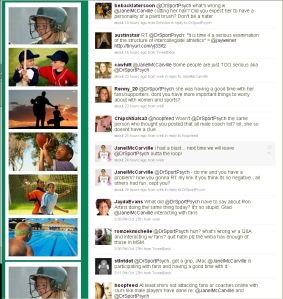
I continued to watch for about 10mns, and then shut down for the day. I continued to think about it over the next day or so.  In the course of “doing my warm up activities” for the day (aka surfing), I looked at my @ replies on Twitter and saw that my tweets had incited quite a bit of outrage, and a direct response from Janel herself! (see screen shot right, it will enlarge if you click on it).mccarville tweet responses The tone of the responses was “lighten up, this is just silly and fun and everyone but YOU thinks this is great”. Fair enough. I responded to Janel via Twitter:  “@JanelMcCarville No anger, just continuing conversation re: women’s sport & social media, both pro/con. See http://bit.ly/352s8T“. But I felt badly for criticizing her and it bothered me.
I learned a few valuable lessons which may be instructive as we all move forward and think about how to use social media effectively to positively promote women’s sports.

First, if social media is truly a two-way conversation, then I should of phrased my tweet “What is your opinion about @JanelMcCarville’s UStream videocast?”

Second, attacking people on Twitter is just in poor taste and not classy. My apologies Janel. This has played out for KC Chiefs NFL player Larry Johnson this week, as he is paying the price literally and in the media and  for using a homophobic slur. It will continue to occur with increased frequency as social media becomes part of the way we communicate.

Third, shortly thereafter I read a great piece by Q McCall of www.swishappeal.com on Feministing.com titled,  Is there a “feminist responsibility” to support women’s sports? It put into context some of the guilt I felt. Why was I attacking a female athlete?  I’m supposed to support women’s sport. But on the other hand, as a feminist, scholar, and advocate of women’s sport  I often feel I have the responsibility to wave the red flag and point out when I see something that may not be a “good thing”.  Perhaps my role is to raise the issue, provide an alternative viewpoint, and promote respectful discussion.

It also got me thinking about where female athletes and women’s sport might be headed in terms of social media. If everyone  “loves it” (all 66 viewers)—is this our new model of promoting women’s sport? Is that what fans really want to see? Is this how fans want to interact with athletes? Where is the line between “good access” and access that, to borrow from C + C Music Factory,  “Makes You go Hmmmm”? As was pointed out to me,  Ron Artest of the LA Lakers, got his hair cut that same day…which garnered media attention. But if the men do it, should the women follow? Should we always be trying to emulate our male counterparts? (I’m not suggesting that is why Janel chose to UStream, she’d have to tell us the inspiration). Is it possible male athletes use social media differently because of disparate patterns of traditional media coverage? What are the similar and different ways elite male and female athletes use social media? How can female athletes take control and use social media in positive ways to combat sexism, inequalities, and disparities that are well documented in sport contexts? Is this a responsibility they should bear? In conclusion, I highlight Janel not to criticize or judge, but to provide an exemplar real-life issue to promote discussion about social media and women’s sports.

I don’t have the answer, only a lot of questions. What do you think?

Stereotypical Media Representations of Female Athletes Starts Early

boy & girlToday I was preparing for a WeCoach workshop and was looking for some images on IStock.com. Pictured here is a classic example of how the (re)production of gender stereotypes starts early and in ways we might not even notice because they seem so innocuous. Ironically, shortly after I found these images I read the AAUW blog on Why Media Representation Matters which touched upon the newly released The Shriver Report-A Woman’s Nation. So far, I’ve read the Executive Summary of A Woman’s Nation, and in light of the Tucker Center’s Distinguished Lecture on the potential impact  of social media on women’s sport and the story released today by the New York Post suggesting that ESPN encourages “sexual insensitivity”,  I was struck by the assertion that outdated gender stereotypes will only change if women rise within the ranks and launch new media of their own. So what are we waiting for?

LaVoi’s 3C’s of Effective Coaching

If there is one theoretical framework that can easily be applied to helping coaches be more effective, it is the motivational framework of the Self-Determination Theory (SDT). SDT posits that human beings have 3 essential needs: the need for relatedness, the need to feel competence, and the need for autonomy.

I like to call these needs “The 3C’s“–care, competence, & choice–as talking “theory” is usually not met with interest and enthusiasm! When the three needs are not being met, well-being, optimal health, functioning, performance, and development are less likely to occur. Coaches play a unique role in meeting the needs of their athletes. If you’re interested in increasing your effectiveness as coach, parent, manager or any task that involves social interactions with other human beings, I’d encourage you to learn more about SDT.

What do Online College Coach Biographies Tell Us About Inclusivity?

See a guest column I wrote with graduate student Austin Stair Calhoun for the Women’s Sports Foundation, It Takes a Team newsletter titled: What Can Online Intercollegiate Coach Biographies Tell Us About Inclusivity and Tolerance of Diverse Sexual Orientations?

In a previous blog I posted our pilot study poster and results about this project. We’re currently finishing the data collection and analysis (with undergraduate Alicia Johnson, Minnesota State) for a full-scale national study which replicates the pilot. Stay tuned!

A Pattern Has Emerged

I’m not a big fan of ESPN The Magazine, as I’ve written about their cover photos and coverage of women’s sport in a previous blog….or should I say LACK of coverage that focuses on athleticism, rather than being feminine and sexy.

Serena ESPN mag_Oct 2009

Their latest series of 6 covers for the October 19, 2009  “The Body Issue” has Serena Williams posing naked (thanks for the head’s up EH). It seems to me a recent pattern has emerged.

Here is the pattern:

1) A Black female athlete performs well and dominates opponents,

2) During the course of competition she acts outside prescribed gender norms (i.e., looks like a man, yells and argues with a referee),

3) Subsequently she is grilled and sanctioned by the public and the media,

4) Therefore she has to recover by performing versions of the female athlete apologetic by literally apologizing like S. Williams, and/or highlighting heterosexy femininity on the cover of  magazines. I’m talking about first, Caster Semenya and now Serena Williams (see picture here).

Underlying sport media portrayals of highly talented Black female athletes are racism and sexism. I suppose my blog title should really read…A Pattern Has REemerged.

NOTE: If you want to see the making of The Body Issue and gain insight to the ‘issue’ (and see a whole lot naked) click here.

Physical Activity, Organized Youth Sport & Youth Obesity

soda machineSome and colleagues and I are working on research pertaining to what is known (and mostly not known) about the role of youth sports in obesity prevention. Last week Toben Nelson, University of Minnesota’s School of Public Health, presented some of our work at the monthly Tucker Table. You can view his PowerPoint and see a small video clip. This work has made me think critically about how youth sports may not be the healthiest places for some children–including the ubiquitous presence of unhealthy snacks which I wrote about in an earlier blog. While physical activity and active living may help prevent childhood obesity, healthy eating is the other half of the equation. To highlight the relationship between physical activity and the presence of unhealthy food, this Village Voice post and picture showing how NYC playgrounds house soda machines says it all (via AN).

Relational Expertise for Coaches

Relational expertise for coaches is the capacity to create meaningful, close connections with others that leads to mutual growth and development. My work in this area has been greatly influenced by the Relational-Cultural Theory (RCT) developed by Jean Baker Miller and colleagues at the Wellesley Centers for Women (WCW) at Wellesley College. I was introduced to WCW and RCT when I has the head tennis coach at Wellesley from 1994-1998.

growthRelational-Cultural Theory (RCT) suggests that growth-fostering relationships are a central human necessity and disconnections are the source of psychological problems. According to RCT a close relationship is defined by four qualities: (a) authenticity (the process of acquiring knowledge of self and the other, feeling free to be genuine in the context of the relationship in an ongoing effort to represent one’s true self while assessing one’s own risk and gauging the impact of certain truths on the other and respecting the needs of the relationship), (b) engagement (perceived involvement, commitment, responsiveness and emotional availability), (c) empowerment/zest (the experience of feeling personally strengthened, encouraged and inspired to take action through connection in a relationship), and, (d) the ability to deal with difference and conflict (the process of expressing, working through and accepting differences in background, perspective and feeling leading to enlargement of the relationship, rather than disconnection)

We rarely and explicitly train coaches to become relational experts.

I wrote a guest column this month for the Minnesota Women’s Press LeaderVoice on my experiences and thoughts on the Relational Coach. I also have a published article in the International Journal of Sports Science & Coaching titled Expanding the Interpersonal Dimension: Closeness in the Coach-Athlete Relationship

picture from the401kconnection.com

Social Media & NFL on the Brain

BrainGiven the upcoming Tucker Center Distinguished Lecture on social media and women’s sports I’m helping plan, I’ve had social media on the brain. Here a few interesting tidbits I thought to share:

1. Did You Know 4.0 (video on YouTube produced in conjunction with the Third Annual Media Convergence Forum). This is a very cool piece (thanks to ASC!).

2. Blogs about social media and women’ sport on the NEW Tucker Center blog. The first is an intro piece written by TC staff about social media and why it matters to women’s sports, followed by Dave Zirin’s piece on Double Standards.

3. Marie Hardin, contributing panelist for the TC Distinguished Lecture posted a Sports, Media & Society blog today about the topic. Look for her guest TC blog in the next day!

GQ brain injury footballLATE ADDITION: Speaking of brains, a just colleague sent an interesting piece over the NASSS listserv from GQ. The story is on the NFL, brain trauma, concussions and cover up. As my colleague explained it, “Good insight as well on the commodification of athletes and institutional denials of medical conditions.”

update: ESPN.com ran a story this week on the higher incidence of dementia in NFL players compared to the general population.

Update October 13, 2009: Malcolm Gladwell, author of The Tipping Point and Blink, wrote a piece for The New Yorker titled, Offensive Play: How different are dogfighting and football? Great read.

Weekend Gender Observations

Notre Dame Football3This past weekend I traveled back to Notre Dame (ND) for the Michigan State football game. I go back every other year to catch a game and see former colleagues. While I was there I observed a few things I had to share related to how females are marginalized and gender is (re)produced in subtle and not to subtle ways. Here are the Top 5:

1. On Friday morning I played golf at the beautiful links style ND Warren Golf Course. When I worked at ND I would decide to golf after work and show up at the course and be assigned a tee time with a group that had room for one more. Mostly I played with all men. As we stood on the tee box, I would invariable get “advice” from one or more of the men on how to play, how to hit a drive etc….They would tee off first, and then we’d go up to the “Ladies Tees” where I would hit. When I play frequnetly I can hit a 200 yard drive which often surpasses some of the mens’ drives. After that I didn’t get any more advice. I wondered, do men give other men advice on the first tee? Why do men feel compelled to give females paternalistic advice on how to play golf when they have no idea how skilled she may or may not be?

2. One of the traditions of ND football is the Friday night pep rally. While at the pep rally, a distinguished alum and former NFL player was challenging the crowd to cheer loudly for the Irish. He said he was told to keep it “PC”. He told the crowd they should stand the whole game to show support. He then told the players to be tough and not let Michigan State control the game in “their house.” He said if the players wanted to be weak and soft he told them, “You should go to school across the street” (meaning attend the all-women’s sister school St. Mary’s College). To my surprise, a few people in the crowd booed him.

3. While wandering around campus I came across the 2008-09 ND men’s & women’s basketball schedule posters (see picture). 2008-09 nd posters Given the research on portrayals of female athletes we have conducted in the Tucker Center, I noticed immediately that ALL the male athletes were in uniform, in action, and on the court. Some of the female athletes were in uniform, in action, and on the court but the dominant image was the “team shot.” These two posters convey very different messages about athletic competence.

4. On my way home I was checking Facebook and email on my phone when I saw a Facebook post that read: “Eagirls v. New Orleans“…meaning the Eagles were playing the New Orleans Saints. This person felt the Eagles were not playing well, which meant they were playing like girls.

5. Last but not least and related to #1 above…I wandered into an airport book store to find a new book to read on the way home. I came across a book written by man titled, Act Like a Lady, Think Like a Man. I was curious so I picked it up. I’d encourage you to take a look at the table of contents, depending on your perspective you’ll find it infuriating, entertaining or informative.

I think these example speak for themselves. Comments?