Comparisons between male and female athletes

While talking with a reporter today about WNBA Champions the Minnesota Lynx, I had a realization…it most likely isn’t new, but I’d never thought about selective comparisons between male and female athletes in quite this way before.

Comparisons between male and female athletes in the same sport and in general are commonplace. Today I realized that most comparisons are used to marginalize female athletes, while sustaining and promoting male athletes as the normative best.

When people want to trivialize or put down female basketball players or the WNBA for instance, the comparison goes something like this…. “Women’s basketball is boring. They don’t play above the rim, jump as high, or dunk like the men. No woman could ever play in the NBA.”

The reporter said she had written a piece which suggested that WNBA players are great athletes but more sportsmanlike, team oriented, and accessible than NBA players, which makes them appealing to watch….and she got a lot of push back and negative feedback to the effect of  “Why do you always have to compare the leagues and players?”

This got me thinking that some people use comparisons selectively to promote men’s sport and relegate women’s sport. When comparisons are used to highlight to the good or better elements of women’s sport or female athletes compared to their male counterparts, backlash usually ensues. Why? Because the upsides might make people realize that perhaps the better value and product lies in consuming women’s, not men’s, sport.

The similarity lies in the fact females are great athletes!

The difference lies in many factors, some of which I mentioned above.

Both similarities and differences can be used effectively to promote and sustain interest in and for women’s sport.

After the espnW Summit I’ve been thinking about how “we” need to reclaim some of what was lost when the AIAW was taken over by the NCAA in the early ’80’s, as well as take what is working in the current business model of sport (the traditional male model) to help promote and achieve sustainability for women’s sport. Women’s sport doesn’t have to follow or emulate what men’s college and professional sport teams are doing (i.e., conference realignments, rule violations, player strikes and lockouts, egregious behaviors, entitlement, arms race…and so on).

With the 40th anniversary of Title IX upon us soon, it is a great time to reflect on where we are, where we need to go, and how to get there.

Opposing Views of Media Portrayals of Female Athletes

With the 2011 issue of ESPN The Body Issue magazine coming to shelves Friday, and images being released online today, I thought it a good time to summarize common ways media portrayals of females athletes are framed and discussed. Today I got to hear colleague, Kent Kaiser, Ph.D., discuss his work around media framing of Title IX in print journalism. (to read his recently published article on this topic, Gender Dynamics in Producing News on Equality in Sports: A Dual Longitudinal Study of Title IX Reporting by Journalist Gender click here).

He used conflict framing as his theoretical framework to look at this issue, and coupled with my recent trip to the espnW Summit to sit an a panel to discuss if sex sell women’s sport, and colleague Mary Jo Kane’s column this summer in The Nation magazine on this topic… it got me thinking. Kaiser identified some themes in his work, that I modified, that might be a good way to promote discussion about media portrayals of female athletes. I’ll elaborate on each below.

Advocacy Frames are those that advocate that sexy, hyper-feminine, or in some cases semi-nude or nude images of females athletes are good for women’s sport and female athletes. Opposition Frames are those arguments which see such images as trivializing, problematic and doing nothing to promote respect and sustainability of women’s sport, or any particular individual female athlete.

ADVOCACY FRAMES

  • Equality-both male and female athletes are seen semi-nude or nude (i.e., the ESPN The Body Issue), so it isn’t that ONLY female athletes are portrayed this way.
  • Personal Opportunity-inclusion and portrayal of sexy, beautiful female athletic bodies provides opportunity for exposure (literally and figuratively!), sponsorship, and branding.
  • Autonomy-female athletes have a choice whether or not to pose in magazines or be photographed. No one makes them pose in those ways, they want to.
  • Market-sex sells! and people want to see sexy images of female athletes, it is what the market wants…no one is interested in seeing real female athletes that aren’t attractive, sexy or feminine.
  • Zero-Sum-there is only a limited amount of coverage for all sports, so the more women’s sport is covered or female athletes are featured, men’s sport suffers.

OPPOSITION FRAMES & COUNTER ARGUMENTS

  • Equality-yes of course male athletes are portrayed nude and semi-nude (i.e, ESPN The Body Issue), however female athletes only get 2-4% of all sport media coverage and when they do, it is most often in ways that minimize athletic competence and highlight sexy, feminine characteristics. Also, men’s sport and male athletes already enjoy respect and credibility so when male athletes are portrayed nude it means something very different culturally.
  • Personal Opportunity-Yes, posing semi/nude provides short term exposure, but no data exist that demonstrates such images lead to additional sponsorships, contract extensions, increased pay, or respect and credibility for female athletes. In nearly every professional context, when women take off their clothes it does not lead to respect and perceived credibility and competence. Additionally no data exist that demonstrates such images increase TV ratings, fan attendance, or season ticket sales….therefore opportunity for the greater good and league sustainability might actually be undermined when individual female athletes are portrayed this way.
  • Autonomy-Yes, no one is holding a gun to any female athlete’s head and they do choose to participate. Female athletes are smart…they see the women getting the most exposure and media coverage are the ones who conform to the sexy, feminine mold and they want to capitalize on their physical assets as well. However, if this way of being portrayed is the dominant model in the absence of a virtual black out of coverage that features athletic COMPETENCE, of course female athletes will choose to be included, rather than excluded. Choices are made within the context of sport, which is male-centered and male identified.
  • Market-Yes, of course sex sells! and sex sells magazines, but no data exist that demonstrates sex sells women’s sport. In fact emerging data suggest otherwise…that images of athletic competence is what sells women’s sport and help to generate respect and credibility. In addition, for years and years leagues and organizations have been selling sex, but at the same they lament the low interest in and attendance of women’ sport. Maybe it is time to try a new way to market female athletes….put athletic competence first and see what happens!
  • Zero-Sum-Female athletes are so rarely portrayed in sport media. Roughly 40% of all high school and college athletes are female, yet they are rarely portrayed in sport media. What would it look like if female athletes received close to 40% of all sport media coverage? How would that affect interest in, and respect of women’s sport? Interest in men’s sport will likely not wane or lose its cultural primacy, so why not try it?

That is enough for now…I’m off to watch some highly competent female athletes take the court in the WNBA Finals! Go LYNX!!! And I’m betting the arena will be full of fans who have come to see amazing basketball, and I will not see ONE image of a semi/nude female athlete.

Authenticity & Go Lynx!

I just returned from the espnW Summit and have many thoughts I need to blog about! Best quote of the summit by Don McPherson, “Authenticity is your brand. You don’t create a brand, you are your brand.”

However, the “to do list” is taking priority over more extensive and thoughtful blogging.

More to come soon I promise, but in the meantime….

The Minnesota Lynx: A Case About Media Coverage for Female Athletes

I live in Minneapolis and am a fan, advocate and scholar about gender issues in sport, particularly girls and women in sport. In the last two months, while I haven’t blogged much I have been keeping in eye on happenings around women in sport. Media coverage, or should I say the lack thereof, has been on my mind a great deal.

An anomaly was the 2011 Women’s World Cup aired and covered by ESPN = Fantastic coverage of dramatic competition, athleticism and serious athletes. Unfortunately what we see far too often is the trivialization, erasure and sexualization of female athletes…which I’ve written about a lot.  This last point is why I haven’t blogged much lately. I’m just plain depressed and discouraged that over and over again these patterns emerge, despite record numbers of females participating in sport in the post Title IX era. How many times can I write the same thing over and over without anything changing…and in fact, in most cases, is getting worse?

6 Ways Media Present Female Athletes

I’ll say it again…media coverage by major networks of female athletes has DECREASED in the last 10 years and is now down to a dismal 1.6%. (What would the Twins’ attendance or interest in the team look like if we only read 1.6% of the time about the team in the sports media or if we didn’t hear and read non-stop coverage of the team—even in the off season?)

Dave Zirin pointed out that GQ left out an entire gender when naming their 25 coolest athletes.

If you want to read a great critique and column titled “Sex Sells Sex, Not Women’s Sports” in the special sports issue of The Nation magazine written by my colleague Dr. Mary Jo Kane, Director of the Tucker Center for Research on Girls & Women in Sport, and get up to speed about why these trends persists and why it is problematic, I’d encourage you to read it.

You can also see an exceptional slide show of the six categories of representation of female athletes commonly witnessed in the sport media from athleticism to soft core porn if you click here. Kane argues the majority of sport media and marketers are complicit and unquestioning that sex sells women’ sport and “believe that reaffirming traditional notions of femininity and heterosexuality is a critical sales strategy.”

Ironically, in our own backyard the WNBA Minnesota Lynx are providing an interesting case study for sport media scholars. Currently the Lynx have the best record in the WNBA and have secured a playoff bid. The Lynx have a great deal of athletic talent: Whalen, Wiggens, Bruson, Augustus, and Moore are some of the players lighting up the scoreboard this season. Meanwhile…the MN Twins are struggling, the NBA is facing a lockout and the Timberwolves were horrible last season, the NFL is limping back to full speed after their lockout and the Vikings will struggle, and the NHL and MN Wild have their own issues.

Case in point: Today I got a call from a local media outlet to discuss why the Lynx are getting very little coverage despite a winning season. I was ready. I got a call 10mns later, the story was canceled– “Something better had come up”. How can people get interested in the Lynx if they don’t hear about them and the team isn’t covered?

I know for a fact that the Lynx are selling more tickets this year, over 1,000 more a game, than last year. Fans are filling the seats. People ARE interested and DO care about women’s sport. The Lynx are talented and exciting to watch. Hey sport media….PAY ATTENTION AND GIVE THE LYNX THE COVERAGE THEY DESERVE! Sport media journalists argue they will cover women’s sport when interest is there. Here is a clue: NOW IS THE TIME.

Here is a novel chicken-egg idea: The more media coverage you give the Lynx, the more people will attend and the more interest is generated.

The ironic thing is, people are interested DESPITE poor media coverage of the Lynx.

Even more ironic, people are interested in the Lynx because they are GREAT ATHLETES and are fun to watch not because the Lynx players are being marketed and portrayed in sexy and hyper-feminine ways.

Fans of women’s basketball and women’s sport want to see and read about athleticism and see quality play. They are getting that and Moore with the Minnesota Lynx.

added 9/1/11: Watch me talk to WCCO’s Jason DeRusha on the “Good Question” discuss the lack of coverage of the MN Lynx.

Some good, some bad outcomes of the #wwc2011

1. You have to hand it to Japan. They won the game and many hearts along the way. I’d like to think this a universal sentiment, but unfortunately it is not. To see backlash, racism and jingoism from fans pertaining to the WWC Final click here.

2. I find it interesting that the “success” of the WWC has been attributed to Title IX. Wendy Parker provides an alternative viewpoint here.

3. SI.com columnist Ann Killion writes “In the past, women’s teams were expected to do more than just play. They had to build a movement, change their culture, make history. This team is liberated from that.” She lists some things the current US players do not need to do…but what are the responsibilities of female athletes? What should they be?

4. Dave Zirin @EdgeofSports and The Nation writes highlights the “raunch culture” of women’s sports in his piece. “raunch culture” is when women athletes buy into the idea that it’s somehow empowering to display their naked bodies for men’s magazines.” Some members of the women’s French national soccer team decided to provide resistance to raunch culture and the idea that sex sells women’s sport by providing a caption: “Is this how we should show up before you come to our games?” (to see the accompanying picture click here)

5. Despite some of the negative outcomes of the WWC2011, I’m happy to report that much of the coverage and commentary seemed to allude to the fact that women’s soccer is fun to watch because the women are GOOD ATHLETES.

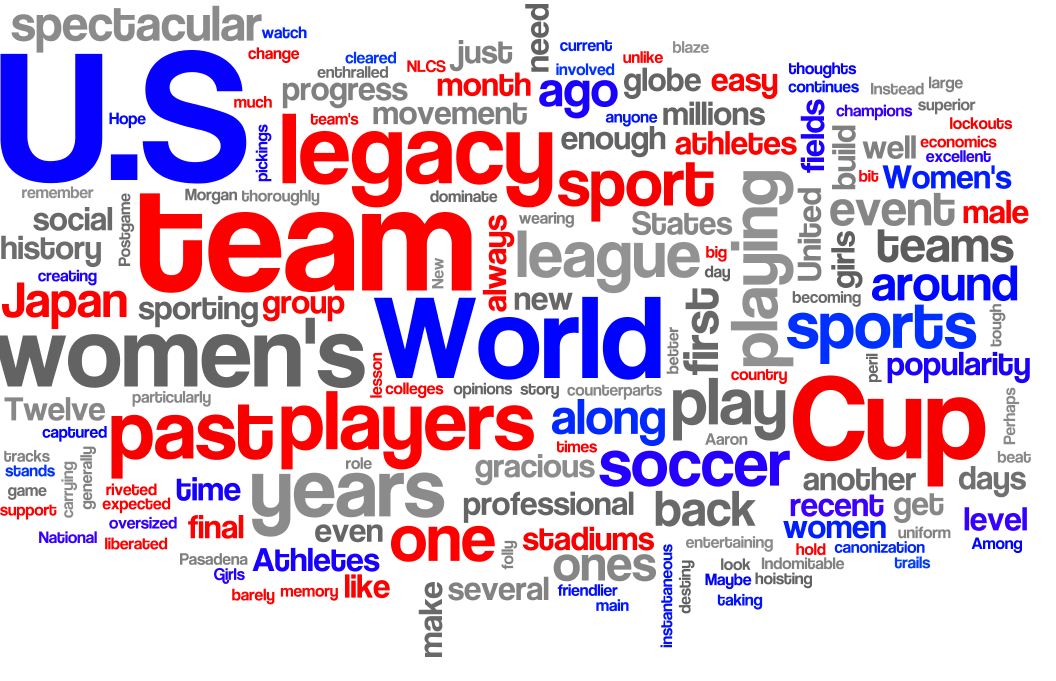
The WWC2011 picture above was created in Wordle.

6. Based on the data, the Women’s World Cup Soccer Final set a new Twitter record for tweets per second, at 7,196….more than killing Bin Laden, the Royal Wedding, the SuperBowl or NBA finals!

Tidbits and Stories Related to Women’s Sport

Since there is so much going on in women’s sport right now I thought I’d post some stories, links and videos of interest.

WOMEN’S WORLD CUP 2011 (WWC, #wwc2011)!

USA player Abby Wambach celebrates her goal against Brazil in final minutes of game

Who has caught the fever and excitement? I’m torn about the coverage because the WWC has been fantastically covered by ESPN and ESPN2. However given that coverage of women’s sport has DECLINED since the 1999 USA World Cup win, women’s sport is only on ESPN Sports Center is less than 2% time, and appears only 1.6% on major networks, we should consider the big picture of overall coverage patterns (for the full report by Messner & Cooky, 2010 click here). When female athletes are featured, it is usually in ways that sexualize them, which is why the WWC coverage has been such a nice example of covering women’s athleticsm. Just for fun I typed in “women’s sport” into Google Images, and the FIRST picture I got was this one of beach volleyball. It really makes me wonder why this picture is first…one step forward, one step back….

Is this the best picture to represent "women's sport" on Google?

There has been some interesting dialogue about the coverage of WWC 2011 in comparison to the WWC 1999. Until Sunday’s game unforunately the WWC was barely a blip on the radar. While fans watch hours of men’s sport that is boring, lopsided, and not compelling, it appears that women’s sport is only “watchable” when it is drama filled, dramatic spectacle.

Read the SI.com piece by Georgia Turner here, and read Wendy Parker’s blog on why she is sick of female athletes having to be “role models” and “good girls” and why she thinks the way to promote female athletes is through their athleticism (well played Wendy!). I also like Jennifer Doyle’s From a Left Wing blogs about the WWC. There are so many good blogs about the WWC on Women’s Talk Sports, I can’t possibly mention them all.

Rachel Maddow did a great segment on MSNBC about the USA v. Brazil game and fans’ reactions to that game (most of whom are young males!). The fan segments challenge notions that young men aren’t interested or don’t watch women’s sport. LOVE IT.

However, just when there is hope (not just Hope Solo, the goal keeper for the USA WWC team) for legitimate coverage of women’s sport, I get a link sent to me about this story on the WWC with the headline “Brazil Didn’t Mind Losing to the U.S. Women Because the Goalie’s Hot.” SIGH….another step back.

And just for fun and unrelated to WWC, watch a funny and clever video of Justin Timberlake as he tries his hand at a variety of college sports, leading up to his presentation of the Capital One Cup trophy at the ESPYs.

Let’s not leave out men’s sport. Read After Atalanta’s blog critiquing an espnW opinion piece about “overweight MLB players” Good stuff!

Recent focus on female athlete “unifems”

The recent focus on the athletic attire of female athletes, “unifems”, concerns me for many reasons. I write “unifem” instead of “uniform” to make a point. Most of the discussions about what is to be worn, or not, in competition is largely about underlying concerns that female athletes remain and at least look “feminine.”

Aside from unifem concerns, some female athletes like some members of the German soccer team, purposefully pose nude in magazines like Playboy that exploit women so they can be perceived as less “butchy” and tomboy-like (i.e., “sweet”, feminine, and thus heterosexual).

Let’s be clear–concerns, policies and rules about females athlete uniforms are usually about making the uniforms smaller, tighter and a more feminine color. These concerns are usually couched under the guise of “performance” or “safety” or both. To my knowledge, and I will stand corrected, that aside from some initial data on compression wear, very little empirical evidence exists that demonstrates that a smaller or tighter uniform will improve performance for athletes (aside from the razor suit in swimming…which is under scrutiny and I believe is now banned). If uniform size were about performance, you would also see scantily clad male athletes.I am also unaware of any sport marketing evidence that demonstrates that smaller, tighter, more feminine uniforms actually increases ticket sales, interest in the sport, or sponsorships. Show me the evidence.

It is my opinion the discussion about female athlete uniforms is first, outdated, and second sexist.

Let me summarize some of the very recent discussions pertaining to unifems. Reminder: this IS 2011, but attempts to marginalize, sexualize and exploit the female athletic body and female athletes is alive and well, and I think getting more egregious.

UNIFEM EXAMPLES

1. To create a more “attractive presentation,” the Badminton World Federation decided all elite level female players must wear a skirt or dress while competing. The complete NYT story here.

2. The lack of attire for the Lingerie Football League earlier this spring I have already written about (and no, I still don’t consider the LFL a sport, but I do support the notion that some, probably a good %, of the women in the LFL are real athletes.)

3. A female Muslim weight lifter, Kulsoom Abdullah, who wants to complete but keep with religious traditions by covering her entire body, aside from her hands and face, has sparked debate at the international level. Many argue this policy is racist and Islamophobic, in addition to being sexist as male Muslim athletes do not have the barrier of covering in public that impedes athletic performance.

4. The Iranian women’s soccer team was in tears after being forced to forfeit a 2012 London Olympics qualifying match this past weekend because it showed up to play in hijabs, and some argue that “FIFA makes things worse for women.”

5. Twitter blew up when a picture of tennis player Serena Williams in a hot pink cat suit appeared on the internet.

So what is going on with the recent barrage of unifem incidents? Why now? Is this further evidence of the gains women are making in sport?

2011 post-commencement thoughts

I haven’t had much to time to blog lately with end of semester stuff, reading thesis drafts, grading papers, and all those things professors do. However, yesterday I went to both the undergraduate and graduate student commencements for the College of Education and Human Development for the University of Minnesota and wanted to share a few thoughts.

1. One of our commencement speakers Na’im Madyun, gave a creative, thoughtful address to the undergraduates. T. Mychael Rambo also performed a musical piece and gave a speech in which he said his father used to tell him, “Everyone is born with a degree in the humanities and accounting. You are accountable for yourself and everyone is a human being, so act like one.” Love this!

2. Each time I go to commencement I am reminded by the 1997 commencement address by Oprah at Wellesley College, when I was teaching and coaching tennis there. She said, “The first time someone shows you their real self, believe them,” I have reflected on and used this advice many times over the years and it holds true every time. It holds true for people who both enrich your life, and for those who are toxic energy vampires. Her address is worth reading.

My awesome graduate students (L to R) Alyssa Norris, MA; ME, Chelsey Thul, Ph.D.; Katie Wurst, MA

3. Seeing the smiling faces of the students as they walked across the stage reminded me why I am in higher education…and everyone needs a reminder like that from time to time.

4. Three of my amazing graduate students walked in commencement, including my very first doctoral student.  Oprah read Maya Angelou’s “Phenomenal Women” poem to the women of Wellesley College, and it is a fitting poem these graduate students and the others I have the privilege of working with on a daily basis. I am very grateful for all the students I get to work with and teach (even when they are questioning me about their final grades!)

Summary: Act like a human being with kindness and empathy, be grateful for the people who make a difference in your life, and make sure to take the time to reflect on why you do what you do.

2 Steps Backwards for Female Athletes

2 Steps to Nowhere are Better Than 2 Steps Back

Today I came across two articles in the New York Times related to female athletes and women’s sport. Neither contains good news and in fact both articles highlight that despite gains made in the post Title IX era, female sport participation is still constantly under attack.

Sport sociologists term the participation of females in sport and the conflicts that arise over who will play and under what conditions as “contested terrain.” Contested terrain means both oppression and resistance exist simultaneously and that existing power dynamics and social inequalities are both reinforced and challenged in and through sport.

Katie Thomas wrote a piece titled  College Teams, Relying on Deception, Undermine Gender Equity about how many college athletic teams are padding the number of female athletes on their rosters in order to make it appear the school is in compliance with Title IX.

update 4/29/11: Read the Women’s Sports Foundation response to these deceptive Title IX practices here. In the response Kathryn Olson, CEO of the WSF, said, “If an athletic department is willing to manipulate its sports programs by creating an artificial veneer of fairness among its male and female students with these laws on the books, one must wonder what would happen without Title IX.”

Alice Dreger wrote a piece titled Redefining the Sexes in Unequal Terms about how a new rule pertaining to the level of functional testosterone in female athletes is a sexist form of biochemical policing that male athletes do not endure.