An Unlikley Place to Find Gender

How many ways is gender constructed in this picture?

Last night I was watching TV and saw an ad for Depend undergarments that had a “Mars-Venus” ring to it. I thought is was strange, but when I went to their website this morning, the print ad I saw was even more disturbing. I know this isn’t sport related (although the male is playing golf!), but I had to include it. If there was ever a doubt that gender is constructed, this would be an exemplar! I’ve included the print ad here, but I’d encourage you to go visit the website just to get the full effect (click on picture to enlarge and get the best look).

How many ways is the dominant, traditional way of thinking about “gender as binary” constructed in this screen shot? What I find interesting, aside from the obvious, is that we rarely see gender (re)constructed for the Boomers.

I graduated or I’m injured…and I’m an athlete, now what?

A One Sport Voice reader sent me an email looking for resources helping collegiate athletes transition into “the real world” after they no longer are competitive athletes. Great query! There is a fair amount of literature from the sport psychology world on this issue. While it is not my primary area of expertise, I can provide some guidance into existing resources.

The first is a book titled Career Transitions in Sport (Lavallee & Wylleman, 2000). This book gives some theoretical perspectives on transitions, self-identity issues, causes and consequences of transitions, as well as some intervention strategies.

Another book that is helpful is book pertaining to the psychology of sport injury-a common cause of career transition- is titled Counseling in sports medicine (Ray & Wiese-Bjornstal, 1999). If an athlete suffers from a career-ending injury, a transition is inevitable.

While both these resources are geared for sport psychology students and professional, it is a starting place for those looking for information on this important, but scarcely talked about phenomena.

Unhealthy Practices of Coaches

In a session at NASSS, colleague Jim Denison (University of Alberta) made an interesting comment I’ve been thinking about ever since. He asserted that some coaches ask athletes to do all kinds of things that are bad for their health– and much less healthy than a supervised doping program.  He also raised the issue that some problems and knowledge get silenced, while other forms are given power.  What do you think?

The LFL Sells Sex, Not Sport

During the recent sport sociology conference (NASSS) I heard inspired critiques of  sport and had many great conversations about sport media and female athletes. Ironically, I returned home today to this tweet by the Lingerie Football League.

RT @MyLFL: “THE LINGERIE FOOTBALL LEAGUE’S OFFICIAL WEBSITE WWW.LFLUS.COM IS OFFICIALLY ONE OF THE FASTEST GROWING WEBSITEShttp://bit.ly/2YQYvj”

As you know, I’ve written previously about the LFL and I’ve been keeping an eye on what is happening with the league. At the NASSS conference I heard some great audience reception research on why sex does not sell women’s sport, sex sells sex. More specifically, sexy images and sexy female athletes sell sex to young male consumers ages 18-35. I would be really interested to see the market research—who are the consumers and fans of the LFL? (any guesses?)

The LFL is a perfect example of how sex can and does sell sex. The numbers prove it. Arguably, the LFL is not sport it is a dramatic spectacle aimed at entertainment and consumption of the female body.  No where in any of the promotional materials is the athletic competence of LFL “athletes” highlighted or portrayed in any serious way. The  sexualization of the LFL women is overt and aimed at appealing to male sexual fantasy. In fact their website promotes the LFL as “True Fantasy Football” which merges two primary desires and interests of many (not all) US men— football and sex.

If you watch the many videos of LFL games posted on the website, you will see continuous images of women tackling each other, acting violent, and slamming each other to the ground.  Yet one women (New Mexico soccer player Elizabeth Lambert) acts aggressive and pulls a ponytail and we have a national outcry (see the video and read examples of indicative responses on Perez Hilton’s blog).  Male athletes act aggressively and unsportsmanlike all the time (remember Zidane’s head butt in the World Cup? or Florida football team member Brandon Spikes fingers through the face mask? , both of which were similarly caught on national TV). Yet, the sanctions for Lambert were severe and quick (permanent dismissal from the team), while Zindane and Spikes punishments were much less in scope and severity.

What is our take home? Females can act aggressively as long as they are sexy, but if a real female athlete acts outside of the rules in real sport, she will be met with quick and severe sanctions…not only within her sport but will be berated by the public…while male athletes can “act like men” with comparatively less fanfare.

What is most interesting to me is the societal discussion and the media’s construction of Lambert’s transgression, rather then the event itself.

Social Media for Female Athletes as Contested Terrain

imblanced scaleCurrently I’m at the North American Society for the Sociology of Sport (NASSS) in Ottawa. I’ve heard A LOT of great research and ideas that much head is spinning a bit.  I was in a session today that crystallized some thoughts about social media and women’s sports, and the dialogue that is occuring. Social media is a contested terrain-meaning that it is a site where struggle is occurring on many levels. Some of the issues that have arisen during the dialogue happening in many places (like here, here, and here) encompasses such questions as:  Who will control social media? Who decides? Is social media good or bad for women’s sports? I have some additional thoughts, albeit jumbled, I’ll add here to add to the conversation.

Social media is both good and bad, both positive and negative. It challenges and reproduces gender stereotypes. It allows female athletes and advocates of women’s sport to control the message and it is also a residual of traditional media (meaning social media has converged with traditional sport media…like ESPN channel and its social media correlate ESPN.com so therefore it really is not different). Social media is a space to promote women’s sport in the abasence of traditional media coverage and it is a site of unedited and unmediated backlash towards women’s sports. It is a powerful tool to promte women’s sports and also a tool that can hinder its progress.

Discussing social media in binary terms of good/bad erases the fact that women’s sports are forced to turn to and use social media as a way to promote themselves and their sport because of the lack of coverage in mainstream media. I think that is the bigger issue.  How can we tap into more progressive notions and mobilize ourselves to create social change–both in mainstream and social media.

However, this notion is predicated on the idea that everyone involved in women’s sports is on the same page. This is just not true. Diverse viewpoints  fosters rich dialogue and how issues are taken up varies,  for example: “Serena on the cover of ESPN magazine is beautiful” to “Serena is setting back women’s sport”.

Here is my question: Is it possible to create social change and challenge the system if we’re not all on the same page? Who’s page counts? Who decides?

What do you think?

Found! Pictures of REAL Female Coaches

DSC_7517In a previous blog I was lamenting about the scarcity of pictures of real female coaches, especially at the youth level. I’m pleased to report I found some! A photographer for the University of Minnesota’s College Education of Human Development Connect Magazine shot some GREAT pictures of females coaches for a story they ran recently on some of our research. To read the story “The Sporting Life: Research Helps Families Adjust to an Increase in Youth Athletics” and see the pictures of two great female coaches in action, on the field, and in coaching attire click here (and scroll down to the link below the picture that states “enlarge picture and launch slide show”).

Most remarkable is that in some of the pictures, Coach Kari Ornes is pictured coaching high school boys! Even though females coaching males at all levels of competition occurs about 2% of the time-you never see it. We need more pictures of this nature to be taken and portrayed in traditional and new media outlets. Both Kari and Julie are part of the We Coach advisory board and two exemplary female coaches!

Things That Make You Go Hmmmm…More on Social Media & Women’s Sport

Following the  Tucker Center lecture and new blog about the impact of social media and women’s sport, it didn’t take too long for me to be in the middle of a real life example. Life works in ironic ways sometimes, doesn’t it? This example is meant to continue the conversation about this emerging and important topic.

9uwom0322w.lOn Tuesday I was at my computer and looked over the TweetDeck and saw that WNBA player Janel McCarville was live on her UStream channel JMACTV. I’d heard about Candace Parker using UStream but hadn’t checked it out yet, so clicked on the link and….ta dah!…there was Janel. As a Minnesotan, two-time Gopher Alum and now Gopher faculty, huge fan of women’s basketball, and advocate/scholar of women’s sport, I’ve been a long time fan of Janel McCarville (no hate Janel, only love!). Who can forget the Whalen/McCarville dynasty in The Barn!

Janel !I thought, “This is really cool… instant access to an elite female athlete“, as I watched her looking at and responding to the comments and questions from the 60+ fans watching her. I shouted through my office door to my two graduate students to “check this out”. Then I took a harder look and wrinkled my brow, “Is she in the bathroom?” I asked them, “and is she really cutting her own hair?” (see screen shot)  Somehow I was a bit disturbed by this. I immediately wasn’t so sure this was cool anymore—or good for women’s sports. So given this subject has been top of mind, I tweeted about it—twice (see screen shot below).mccarville tweets

I continued to watch for about 10mns, and then shut down for the day. I continued to think about it over the next day or so.  In the course of “doing my warm up activities” for the day (aka surfing), I looked at my @ replies on Twitter and saw that my tweets had incited quite a bit of outrage, and a direct response from Janel herself! (see screen shot right, it will enlarge if you click on it).mccarville tweet responses The tone of the responses was “lighten up, this is just silly and fun and everyone but YOU thinks this is great”. Fair enough. I responded to Janel via Twitter:  “@JanelMcCarville No anger, just continuing conversation re: women’s sport & social media, both pro/con. See http://bit.ly/352s8T“. But I felt badly for criticizing her and it bothered me.
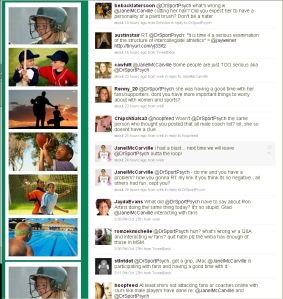
I learned a few valuable lessons which may be instructive as we all move forward and think about how to use social media effectively to positively promote women’s sports.

First, if social media is truly a two-way conversation, then I should of phrased my tweet “What is your opinion about @JanelMcCarville’s UStream videocast?”

Second, attacking people on Twitter is just in poor taste and not classy. My apologies Janel. This has played out for KC Chiefs NFL player Larry Johnson this week, as he is paying the price literally and in the media and  for using a homophobic slur. It will continue to occur with increased frequency as social media becomes part of the way we communicate.

Third, shortly thereafter I read a great piece by Q McCall of www.swishappeal.com on Feministing.com titled,  Is there a “feminist responsibility” to support women’s sports? It put into context some of the guilt I felt. Why was I attacking a female athlete?  I’m supposed to support women’s sport. But on the other hand, as a feminist, scholar, and advocate of women’s sport  I often feel I have the responsibility to wave the red flag and point out when I see something that may not be a “good thing”.  Perhaps my role is to raise the issue, provide an alternative viewpoint, and promote respectful discussion.

It also got me thinking about where female athletes and women’s sport might be headed in terms of social media. If everyone  “loves it” (all 66 viewers)—is this our new model of promoting women’s sport? Is that what fans really want to see? Is this how fans want to interact with athletes? Where is the line between “good access” and access that, to borrow from C + C Music Factory,  “Makes You go Hmmmm”? As was pointed out to me,  Ron Artest of the LA Lakers, got his hair cut that same day…which garnered media attention. But if the men do it, should the women follow? Should we always be trying to emulate our male counterparts? (I’m not suggesting that is why Janel chose to UStream, she’d have to tell us the inspiration). Is it possible male athletes use social media differently because of disparate patterns of traditional media coverage? What are the similar and different ways elite male and female athletes use social media? How can female athletes take control and use social media in positive ways to combat sexism, inequalities, and disparities that are well documented in sport contexts? Is this a responsibility they should bear? In conclusion, I highlight Janel not to criticize or judge, but to provide an exemplar real-life issue to promote discussion about social media and women’s sports.

I don’t have the answer, only a lot of questions. What do you think?

FACT: Winning in College Sports Does Not Lead to….

knight_logo Fun fact of the day from College Sports 101. It is commonly assumed that a winning athletic program, particularly in big-time “revenue” sports, leads to institutional benefits—such as increased number and quality of student applications and alumni donations. To win, athletics departments argue that increased spending is needed to compete the in the college “arms race”.  Research indicates that increased spending does not lead to an increase in the “W” column, and that winning has no institutional benefit as is commonly believed. If any benefit is to be accrued is it likely short-lived and not significant.

FACT: Football & Men’s Basketball (Usually) Don’t Pay for Themselves

knight_logoA new report, College Sports 101: A Primer on Money, Athletics, and Higher Education in the 21st Century released by the Knight Commission on Intercollegiate Athletics reveals some interesting facts and current trends about intercollegiate sports.  Jay Weiner (@JayWeiner) author of the report writes, “The myth of the business model – that football and men’s basketball cover their own expenses and fully support non-revenue sports – is put to rest by an NCAA study finding that 94 [of the then 119 FBS] institutions ran a deficit for the 2007-08 school year, averaging losses of $9.9 million.”

More fun facts later…

Differences Between Coaching Girls and Boys

Ok, I need your help. I’d really like to hear your opinion.I know many of you coach or have coached. Are there differences in coaching boys and girls?If so, what are they? Please respond by voting in the poll and making a comment to this blog. If you’d rather not make a public comment, email me at nmlavoi@gmail.com    I’ll be sure to share your responses in a future blog.