March Madness! Visible Women Head Coaches

Here is a different twist on March Madness 2015.

It is pure Madness! (in a good way) that:

  1. the ESPN coverage of the NCAA D-I women’s basketball tournament is well produced so that we can actually SEE these amazing female athletes and their coaches
  2. a majority of the head coaches of women’s basketball are women. In the Women in College Coaching Research Series, 62.8% of head coaches of women’s basketball in the 86 “big time” NCAA D-I schools (many of which are in the tournament) are women.

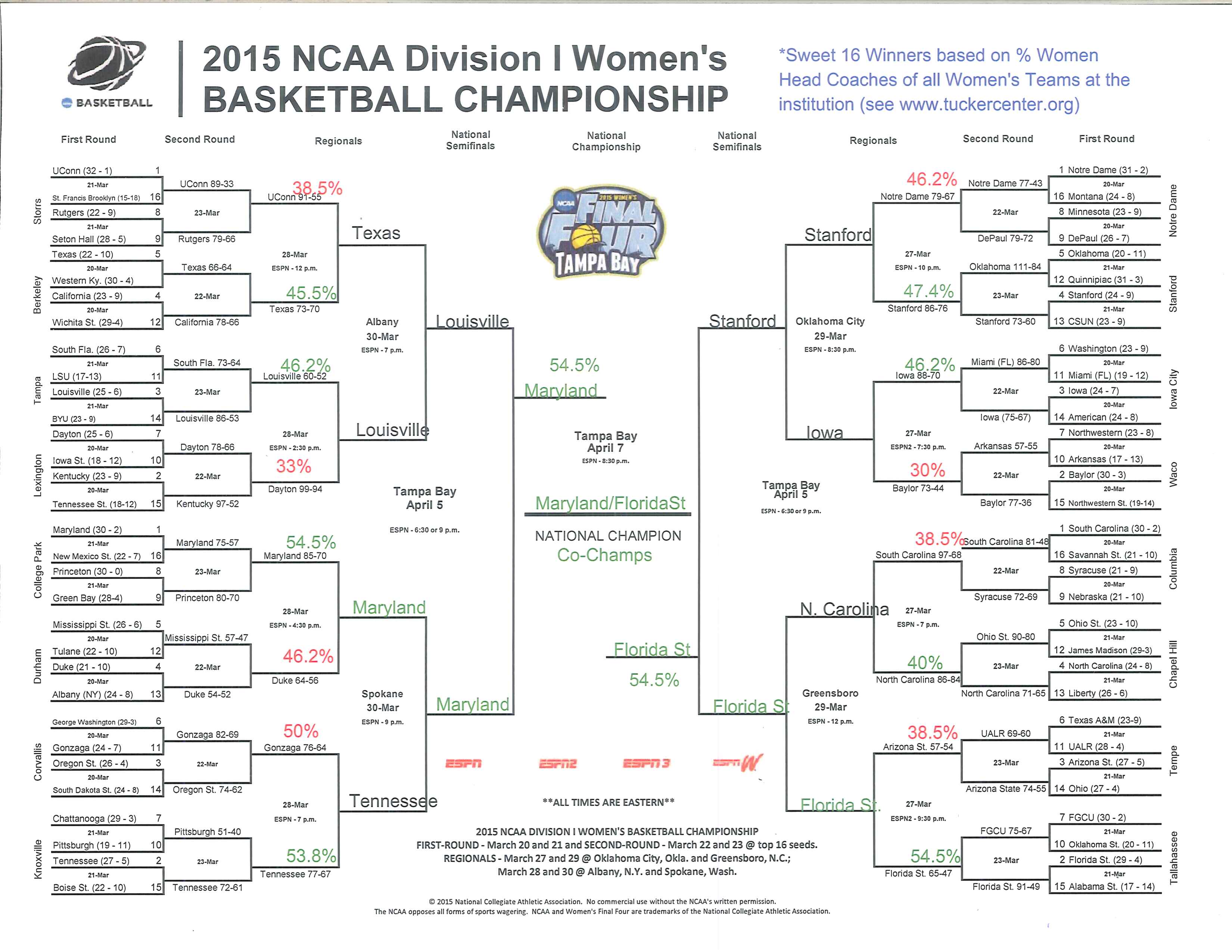
Based on the 2014-15 data in the Women in College Coaching Research Series, I took the remaining 2015 Sweet 16 teams and filled out the bracket based on the percent of women’s teams at that institution which had a female head coach (see Figure 1). With that data, Maryland and Florida State would be Co-National NCAA D-I Champions (coached by Brenda Frese and Sue Semrau respectively), due to the fact 54.5% of all their women’s teams at both institutions are coached by a woman head coach. Madness!
2015 WBB sweet 16 bracket
Figure 1. 2015 Women’s NCAA D-I Winner by Percent of Women Head Coaches of Women’s Teams by Institution


Madness! Of note, 13 of the Sweet 16 women’s teams (81.3%) have a female head coach–that is an over-representation of women head coaches for the best teams in the nation, than are found in women’s D-I basketball in general, given the stat I stated before (62.8%). The Sweet 16 stat is a really interesting stat in that 29 of 64 teams (45.3%) in the full bracket are coached by a female head coach. Based on the data, it appears the female head coaches are proportionately outperforming their male coaching colleagues and are represented in a larger percentage in the Sweet 16, than the initial pool of women coaches in the bracket. More Madness!

And there are many other competent women head coaches represented in earlier rounds, such as Princeton coach Courtney Banghart, whose undefeated 31-0 team lost to Maryland in a hard fought game which was written about by USA Today columnist Christine Brennan.

To break the tie and declare a national champion, we (thanks Marnie Kinnaird!) looked at the gender composition of the coaching staffs for the Sweet 16 women’s basketball teams (see Figure 2 below).

We weighted the score by position, if a woman occupied the position a school earned the following points: Head Coach = 3pts, Associate (Head) Coach = 2pts, Assistant Coach = 1pt. Males in any position earned zero points. We counted only 4 coaching positions for each institution (except for UNC who had 5).

Based on the data in Figure 2, Notre Dame and Arizona State tied for the “win” with 8pts each (due to the fact both programs have 2 Associate Coaches, which are weighted more heavily than an Assistant Coach, therefore giving them the lead), and Stanford and Iowa tied for second place with 7pts each. Notwithstanding Notre Dame, Arizona State, Stanford and Iowa share an interesting stat–the coaching staff is comprised of all women.

Meaning 4 of the Sweet 16 teams (25%) are coached by all women–prime examples of women mentoring women. Madness! 

2015 Gender Composition of Coaching Staff for Women's Sweet 16 Women's Basketball  Teams
Figure 2. 2015 Gender Composition of Coaching Staff for Women’s Sweet 16 Women’s Basketball Teams


This data did not break the Co-National Champs tie…both Maryland & Florida State had 5pts! (mini madness!)

Seeing powerful, successful female role models, athletes and coaches, on TV matters!

It provides proof that women can be successful at the highest levels in the coaching profession. It provides visibility to young girls and women who aspire to play college athletics and who may aspire to continue following their love and passion in sport by coaching. It provides evidence and gives boys and young men a picture that women can be, and are, leaders. So thanks to ESPN and espnW for providing excellent coverage, content and production value, so that these amazing women athletes and their coaches can be seen for the role models they are. So here’s to more Madness!

p.s.-If you have an idea on how to break the tie between Maryland and Florida State, tweet me @DrSportPsych


Why a Woman Coach in the NBA Matters

Becky Hammon, Assistant Coach San Antonio Spurs

This summer an NBA team was in the news… for hiring a woman to the coaching staff.

During the first week of August 2014, the San Antonio Spurs made history when they hired 16-year WNBA San Antonio Stars veteran Becky Hammon as a full-time assistant coach for the 2014-15 season.

While there are women coaches of men, the Hammon hire matters for a number of reasons:

1.The percent of women coaches at every level of competition has declined since the passage of Title IX in 1972…despite a record number of female sport participants. Based on the data, 20% of all college athletes–male and female–are coached by women and 43.4% of females have a woman head coach. If women are not seen in a position of power or a certain career, it is less likely other females will view that job as a viable and realistic career pathway. Seeing Hammon on the Spurs sideline matters because it communicates that women can (and do!) coach men at the highest level. It communicates a career possibility, and a lucrative one at that.

2. The best team in the NBA, the 2014 Champions San Antonio Spurs and the best coach in the NBA, 2014 NBA Coach of the Year Gregg Popovich, hired a woman coach. What winners do in the most visible and popular sports matters, because winning is valued in sport culture and society. Winners get to communicate what is valued, important and relevant. Popovich’s confidence in Hammon will help quell the gurgle of naysayers who believe women can’t coach men or help “mold boys into successful men” (as was stated by a current male head college coach in a Slate.com piece). If you believe this statement, then by the same logic, men should not coach females because they have no place in molding girls into women. Therefore, all athletes should be coached by the same sex. Obviously this is false logic as we know many male coaches help their female athletes grow and develop personally and athletically, and women coaches provide the same guidance, mentoring and coaching for males. Women can coach males at any level, but are rarely given the opportunity to do so.

Scholars argue the lack of opportunity for women to coach males at the highest level is about preserving and maintaining power. If women are given the opportunity to coach men in pro sports or D-I high-profile college mens’ teams, and succeed, who benefits and who doesn’t? If women are denied the opportunity to coach males–who benefits and who doesn’t?  If women are revealed as competent coaches in a domain historically and currently dominated by males–coaching males, and recently coaching all athletes–then the existing order of power may shift, and this makes some men who benefit from that power and privilege uneasy. All athletes can benefit from a gender-balanced and diverse work force–meaning they are coached by both men and women.

3. Hammon was hired because she is qualified and competent. It wasn’t a publicity stunt. Spurs head coach, Gregg Popovich stated in a release that Hammon will be an asset to his championship team. Competence matters and Popovich believes that Hammon’s knowledge and experience as a long-time veteran player and Spurs insider, will provide value to him, the coaching staff and the players. In her NBA press conference Hammon claimed she was hired because of her background, personal skills, capabilities and basketball IQ. She owned her competence.

Kudos to Becky Hammon, a coaching pioneer, as her presence at the highest level of a major men’s sport will hopefully start a national dialogue about why women coaches matter.

Related to the issue of women coaches of male athletes…

In July 2014 Doc Rivers, head coach of the NBA Los Angeles Clippers, asked Natalie Nakase to be an assistant coach for the team’s short summer league and announced she will return as the Clipper’s assistant video coordinator, a position she held last season. Nakase made her debut coaching males when she became the first female head coach in Japanese men’s professional basketball. Nakase’s goal is to be a head coach in the NBA.

In the MLB, Kim Ng is motivated, competent, experienced and poised to become a general manager. She is currently working with Joe Torre again in the MLB executive offices as Senior Vice President of Baseball Operations.

In professional men’s tennis, early in the summer of 2014 Amelie Mauresmo (2-time Grand Slam women’s tennis champion) was signed by ATP Top 10 player Andy Murray, which is in the works to become a long term arrangement.

There are other women like Hammon, Nakase, Ng and Mauresmo who want to and are competent to coach men and I hope 2014 will be the start of a trend…that competent and eager women will be considered, given a real opportunity, and hired for coaching positions, regardless of the sex of the athlete or level of competition.

To learn more about the Alliance of Women Coaches, a group dedicated to growing the number of women in the coaching profession click here.

Access free educational materials for espnW Nine for IX films

I recently had the opportunity to work in collaboration with espnW to develop discussion guides for the Emmy-nominated Nine for IX film series.

Nine for IX premiered June 18, 2013, as part of ESPN’s celebration of the 40th anniversary of Title IX. Inspired by the 40th anniversary of Title IX, ESPN Films and espnW produced nine documentary films about women in sports, told through the lens of female filmmakers. Nine for IX Films are a collection of remarkable stories that offer teachable moments and powerful lessons in the history of sports. .

The Nine for IX Knowledge Center is a free resource available to institutions, organizations, administrators, professors, coaches, and students who want to lead thoughtful and engaging discussions around key themes in the films. The Knowledge Center provides discussion guides for each film, film posters, and a sign-up form to receive the Nine for IX DVD set, all free of charge. The Knowledge Center is a tool that goes beyond the entertainment value of the films and leverages the rich educational content of the embedded lessons and messages within the films.

The discussion guides generate thought-provoking discussion topics around key themes and issues present in the films such as gender equality, intersectionality, identity politics, sport and politics, social class, racism, and sexism, along with issues related to sport psychology, sports media coverage, sports marketing, and sports as a vehicle for developing role models. Each unique guide contains Key Concepts, Discussion Questions, Additional Readings and Additional Activities.

I wrote a specific guide for coaches for The 99ers, a film about the 1999 Women’s World Cup Championship team, that coaches can use as a team building activity and to discuss what it takes to develop performance excellence and a positive team culture.
To access the free materials, including obtaining a free DVD box set of the Nine for IX film series, discussion guides, and posters visit the espnW Nine for IX Knowledge Center.

Football Bowl Winners…A Slightly Different Approach

Now that the 2013-14 Football Bowl Series has come to a close and winners declared, I am posting bowl winners based on a slightly different approach.

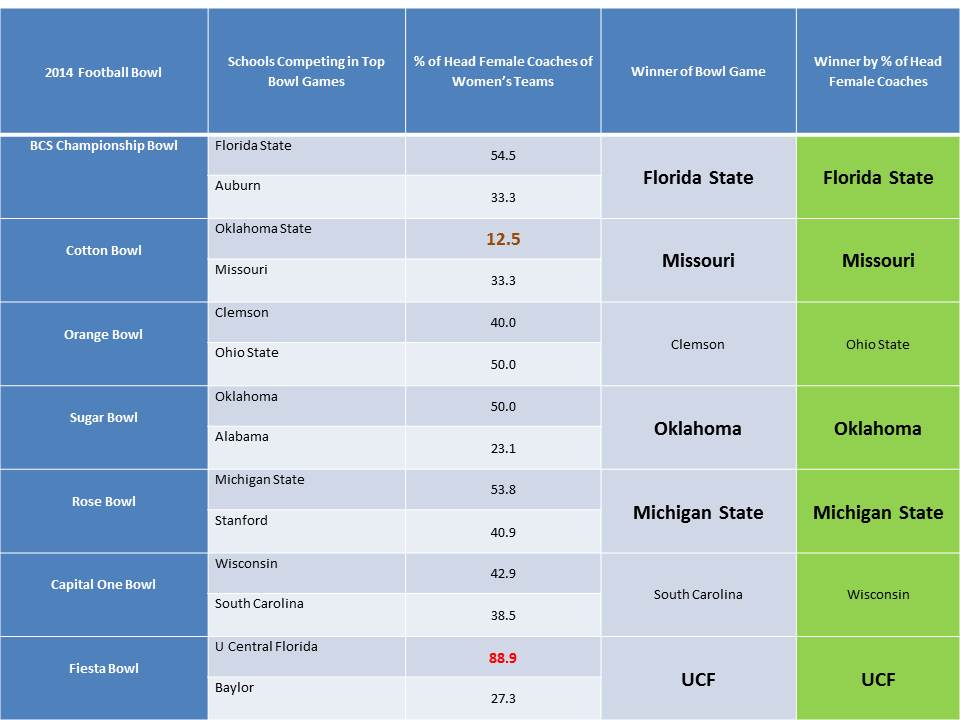
The winners of 7 arguably most prestigious bowls in this graphic (click on it to make it larger) are based on the institution’s commitment to gender equity in its hiring of women head coaches for women’s teams for 2013-14.

One Sport Voice Bowl Winners 2014

So if you are a fan of Ohio State and Wisconsin…you have something to cheer about, even though your teams lost their bowl game, your institutions have a higher percentage of female head coaches (FHC) of women’s teams than did your opponents!

Sorry Florida State (54.5%)… yes you beat Auburn (33.3%) both on the field and by % of FHC and even though they didn’t play in the title game, University of Central Florida is the real National Champion as 8 of 9 (88.9%) of their women’s teams are coached by women head coaches! Well done UCF!

Oklahoma State, you lost to Missouri (33.3%) both on the field and in % of female head coaches, but you are the winner the Toilet Bowl as only ONE of 8 (12.5%) of your women’s teams are coached by a woman…you can do better, A LOT better! However OK State to be fair, in 2012-13 NONE (0%, ZERO) of your women’s teams were coached by women, so you are moving in the right direction!

This data is taken from 2014 Women in College Coaching Report Card. (note: UCF is not included in the sample, but data was calculated separately from the UCF Athletics Web site)

RELEASED: New Reports on Women College Coaches

Did you know that in the 40+ years after the passage of Title IX, female sport participation is at an all-time high but the percentage of women coaching women at the collegiate level has declined from 90+% in 1974 to near an all-time low today of 40%? While the number of collegiate coaching opportunities is also at a record high, only 20% of all college coaching positions for men’s and women’s teams are filled by women.

T2012-13_women-coaches-reportoday we (meaning the Tucker Center & the Alliance of Women Coaches) released a research series, 2 report cards and infographic on the status of women college coaches at 76 of the biggest NCAA D-I athletics programs. This work is the culmination of many people’s efforts. The purpose of this initiative is to increase the number of women in the coaching profession, generate awareness, and hold institutions accountable. I hope you will check out the reports and infographic and read the article Christine Brennan wrote in USA Today about the report.

Here are some key take-aways from the reports:

  • As the position became more visible and arguably powerful from graduate assistants, to assistant coaches, to head coaches, women occupied those positions less frequently.
  • In one academic year the percentage of women head coaches declined from 40.2% to 39.6%
  • Only ONE school, Cincinnati at 80%, was awarded an A for the percent of women head coacheswcr_2013-14_infographic
  • An equal number of schools got above average grades of A’s and B’s as got F’s (11 each). To see which schools passed and failed, or where your school stacked up, click on the infographic.
  • Two sports had 100% female head coaches (field hockey, synchronized swimming) while five sports had ZERO (0%) (water polo, bowling, skiing,, sailing, squash)
  • The B1G Ten (46.1%) conference had the most female head coaches of the 6 conferences we examined (ACC, Big East, Big 12, SEC, PAC 12), the SEC had the lowest (33.3%)wcr_2013-14_head-coaches
  • 66 of 886 head coach positions turned over from 2012-13 to 2013-14. Out of those 66 positions 74.2% of all coach vacancies were filled by men resulting in a net gain of five head male coaches, thus the decline in the percentage of women head coaches.
  • 7 schools increased the % of female head coaches in one academic year, while 13 decreased.

To read more about why this research matters, grading criteria, methodology and more specifics on processes go to the reports.

Female Coaches in High School Sports: Data Released

You don’t need to look far or drill down very deep in a Google Search on ‘female coaches’ to find out two facts.

1. Female coaches at all competitive levels have declined since Title IX passed in 1972
2. Female coaches are the minority in almost every workplace

Many are familiar with the longitudinal work of Vivian Acosta and Linda Carpenter, who have tracked the number of females in positions of power in intercollegiate athletics for the past 35 years. Based on their data we know that in 1972 over 90% of female college athletes were coached by women, and in 2012 that number is near an all time low at 42.9%.   To date a similar nationwide analysis for high school sports did not exist.Colleague Cindra Kamphoff, PhD and I decided to change that by analyzing a 2010 national data set of high school coaches we obtained from a reputable coaching directory. Some interesting, but not surprising, patterns emerged. Here are three key findings:

Slide141. 27% of all high school head coaches are female

2. Females coached of girls’ teams (39.6%) more often than boys’ teams (7.5%)Slide16

3. In basketball, the most popular** high school sport (and therefore the most visible, prestigious, important, valued, and known) females coached girls’ (28.1%) teams more often than boys’ (0.2%) teams.

Based on the data, female head coaches are often statistical tokens (<15% of a workforce) and marginalized (i.e., assigned to coach the less important and visible teams) in high school athletics. Tokens often experience or are subjected to scrutiny, pressure to over-perform to gain credibility, discrimination, harassment, and a host of negative workplace outcomes, and this is supported in the vast literature on barriers and support for female coaches which I’ve previously written about on this blog.

**most popular as indicated by the National Federation of High Schools

NOTE: Complete and refined analysis will continue. Please note these numbers represent a 3-5% variance, are not exact, but provide an initial picture into power, leadership, and high school sports.