Part III: Changing the “Women Don’t Apply” Narrative for Women Sport Coaches

In Part I and II of this series, Changing the Narrative for Women Sport Coaches, I laid out how women coaches are framed shapes the discussion, and the numerous “blame the women” narratives that exist. In this blog I will tackle one particular narrative, provide counter narratives and suggest strategies for change.

employment-application-clipart-1BLAME THE WOMAN NARRATIVE: Women don’t apply.

I hear from coaching directors and athletic directors (ADs) they want to hire women, but women just don’t apply.  For example, if a head coach job is open an AD might get 45 male and three female applicants. The lack of women applicants provides proof that women don’t apply [subtext: Women CHOOSE not to apply].

Let me provide a few counter narratives and perspectives.

  1. In the example above three women did apply, so it isn’t they “don’t” apply, they don’t apply in the same numbers as men.
  2. In Part I, I outlined that choices of individuals are made within a system. The fact women “choose” not to apply is due to numerous factors and interpersonal, organizational and societal barriers their male counterparts do not encounter.
  3. Often when a head coaching position is posted, the AD already has a short list of candidates. Women know this, and if they aren’t on the “short list” why take the time and effort to apply. What this speaks to is this: informal and formal networks of the AD matters. When an AD wants to hire someone he (and in some cases she, but we know a majority ADs and coaching directors are men) turns to his networks. Most people’s networks are other people like them (i.e., other men, people they worked with in the past, classmates from undergraduate or graduate programs, people in the same position and industry. This is often called the ‘Old Boy’s Club’). Who is hired is often a reflection of the formal and informal network of the person doing the hiring. Staying within one’s network reproduces gendered discrimination (whether intentional or not). If you’d like to read a great article about gendered networks of NCAA ADs and SWAs click here.
  4. Women coaches exist in a system where they lack the network, status, resources, information, and access needed to seek, occupy and maintain leadership positions. Another way to put it, women coaches aren’t in the Old Boy’s Club and when a job opens, it is often too late for them to get in the game.

So what is the solution?

Change must occur at ALL LEVELS but it starts with the AD because that person has the most power in the system!

Strategies for the AD to consider:

  • Believe that qualified women exist and do want to coach. Go out and actively seek, find, encourage, invite, ASK and ACTIVELY recruit women to apply. Build relationships with a diverse pool of candidates in advance so your short list is diversified. Recruiting women coaches, just like coaches recruit athletes to their teams, is about building a trusting relationship. You must work to convince women why your institution is a good fit for them (and their family if that applies) and why you want them.
  • Contact the Alliance of Women Coaches and sport coaching organizations and ask for qualified candidates who are looking to make a move. Call colleagues who have made a similar hire recently and get their short list.
  • Diversify your network.
  • Ask yourself: Why aren’t women applying to your institution? Is your department a place where women want to work? Do they see others like them? Do they see evidence that women coaches matter? Will they feel valued and supported in your department?
  • Challenge your common sense beliefs and the way you frame and think about the lack of women coaches in the applicant pool. Try to see it from the perspective of the female applicant and potential female applicants.
  • Resist the temptation to blame women for not applying and instead reflect on how to encourage more women to apply, and make the workplace a supportive and inclusive place.


Changing the Narrative for Women Sport Coaches: Part I

dorothy_webb
Dorothy Webb, Head Volleyball Coach, Wellesley College

The under representation of women coaches within the institution of sport has been framed in many ways–from a historic decline since the passage of Title IX, to scarcity, to the more current narrative of stagnation.

OK if you are new to this topic, let me give you the data to get you up to speed. In 1972 prior to the passing of Title IX, 90% of girls and women were coached by women–today that number is only ~40%, a number that has been stagnant for the last decade (see graph below).

stagnation

If you are asking why this matters or women coaches matter, please watch this video [forward to 22:00-25:00mn in].

Women coaches exist within an occupational landscape and sport system that is dominated by men at every level, in every position, and in nearly in every sport and institution (see here if you need the data!).

Within this system, many women coaches do not feel supported, valued, or connected to the athletics administration in ways that help them be successful. Ironically, women are often blamed for the lack of, or stagnation, of women coaches. By blaming women (the people in the system with the least power) the systemic changes that need to occur to create change and unstick the stagnation fail to happen. “Women just don’t apply” is an oft heard narrative, which places blame on women. Instead of figuring out why women don’t apply or spending time and energy to actively recruit women into the candidate pool, the buck stops at the individual level–the woman or women who CHOOSE not to apply. The End.

A lack of women applicants then provides proof that women aren’t interested in coaching, and the decision maker doing the hiring is off the hook and the system in which women make choices remains unchallenged. Choices are not made in a vacuum. Choices are influenced by the people, communities, networks, family, organizational culture, and socio-cultural factors around the individual [if you want the data pertaining to the numerous barriers women coaches face in the system, see Women in Sports Coaching, watch this video, or read these blogs].

How the issue of women coaches is framed matters!  Narratives matter!

framesFraming is how something, someone or a group of people are presented to the audience which influences the choices people make about how to process that information. Frames are powerful communication schemas (i.e., narratives) in which meaning assigned to an individual, in this case women coaches, is constructed. Framing is the selection, omission, and organization of the issue by individuals (i.e., the media, ADs) to explain the phenomena. Often dominant frames, whether true or not or whether based on empirical data or not, get taken up as “the truth” and uncritically accepted, like the example above that “women just aren’t interested in coaching.”

Leading up to International Women’s Day on March 8, 2018 I am going to be writing a series blogs to help shift the narratives around women sport coaches that might help us unstick stagnation.

New data on women college coaches!

2017-18 Select 7 cover
Jamelle Elliott, Head Women’s Basketball Coach, at U of Cincinnati, Alliance of Women Coaches member, NCAA Women Coaches Academy graduate

To celebrate National Girls & Women in Sport Day, the Tucker Center for Research on Girls & Women in Sport (where I am the co-director) released its annual Women in College Coaching Report Card. Produced in collaboration with the Alliance of Women Coaches, the report documents the percentage of women in head coaching positions at institutions in seven select NCAA Division-I conferences (AAC, ACC, Big East, B1G Ten, Big 12, PAC-12, SEC) for 2017-18.

Key Findings:

  • The percentage of women head coaches of women’s teams went up for the 5th year in a row and is now at 41.5% (the bad news is that number is stagnant!, works remains to be done!)

  • In 60% of vacant head coach positions, a male was hired

  • Cincinnati and University of Central Florida were the only institutions to be awarded an A grade.

  • Nine institutions earned F grades

  • None of the select 7 NCAA D-I conferences received above a C grade

  • NCAA D-III institutions have the highest percentage of women head coaches at 45.7%

To read the full report, download the infographic, discover how the report is making a 2017-18 Select 7 infographicdifference, learn about interesting trends (including insight into which of the 86 select “big time” NCAA Division-I institutions, sports and conferences receive passing and failing grades, and see our NCAA D-III and D-II Report Cards visit : http://www.TuckerCenter.org

Podcast: Tips for Character Development Through Sport & More!

sidelineI visited Marti Erickson on MomEnough to do a second podcast on sport parents where we discussed youth sports, questioned many assumptions, called out unhelpful parental behavior and challenged parents to step up and use proven approaches to help children reap optimal benefits of organized sports. Listen to the podcast here.

Did you recognize any of your own parenting behaviors in what parents should not do? What were the most important things parents should do?

My first podcast “Being a Good Sport Parent: Practical Guidance on Bringing Out the Best in Your Young Athlete” with MomEnough is here.

LaVoi gives Distinguished Lecture on Women in Sports Coaching

dsc_1051
Nicole M. LaVoi, Ph.D., Co-Director of the Tucker Center

I recently had the opportunity to give the Tucker Center’s Distinguished Lecture where I laid our current and historical data on the Paradox, Pitfalls & Parity: Where Have all the Women Coaches Gone?  You can watch the lecture here (I start about 14mns in, so fast forward!!)

A puzzling paradox exists when it comes to women occupying sport leadership positions—particularly coaches. Two generations removed from Title IX, female sports participation is at an all-time high, yet the number of women coaches is near an all-time low. At the college level alone, female coaches are in the minority, representing just 43% of all head coaching positions in women’s sports nationwide. It is simply not possible that as each new generation of females becomes increasingly involved in and shaped by their sport experience—especially at the most elite levels of competition as evidenced by the dominance of the U.S. female athletes at the 2016 Rio Olympics—they simultaneously become less qualified to enter the coaching profession.

In this lecture I answered three questions I frequently get about women in sports coaching:

1. Why do women coaches matter? Why should we care?

2. Why is there a stagnation in the under-representation of women coaches?

3. What can we do about it?


New Report on the Dangers of Early Sport Specialization

sport-specialization-aap-2016
Sports Specialization and Intensive Training in Young Athletes; ©2016 by American Academy of Pediatrics

I am a long time advocate of late specialization-early diversification in youth sport, and this research report by the American Academy of Pediatrics “Sports Specialization and Intensive Training in Young Athletes” in the September 2016 issue of Pediatrics hits the mark and provides concrete evidence that early specialization in NOT the optimal pathway to either elite performance or health and well being.

The AAP report along with the Aspen Institute’s Project Play, I “hope” will begin to shift the discussion and beliefs about youth sport participation and structure 180 degrees away from winning/performance to fun and enjoyment and development.  In January 2015, the Aspen Institute released “Sport for All, Play for Life: A Playbook to Get Every Kid in the Game,” a 48-page report that offers a new model for youth sports in America, with eight strategies for the eight sectors that touch the lives of children.

The cultural shift has to start with sport parent and coach education.


SI Sportsperson of the Year Cover Image of Serena Williams: Opportunity Missed

Guest Contributors:
Elizabeth Daniels, Ph.D., Assistant Professor, University of Colorado at Colorado Springs
Mary Jo Kane, Ph.D., Director, Tucker Center for Research on Girls & Women in Sport, U of Minnesota
Cheryl Cooky, Ph.D., Associate Professor of American Studies, Purdue University
Nicole M LaVoi, Ph.D., Co-Director, Tucker Center for Research on Girls & Women in Sport, U of Minnesota


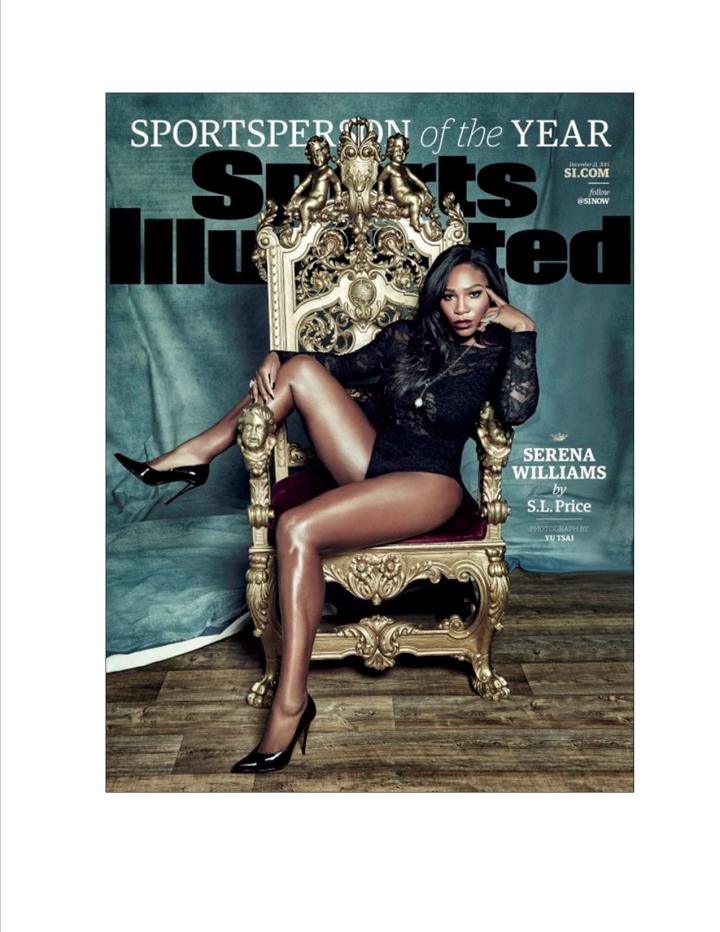
Sports Illustrated (SI) recently named Serena Williams its Sportsperson of the Year. As scholars who have spent our academic careers examining media coverage of women’s sports, we are thrilled to see a highly accomplished female athlete awarded this most prestigious title. Considering her on-the-court accomplishments in 2015 Williams is clearly worthy, having won three major tennis titles, amassing an overall 53-3 record, and extending her No. 1 ranking for a third consecutive year. Williams has now joined an elite club of past SI winners: Only 8 other women and one women’s team are in this elite group compared to 68 male athletes or men’s teams. It should be noted that Williams is only the second women of color to be awarded this distinction (track & field star Judi Brown King was the first in 1987). This honor is especially poignant on the heels of Williams’ return to the WTA’s Indian Wells Tournament this past spring after a 13-year boycott of the tournament where she endured racist comments from the audience in 2001 about which tournament organizers did nothing. SI noted her commitment to drawing attention to issues of race in sport was part of why Williams was selected. Serena Williams has proven herself to be a champion time and time again despite discriminatory and harmful distractions leveled at her by sport audiences and media. For example, she was subjected to critiques of her muscularity this summer in an article in The New York Times on body image in sport, which some argued was a thinly veiled commentary regarding black women’s bodies and how they do not fit white, middle-class norms of beauty.

Serena Williams SI Sportsperson of the Year 2015

In spite of Williams’ unprecedented accomplishments as arguably the greatest female tennis player in U.S. history, she was featured on the cover in a sexually provocative pose. Perhaps anticipating criticism for such a choice—SI is, after all, a sports not a fashion magazine—they immediately emphasized the point via tweet that this portrayal was Williams’ idea. The choice to feature Williams dressed in an all-black lace bodysuit and patent leather power pumps perched on a throne as Queen of the Court has been supported by some who see this portrayal as empowering. We suggest that there were other choices available to SI and to Williams herself, ones that are not only empowering, but powerful. Unfortunately, such an editorial choice is not new at SI. Anna Kournikova (5 June 2000), Jennie Finch (11 July 2005), and Lindsey Vonn (8 February 2010) have all been portrayed in similarly sexualized ways. Serena Williams herself has appeared in SI’s Swimsuit Issue in 2003. Perhaps not surprisingly, SI has a poor track record when it comes to depicting highly accomplished female athletes outside of the Swimsuit Issue. A recent study of SI covers from 2000-2011 found that women were on only 35 out of 716 covers, and just 11 of those 35 covers showed female athletes in poses comparable to male athletes (2). Clearly, it is a rarity to see a female athlete portrayed as an athletic champion on the cover of this incredibly influential U.S. sports magazine. Regrettably, female athletes are similarly ignored in broadcast media (3). As a result, we fail to see female athletes on any regular basis portrayed as accomplished athletes in mainstream sport media and we have all written previously about how this paucity of coverage negatively impacts interest in women’s sports (4).

Sexualized images of female athletes, in contrast, are not hard to find–simply google ‘female athletes.’ Numerous scholars have also documented that the sexualization of female athletes is a common practice (5). Unfortunately, this is part of a broader pattern wherein girls and women are sexualized in media and popular culture. Three major reports from the UK (6), U.S. (7), and Australia (8) have all documented the prevalence of this practice and its negative consequences on girls and women. When women are sexualized in the media, female viewers may think of their own bodies as objects and reduce their personal value to their physical attractiveness instead of to their talents, personality, and contributions to the world. Our own research has shown that this is precisely how adolescent girls and college women respond to sexualized images of female athletes (9). In addition, sexualized images of female athletes do not generate interest in women’s sports (10). Research also indicates that media images which portray female athletes in powerful action photos generate not only interest in, but respect for, women’s sports. Additionally, after viewing such images teen girls and college-age women are more likely to think about their bodies in terms of their physical skills and capabilities. Portraying sportswomen as gifted and accomplished athletes has the untapped potential to make girls and women feel good about their bodies—which is a significant challenge in today’s media environment inundated with unrealistic and idealized images that create body dissatisfaction.TENNIS-WTA-QATAR

In an ideal—not to mention realistic—world, images which display female athletes (and their bodies) for what they actually do rather than how sexually empowered they may appear would be easy to come by. If this were the case, girls and young women could have magazine covers of their female sports heroes in their bedrooms as a reminder of what women are capable of and as an equally important reminder that our society values them for what their own bodies can achieve on the court, rather than for how sexually attractive they are. Unfortunately, as Sports Illustrated reminds us, female athletes who dominate their sport are currently only celebrated if they look good doing so.


(1) http://www.nytimes.com/2015/07/11/sports/tennis/tenniss-top-women-balance-body-image-with-quest-for-success.html

(2) http://irs.sagepub.com/content/48/2/196.abstract

(3) http://com.sagepub.com/content/early/2015/06/05/2167479515588761.abstract

(4) http://espn.go.com/espnw/news-commentary/article/13215042/even-wake-record-setting-women-world-cup-myths-surround-women-sports

(5) http://link.springer.com/article/10.1007%2Fs11199-015-0493-x

(6) http://www.ncdsv.org/images/Sexualisation-of-young-people-review_2-2010.pdf

(7) http://www.apa.org/pi/wpo/sexualization.html

(8) http://www.tai.org.au/node/1286

(9) http://jar.sagepub.com/content/24/4/399.refs

(10) http://journals.humankinetics.com/jsm-back-issues/jsm-volume-25-issue-3-may/expanding-the-boundaries-of-sport-media-research-using-critical-theory

Reform Needed in Youth Sport

WCCO Nov 2015 Project Play

I comment this in this piece titled “As competition rises, team sports decline, but traveling teams soar WCCO-TV”.  

The The Aspen Institute’s Project Play is also mentioned.

Project Play focuses on access to quality sport opportunities for children ages 12 and under. “Sport for All, Play for Life: A Playbook to Get Every Kid in the Game (2015),” is a 48-page report that offers a new model for youth sports in America, with eight strategies for the eight sectors that touch the lives of children.

Dispelling Myths About Women’s Sport: Post Women’s World Cup 2015

Even if Dave Zirin doesn’t want to keep defending women’s sport in the wake of the Women’s World Cup that smashed ratings (although I know he will!), we at the Tucker Center for Research on Girls & Women in Sport decided to write a piece that will help change the narrative and dispel false narratives about women’s sport.red card_iStock_000003976608XSmall

Read our exclusive on espnW titled Even in the Wake of a Record-Setting Women’s World Cup, Myths Still Surround Women’s Sports where we refute the four most common myths about women’s sport.

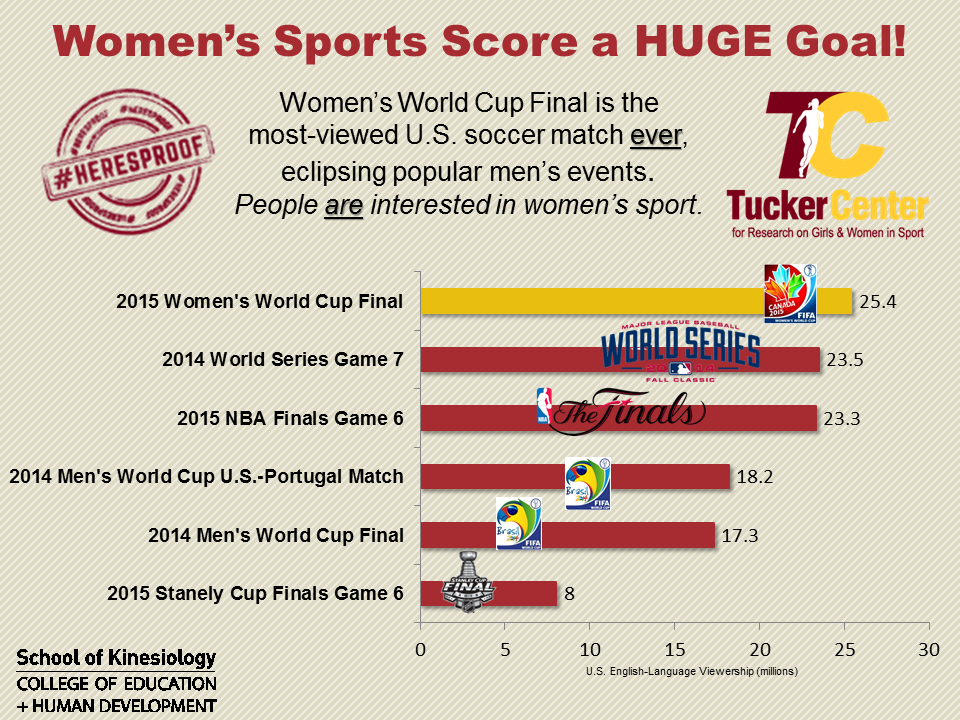
The statistics surrounding the 2015 Women’s World Cup (WWC) make it abundantly clear that people are interested in women’s sport.  In sum, the WWC final:

  • was seen by 25.4 million viewers on Fox—a record for any soccer game, men’s or women’s.
  • generated record numbers of viewers on the Fox Sports Go streaming app.
  • drew 2 million more viewers than Game 7 of the compelling 2014 World Series between the Kansas City Royals and the San Francisco Giants in October which attracted 23.5 million on English-language television.
  • eclipsed the recent NBA Finals Game 6 featuring Golden State’s title-winning victory over Cleveland last month on ABC with 23.25 million viewers.
  • buried Chicago’s Stanley Cup-winning victory in Game 6 over Tampa Bay last month on NBC with 8 million viewers.

Despite these statistics, many myths about interest in women’s sport continue to prevail. Help prove that interest in women’s sport does exist and join the #HERESPROOF social media campaign! Click here to see the infographic we put together on 2015 WWC viewership.

HERESPROOF infographic_3_2015