Comparisons between male and female athletes

While talking with a reporter today about WNBA Champions the Minnesota Lynx, I had a realization…it most likely isn’t new, but I’d never thought about selective comparisons between male and female athletes in quite this way before.

Comparisons between male and female athletes in the same sport and in general are commonplace. Today I realized that most comparisons are used to marginalize female athletes, while sustaining and promoting male athletes as the normative best.

When people want to trivialize or put down female basketball players or the WNBA for instance, the comparison goes something like this…. “Women’s basketball is boring. They don’t play above the rim, jump as high, or dunk like the men. No woman could ever play in the NBA.”

The reporter said she had written a piece which suggested that WNBA players are great athletes but more sportsmanlike, team oriented, and accessible than NBA players, which makes them appealing to watch….and she got a lot of push back and negative feedback to the effect of  “Why do you always have to compare the leagues and players?”

This got me thinking that some people use comparisons selectively to promote men’s sport and relegate women’s sport. When comparisons are used to highlight to the good or better elements of women’s sport or female athletes compared to their male counterparts, backlash usually ensues. Why? Because the upsides might make people realize that perhaps the better value and product lies in consuming women’s, not men’s, sport.

The similarity lies in the fact females are great athletes!

The difference lies in many factors, some of which I mentioned above.

Both similarities and differences can be used effectively to promote and sustain interest in and for women’s sport.

After the espnW Summit I’ve been thinking about how “we” need to reclaim some of what was lost when the AIAW was taken over by the NCAA in the early ’80’s, as well as take what is working in the current business model of sport (the traditional male model) to help promote and achieve sustainability for women’s sport. Women’s sport doesn’t have to follow or emulate what men’s college and professional sport teams are doing (i.e., conference realignments, rule violations, player strikes and lockouts, egregious behaviors, entitlement, arms race…and so on).

With the 40th anniversary of Title IX upon us soon, it is a great time to reflect on where we are, where we need to go, and how to get there.

Opposing Views of Media Portrayals of Female Athletes

With the 2011 issue of ESPN The Body Issue magazine coming to shelves Friday, and images being released online today, I thought it a good time to summarize common ways media portrayals of females athletes are framed and discussed. Today I got to hear colleague, Kent Kaiser, Ph.D., discuss his work around media framing of Title IX in print journalism. (to read his recently published article on this topic, Gender Dynamics in Producing News on Equality in Sports: A Dual Longitudinal Study of Title IX Reporting by Journalist Gender click here).

He used conflict framing as his theoretical framework to look at this issue, and coupled with my recent trip to the espnW Summit to sit an a panel to discuss if sex sell women’s sport, and colleague Mary Jo Kane’s column this summer in The Nation magazine on this topic… it got me thinking. Kaiser identified some themes in his work, that I modified, that might be a good way to promote discussion about media portrayals of female athletes. I’ll elaborate on each below.

Advocacy Frames are those that advocate that sexy, hyper-feminine, or in some cases semi-nude or nude images of females athletes are good for women’s sport and female athletes. Opposition Frames are those arguments which see such images as trivializing, problematic and doing nothing to promote respect and sustainability of women’s sport, or any particular individual female athlete.

ADVOCACY FRAMES

  • Equality-both male and female athletes are seen semi-nude or nude (i.e., the ESPN The Body Issue), so it isn’t that ONLY female athletes are portrayed this way.
  • Personal Opportunity-inclusion and portrayal of sexy, beautiful female athletic bodies provides opportunity for exposure (literally and figuratively!), sponsorship, and branding.
  • Autonomy-female athletes have a choice whether or not to pose in magazines or be photographed. No one makes them pose in those ways, they want to.
  • Market-sex sells! and people want to see sexy images of female athletes, it is what the market wants…no one is interested in seeing real female athletes that aren’t attractive, sexy or feminine.
  • Zero-Sum-there is only a limited amount of coverage for all sports, so the more women’s sport is covered or female athletes are featured, men’s sport suffers.

OPPOSITION FRAMES & COUNTER ARGUMENTS

  • Equality-yes of course male athletes are portrayed nude and semi-nude (i.e, ESPN The Body Issue), however female athletes only get 2-4% of all sport media coverage and when they do, it is most often in ways that minimize athletic competence and highlight sexy, feminine characteristics. Also, men’s sport and male athletes already enjoy respect and credibility so when male athletes are portrayed nude it means something very different culturally.
  • Personal Opportunity-Yes, posing semi/nude provides short term exposure, but no data exist that demonstrates such images lead to additional sponsorships, contract extensions, increased pay, or respect and credibility for female athletes. In nearly every professional context, when women take off their clothes it does not lead to respect and perceived credibility and competence. Additionally no data exist that demonstrates such images increase TV ratings, fan attendance, or season ticket sales….therefore opportunity for the greater good and league sustainability might actually be undermined when individual female athletes are portrayed this way.
  • Autonomy-Yes, no one is holding a gun to any female athlete’s head and they do choose to participate. Female athletes are smart…they see the women getting the most exposure and media coverage are the ones who conform to the sexy, feminine mold and they want to capitalize on their physical assets as well. However, if this way of being portrayed is the dominant model in the absence of a virtual black out of coverage that features athletic COMPETENCE, of course female athletes will choose to be included, rather than excluded. Choices are made within the context of sport, which is male-centered and male identified.
  • Market-Yes, of course sex sells! and sex sells magazines, but no data exist that demonstrates sex sells women’s sport. In fact emerging data suggest otherwise…that images of athletic competence is what sells women’s sport and help to generate respect and credibility. In addition, for years and years leagues and organizations have been selling sex, but at the same they lament the low interest in and attendance of women’ sport. Maybe it is time to try a new way to market female athletes….put athletic competence first and see what happens!
  • Zero-Sum-Female athletes are so rarely portrayed in sport media. Roughly 40% of all high school and college athletes are female, yet they are rarely portrayed in sport media. What would it look like if female athletes received close to 40% of all sport media coverage? How would that affect interest in, and respect of women’s sport? Interest in men’s sport will likely not wane or lose its cultural primacy, so why not try it?

That is enough for now…I’m off to watch some highly competent female athletes take the court in the WNBA Finals! Go LYNX!!! And I’m betting the arena will be full of fans who have come to see amazing basketball, and I will not see ONE image of a semi/nude female athlete.

The Minnesota Lynx: A Case About Media Coverage for Female Athletes

I live in Minneapolis and am a fan, advocate and scholar about gender issues in sport, particularly girls and women in sport. In the last two months, while I haven’t blogged much I have been keeping in eye on happenings around women in sport. Media coverage, or should I say the lack thereof, has been on my mind a great deal.

An anomaly was the 2011 Women’s World Cup aired and covered by ESPN = Fantastic coverage of dramatic competition, athleticism and serious athletes. Unfortunately what we see far too often is the trivialization, erasure and sexualization of female athletes…which I’ve written about a lot.  This last point is why I haven’t blogged much lately. I’m just plain depressed and discouraged that over and over again these patterns emerge, despite record numbers of females participating in sport in the post Title IX era. How many times can I write the same thing over and over without anything changing…and in fact, in most cases, is getting worse?

6 Ways Media Present Female Athletes

I’ll say it again…media coverage by major networks of female athletes has DECREASED in the last 10 years and is now down to a dismal 1.6%. (What would the Twins’ attendance or interest in the team look like if we only read 1.6% of the time about the team in the sports media or if we didn’t hear and read non-stop coverage of the team—even in the off season?)

Dave Zirin pointed out that GQ left out an entire gender when naming their 25 coolest athletes.

If you want to read a great critique and column titled “Sex Sells Sex, Not Women’s Sports” in the special sports issue of The Nation magazine written by my colleague Dr. Mary Jo Kane, Director of the Tucker Center for Research on Girls & Women in Sport, and get up to speed about why these trends persists and why it is problematic, I’d encourage you to read it.

You can also see an exceptional slide show of the six categories of representation of female athletes commonly witnessed in the sport media from athleticism to soft core porn if you click here. Kane argues the majority of sport media and marketers are complicit and unquestioning that sex sells women’ sport and “believe that reaffirming traditional notions of femininity and heterosexuality is a critical sales strategy.”

Ironically, in our own backyard the WNBA Minnesota Lynx are providing an interesting case study for sport media scholars. Currently the Lynx have the best record in the WNBA and have secured a playoff bid. The Lynx have a great deal of athletic talent: Whalen, Wiggens, Bruson, Augustus, and Moore are some of the players lighting up the scoreboard this season. Meanwhile…the MN Twins are struggling, the NBA is facing a lockout and the Timberwolves were horrible last season, the NFL is limping back to full speed after their lockout and the Vikings will struggle, and the NHL and MN Wild have their own issues.

Case in point: Today I got a call from a local media outlet to discuss why the Lynx are getting very little coverage despite a winning season. I was ready. I got a call 10mns later, the story was canceled– “Something better had come up”. How can people get interested in the Lynx if they don’t hear about them and the team isn’t covered?

I know for a fact that the Lynx are selling more tickets this year, over 1,000 more a game, than last year. Fans are filling the seats. People ARE interested and DO care about women’s sport. The Lynx are talented and exciting to watch. Hey sport media….PAY ATTENTION AND GIVE THE LYNX THE COVERAGE THEY DESERVE! Sport media journalists argue they will cover women’s sport when interest is there. Here is a clue: NOW IS THE TIME.

Here is a novel chicken-egg idea: The more media coverage you give the Lynx, the more people will attend and the more interest is generated.

The ironic thing is, people are interested DESPITE poor media coverage of the Lynx.

Even more ironic, people are interested in the Lynx because they are GREAT ATHLETES and are fun to watch not because the Lynx players are being marketed and portrayed in sexy and hyper-feminine ways.

Fans of women’s basketball and women’s sport want to see and read about athleticism and see quality play. They are getting that and Moore with the Minnesota Lynx.

added 9/1/11: Watch me talk to WCCO’s Jason DeRusha on the “Good Question” discuss the lack of coverage of the MN Lynx.

Some good, some bad outcomes of the #wwc2011

1. You have to hand it to Japan. They won the game and many hearts along the way. I’d like to think this a universal sentiment, but unfortunately it is not. To see backlash, racism and jingoism from fans pertaining to the WWC Final click here.

2. I find it interesting that the “success” of the WWC has been attributed to Title IX. Wendy Parker provides an alternative viewpoint here.

3. SI.com columnist Ann Killion writes “In the past, women’s teams were expected to do more than just play. They had to build a movement, change their culture, make history. This team is liberated from that.” She lists some things the current US players do not need to do…but what are the responsibilities of female athletes? What should they be?

4. Dave Zirin @EdgeofSports and The Nation writes highlights the “raunch culture” of women’s sports in his piece. “raunch culture” is when women athletes buy into the idea that it’s somehow empowering to display their naked bodies for men’s magazines.” Some members of the women’s French national soccer team decided to provide resistance to raunch culture and the idea that sex sells women’s sport by providing a caption: “Is this how we should show up before you come to our games?” (to see the accompanying picture click here)

5. Despite some of the negative outcomes of the WWC2011, I’m happy to report that much of the coverage and commentary seemed to allude to the fact that women’s soccer is fun to watch because the women are GOOD ATHLETES.

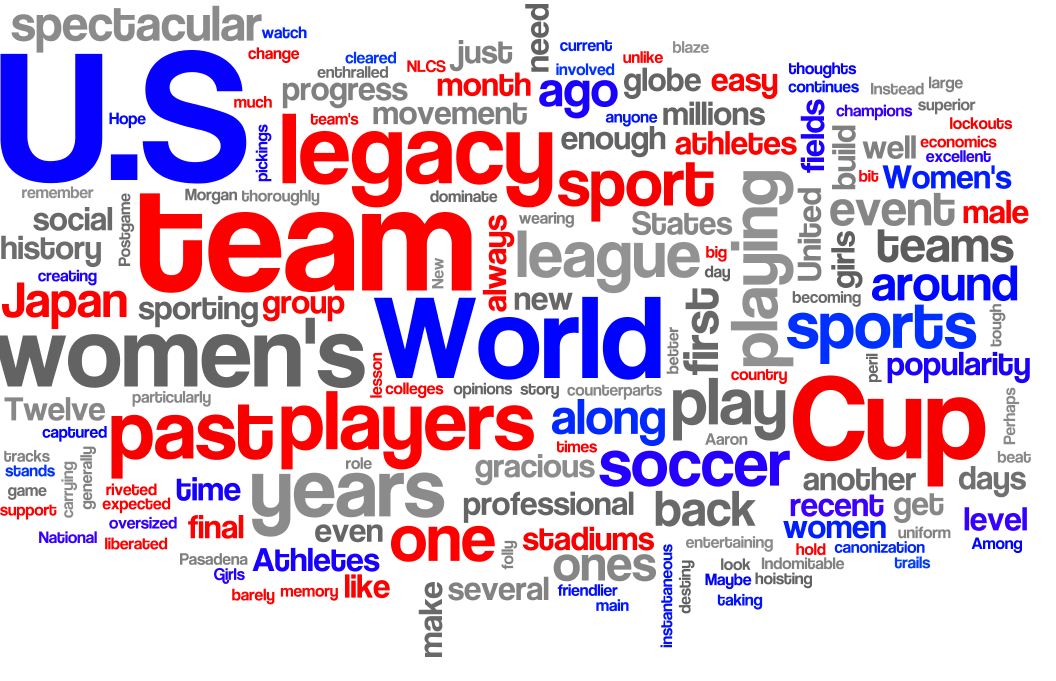
The WWC2011 picture above was created in Wordle.

6. Based on the data, the Women’s World Cup Soccer Final set a new Twitter record for tweets per second, at 7,196….more than killing Bin Laden, the Royal Wedding, the SuperBowl or NBA finals!

Recent focus on female athlete “unifems”

The recent focus on the athletic attire of female athletes, “unifems”, concerns me for many reasons. I write “unifem” instead of “uniform” to make a point. Most of the discussions about what is to be worn, or not, in competition is largely about underlying concerns that female athletes remain and at least look “feminine.”

Aside from unifem concerns, some female athletes like some members of the German soccer team, purposefully pose nude in magazines like Playboy that exploit women so they can be perceived as less “butchy” and tomboy-like (i.e., “sweet”, feminine, and thus heterosexual).

Let’s be clear–concerns, policies and rules about females athlete uniforms are usually about making the uniforms smaller, tighter and a more feminine color. These concerns are usually couched under the guise of “performance” or “safety” or both. To my knowledge, and I will stand corrected, that aside from some initial data on compression wear, very little empirical evidence exists that demonstrates that a smaller or tighter uniform will improve performance for athletes (aside from the razor suit in swimming…which is under scrutiny and I believe is now banned). If uniform size were about performance, you would also see scantily clad male athletes.I am also unaware of any sport marketing evidence that demonstrates that smaller, tighter, more feminine uniforms actually increases ticket sales, interest in the sport, or sponsorships. Show me the evidence.

It is my opinion the discussion about female athlete uniforms is first, outdated, and second sexist.

Let me summarize some of the very recent discussions pertaining to unifems. Reminder: this IS 2011, but attempts to marginalize, sexualize and exploit the female athletic body and female athletes is alive and well, and I think getting more egregious.

UNIFEM EXAMPLES

1. To create a more “attractive presentation,” the Badminton World Federation decided all elite level female players must wear a skirt or dress while competing. The complete NYT story here.

2. The lack of attire for the Lingerie Football League earlier this spring I have already written about (and no, I still don’t consider the LFL a sport, but I do support the notion that some, probably a good %, of the women in the LFL are real athletes.)

3. A female Muslim weight lifter, Kulsoom Abdullah, who wants to complete but keep with religious traditions by covering her entire body, aside from her hands and face, has sparked debate at the international level. Many argue this policy is racist and Islamophobic, in addition to being sexist as male Muslim athletes do not have the barrier of covering in public that impedes athletic performance.

4. The Iranian women’s soccer team was in tears after being forced to forfeit a 2012 London Olympics qualifying match this past weekend because it showed up to play in hijabs, and some argue that “FIFA makes things worse for women.”

5. Twitter blew up when a picture of tennis player Serena Williams in a hot pink cat suit appeared on the internet.

So what is going on with the recent barrage of unifem incidents? Why now? Is this further evidence of the gains women are making in sport?

2 Steps Backwards for Female Athletes

2 Steps to Nowhere are Better Than 2 Steps Back

Today I came across two articles in the New York Times related to female athletes and women’s sport. Neither contains good news and in fact both articles highlight that despite gains made in the post Title IX era, female sport participation is still constantly under attack.

Sport sociologists term the participation of females in sport and the conflicts that arise over who will play and under what conditions as “contested terrain.” Contested terrain means both oppression and resistance exist simultaneously and that existing power dynamics and social inequalities are both reinforced and challenged in and through sport.

Katie Thomas wrote a piece titled  College Teams, Relying on Deception, Undermine Gender Equity about how many college athletic teams are padding the number of female athletes on their rosters in order to make it appear the school is in compliance with Title IX.

update 4/29/11: Read the Women’s Sports Foundation response to these deceptive Title IX practices here. In the response Kathryn Olson, CEO of the WSF, said, “If an athletic department is willing to manipulate its sports programs by creating an artificial veneer of fairness among its male and female students with these laws on the books, one must wonder what would happen without Title IX.”

Alice Dreger wrote a piece titled Redefining the Sexes in Unequal Terms about how a new rule pertaining to the level of functional testosterone in female athletes is a sexist form of biochemical policing that male athletes do not endure.

The LFL Comes to MSP!

Breaking news, the Lingerie Football League (LFL) has just announced that Minneapolis is being awarded a franchise. I’ve written previously about my disdain for the LFL and why I think the league is problematic (click here and here).

What troubles me is that while the LFL is expanding, REAL women’s professional teams and athletes are struggling. The LFL is adding up to five additional teams–which would bring the league to 15 teams. The WNBA has 10 teams. The WPS has 7 teams. Let me be clear, the LFL is not sport. The LFL is about sex, and selling sex. The target consumer of the LFL is not female sport fans, or serious fans of women’s sport. The LFL target market is the coveted 18-35 year old male fan. The LFL is selling sex, not sport. As I’ve written before, sex sells sex. Sex does not sell women’s sport.

There is one small silver lining this for me. The good news about having an LFL franchise in Mpls is that I can finally do some research around the league–who attends, why do they attend, who tries out and plays in the LFL, what is the motive for playing and attending, what is the fan perception of the league, and so much more! Maybe I’ll submit my suggestion for the MSP team name….that way I can win lifetime season tickets so I can conduct my research with lower cost.

Example of why critical thinking is important

As I was walking into school today from the parking lot, two men were talking about women’s sport who were walking behind me. Given the topic I was listening in to see what they were saying, as it is rare I hear two men discussing this topic. It quickly became apparent to me they were discussing a class that one of them had taken, and dropped, that is taught by my colleague.

I’m guessing because they were coming upon Cooke Hall, where he took the class, it spurred him to remember the professor whom he described as “a feminist”…and he wasn’t using that as a term of endearment. In fact he then went onto to say “she was some sort of raging feminist who thought women’s sport should be on TV…and that she should get real because it is a business.” At that point his buddy asked him, “Did she used to play soccer?” Now I was really listening!

He said he’s taken the class as part of his major but this professor was a real crazy b*tch because one day they were talking in class about football, and the professor was arguing that “some women could play football.” To him, as a former high school football player, this was the most ludicrous idea he’d ever heard and because she so out there and was such a crazy feminist, he dropped the class and switched majors!

I was bothered by this for many reasons. First, this guy had no intention of ever seeing another perspective existed, that perhaps there are women who could play football. I wanted to turn around and tell him there are plenty of women who can, and DO, play football (see my previous blog post).

He as never going to entertain another perspective. His perspective was right, and this female professor was crazy. Period. I find these type people and students dangerous, because they then have the possibility to go into the work force and perpetuate current power structures and ideologies (ways of thinking) that marginalize women and dismiss alternative perspectives.And because he was a young, White, fairly good looking former athlete his opinion automatically carries more power.

Second, I didn’t like the venomous way he talked about “feminists.”  I’m not sure he really knew what a feminists really way, but he didn’t like them and in his words thought “they were stupid.” For his information and anyone else that wants/needs to know the definition of a feminist is: any person (not only women) who have an aim of establishing equal rights and legal protection for women, and who believes in the social, political, and economical equality of the sexes.

Third, calling a well known scholar versed in gender and sport “stupid” just because you don’t agree with her/her opinion is stupid. I say it all the time, but as a society we have mostly lost the ability to disagree respectfully and have civic discourse without it quickly devolving into “stupid” comments (see previous blog post). This undermines the fabric of a healthy democracy.

Fourth, I wondered why the friend would ask if the feminist professor “used to play soccer”. Huh? Do some young men think that female athletes are all feminists? Anyone? I’m confused.

I have to go teach, and I’m going to bring up the idea that women can play football….I’ll let you know how that goes!

Girls Competing Against Boys: Part II

I’ve been thinking more about 12 year-old MN female Ingrid Neel who will play on the High School boy’s tennis team this spring. I can see both sides of this issue. I’ve gotten some interesting emails offline and my students this morning had some thoughts as well. Here is a rough summary of those opinions and thoughts:

Why it might be good idea to let her play: the team will mirror the gender composition of the workplace in which she will largely compete against males, helps her develop life skills and “toughness” in competition, her tennis skills will improve, increased recognition which may help with recruiting, helps the boys learn to appreciate athletic talent of girls, has the potential to change outdated gender stereotypes of female athletes as “lesser”, separation of boys and girls in sport is arbitrary anyway so why not let them play together?, challenges the gender binary that all males are better than all female athletes and provides proof that many females CAN outperform or perform with males.

Why it might be a bad idea to let her play: the boys might not want her on team and it will destroy team cohesion, it might reinforce outdated gender stereotypes and ways of thinking about female athletes (the best athletes are male), her experiences will depend greatly on how the coach and the boys’ parents handle her presence on the team, Is it appropriate or should a 12 year old girl be around 17 year old males?; it takes her away from her female peers during a critical developmental window, Is it fair or healthy to ask a teen age boy to play (and possibly lose!) a younger girl…isn’t that emotional abuse?, it might open the floodgate of boys wanting to play on the girls’ team.

There are many facets of this issue to consider, which have been discussed and debated previously. To help us all think through the complexities and know the facts, I would guide the reader to Issues Related to Girls and Boys Competing With and Against Each Other in Sports and Physical Activity Settings: A Women’s Sports Foundation Position. The WSF piece is a nice summary and includes the legality of co-ed sport participation and opportunities to play under Title IX.

Related to the Ingrid Neel case, a colleague (thanks LW!) sent me a story about an Iowa wrestler who defaulted his state tournament match, rather than face a female wrestler (Cassy Herkelman).

One thought I want to share is that I think that most boys can greatly benefit from having to compete against girls. It has the potential (and I say that cautiously) to be a great opportunity for both competitors. Isn’t that the true meaning of competition…to strive together and bring out the best in each other? (NOTE: for a good book on this topic, read True Competition by David Shields & Brenda Light Bredemeier, former colleagues of mine at Notre Dame) However, the opportunity will be lost if the adults in the lives of both competitors mess it up. By that I mean if the coach or parents tease or allow teasing of the boy if he loses, which reinforces that boys should naturally be better than girls. It also tells the boy he isn’t “a real man” if he can’t beat a GIRL and therefore should be ashamed. Comments, teasing, hazing, and bullying directed towards the female competitor should also not be allowed or tolerated.

Some colleagues and I (Fink, LaVoi & Newhall, 2015)  did a study of male practice players of NCAA D-I women’s basketball teams. These researchers found the men in their study respected and appreciated the female athletes, and perspectives about female athletes and women in general did change. Overall the men described it as a very positive and transformative experience, therefore providing evidence that co-ed  competition can work and lead to positive development and growth.

If it can be done at one one the highest levels of competition, surely co-ed competition can be successfully achieved at the youth and interscholastic level. Let the kids play and hopefully if the adults get it right, it will be a positive and teachable moment for all involved.

I’d love to hear your additional thoughts.

Coaches Can Learn…

One of my primary areas of research pertains to the many layers of barriers that influences the scarcity of female coaches at all levels. I find blog inspiration comes in waves, as did the following two today.

1. A great piece on espn.com covered the implications of homophobia and negative recruiting that plague women’s athletics and particularly women’s basketball. I thought this piece was very well done and lays out the complexities of the issue and how it may detract females from entering and staying in coaching, as I had wrote about in a previous blog.

2. The second is a job in the NCAA Job Market posted by Rhodes College for a “Assistant Football Coach & Assistant Softball Coach”. While this is a somewhat  unusual combination, what is more unusual and ridiculous is the job description which states, “Bachelor’s Degree required. Must have served as a high school and/or college football coach, and be able to (learn and) coach softball.” LEARN softball?! It is a college coaching position! How would you like to be the women on that softball team? Would a job posting ever read like this, “Bachelor’s Degree required. Must have served as a high school and/or college softball coach, and be able to (learn and) coach football”?  This example highlights how certain sports (in this case football) are valued over others on this particular campus, but reflects the sentiment on many others.

There are many things  novice and expert coaches can learn, and the stories above outline that often times coaches and those in positions of power in sport learn patterns of behavior that perpetuate and reproduce inequalities.