If you’ve missed the podcast I host, Tucker Center Talks, it’s back! Joining me in some episodes is Anna Goorevich, Tucker Center Research Assistant and doctoral student. We talk to and amplify the work of our women colleagues who study sport and gender. You can find us on Spotify or any podcast platform. Thanks to our producer, Lindsay Hofer!
While girls and women participation in sports since Title IX has exploded, only about 40% of them are coached by women. The film explores supporting research, dispels false narratives, celebrates female coaching pioneers at all levels of competition and highlights stories of success and hardship. Their stories are the universal stories of women coaches who fight many battles to pursue their passion to coach. Produced in collaboration between Twin Cities Public Television and the Tucker Center for Research on Girls & Women in Sport.
Share it widely to your networks and help be a part of changing the culture of sport for women coaches, where they feel safe, valued and supported.
The report includes eleven chapters written by leading multidisciplinary scholars. Evidence-based chapters include psychological, sociological, and physiological dimensions of girls’ physical activity participation, as well as chapters on sports medicine and the influence of mass media of girls’ health and well-being. Because “girls” are not a singular monolithic group, chapters focus on girls’ intersectional identities and include invisible, erased, and underserved populations such as immigrant girls, girls of color, girls who identify as lesbian, transgender and queer/questioning, and girls with cognitive and physical impairments. The report ends with a Best Practices chapter and a Positive Model for Developing Physically Active Girls to guide thought, program development, interventions and research.
To read and download the full report, Executive Summary or the Positive Model click here.
This marks the fourth blog in the Changing the Narrative about Women Sport Coaches series. Brief review: In Part I and II of this series I laid out how women coaches are framed shapes the discussion, and the numerous “blame the women” narratives that exist. In Part III the “Women don’t apply”narrative was addressed. In this blog I will provide a counter to another common narrative: “Women aren’t as interested in coaching as men.”
Colleen Powers, Head Softball Coach, St. Catherine University
Similar to the “women don’t apply” narrative, when fewer women (compared to men) apply for an open position, the fewer number of women provides proof that women aren’t as, or are less, interested in coaching than men. Here is another way to look at this narrative.
As has been proven with sport participation, interest is driven by opportunity. When girls and women were provided opportunity to play sports after the passage of Title IX in 1972, they played. Before Title IX, one could have argued that females weren’t interested in sport because they didn’t play as much as boys. Females were interested and once given opportunity, we now we have record numbers of girls and women playing sports at all levels. Applied to women in sport coaching, currently women are impeded from and denied opportunity to coach compared to their male colleagues. Less than half of college female athletes (~40%) and very few males (~2-3%) are coached by women…that means that only 23% of all head college coaches are women (see data here). Men have a dual career pathway (more opportunity) to coach both males and females, while women do not. Women have less opportunity to coach. This is true at every level of sport. Less opportunity = less interest.
“You can’t be what you can’t see.”
It is simply not possible that as women participate in record numbers in sport, have passion for their sport, and become more experienced and more knowledgeable, that women simultaneously become less interested in coaching.
Most coaches (male or female) don’t get a job by randomly applying. Coaches get recruited, tapped or encouraged to apply (i.e., they are ON the short list) by someone in their network, then he/she applies. If one isn’t encouraged to apply, then why would one waste his/her time applying AND run the risk of damaging relationships at the current workplace by signalling they are looking for a job elsewhere? In short, not applying does not mean not interested. Not applying has more to do with being tapped for the short list and one’s informal and formal networks which I outline in Part III of this series.
Really big picture: What do you mean by “interested?” Who gets to define “interest in” coaching? What criteria are being used to define “interest?”
In Part I and II of this series, Changing the Narrative for Women Sport Coaches, I laid out how women coaches are framed shapes the discussion, and the numerous “blame the women” narratives that exist. In this blog I will tackle one particular narrative, provide counter narratives and suggest strategies for change.
BLAME THE WOMAN NARRATIVE: Women don’t apply.
I hear from coaching directors and athletic directors (ADs) they want to hire women, but women just don’t apply. For example, if a head coach job is open an AD might get 45 male and three female applicants. The lack of women applicants provides proof that women don’t apply [subtext: Women CHOOSE not to apply].
Let me provide a few counter narratives and perspectives.
In the example above three women did apply, so it isn’t they “don’t” apply, they don’t apply in the same numbers as men.
In Part I, I outlined that choices of individuals are made within a system. The fact women “choose” not to apply is due to numerous factors and interpersonal, organizational and societal barriers their male counterparts do not encounter.
Often when a head coaching position is posted, the AD already has a short list of candidates. Women know this, and if they aren’t on the “short list” why take the time and effort to apply. What this speaks to is this: informal and formal networks of the AD matters.When an AD wants to hire someone he (and in some cases she, but we know a majority ADs and coaching directors are men) turns to his networks. Most people’s networks are other people like them (i.e., other men, people they worked with in the past, classmates from undergraduate or graduate programs, people in the same position and industry. This is often called the ‘Old Boy’s Club’). Who is hired is often a reflection of the formal and informal network of the person doing the hiring. Staying within one’s network reproduces gendered discrimination (whether intentional or not). If you’d like to read a great article about gendered networks of NCAA ADs and SWAs click here.
Women coaches exist in a system where they lack the network, status, resources, information, and access needed to seek, occupy and maintain leadership positions. Another way to put it, women coaches aren’t in the Old Boy’s Club and when a job opens, it is often too late for them to get in the game.
So what is the solution?
Change must occur at ALL LEVELS but it starts with the AD because that person has the most power in the system!
Strategies for the AD to consider:
Believe that qualified women exist and do want to coach. Go out and actively seek, find, encourage, invite, ASK and ACTIVELY recruit women to apply. Build relationships with a diverse pool of candidates in advance so your short list is diversified. Recruiting women coaches, just like coaches recruit athletes to their teams, is about building a trusting relationship. You must work to convince women why your institution is a good fit for them (and their family if that applies) and why you want them.
Contact the Alliance of Women Coaches and sport coaching organizations and ask for qualified candidates who are looking to make a move. Call colleagues who have made a similar hire recently and get their short list.
Diversify your network.
Ask yourself: Why aren’t women applying to your institution? Is your department a place where women want to work? Do they see others like them? Do they see evidence that women coaches matter? Will they feel valued and supported in your department?
Challenge your common sense beliefs and the way you frame and think about the lack of women coaches in the applicant pool. Try to see it from the perspective of the female applicant and potential female applicants.
Resist the temptation to blame women for not applying and instead reflect on how to encourage more women to apply, and make the workplace a supportive and inclusive place.
Nicole M. LaVoi, Ph.D., Co-Director of the Tucker Center
I recently had the opportunity to give the Tucker Center’s Distinguished Lecture where I laid our current and historical data on the Paradox, Pitfalls & Parity: Where Have all the Women Coaches Gone? You can watch the lecture here (I start about 14mns in, so fast forward!!)
A puzzling paradox exists when it comes to women occupying sport leadership positions—particularly coaches. Two generations removed from Title IX, female sports participation is at an all-time high, yet the number of women coaches is near an all-time low. At the college level alone, female coaches are in the minority, representing just 43% of all head coaching positions in women’s sports nationwide. It is simply not possiblethat as each new generation of females becomes increasingly involved in and shaped by their sport experience—especially at the most elite levels of competition as evidenced by the dominance of the U.S. female athletes at the 2016 Rio Olympics—they simultaneously become less qualified to enter the coaching profession.
In this lecture I answered three questions I frequently get about women in sports coaching:
1. Why do women coaches matter? Why should we care?
2. Why is there a stagnation in the under-representation of women coaches?
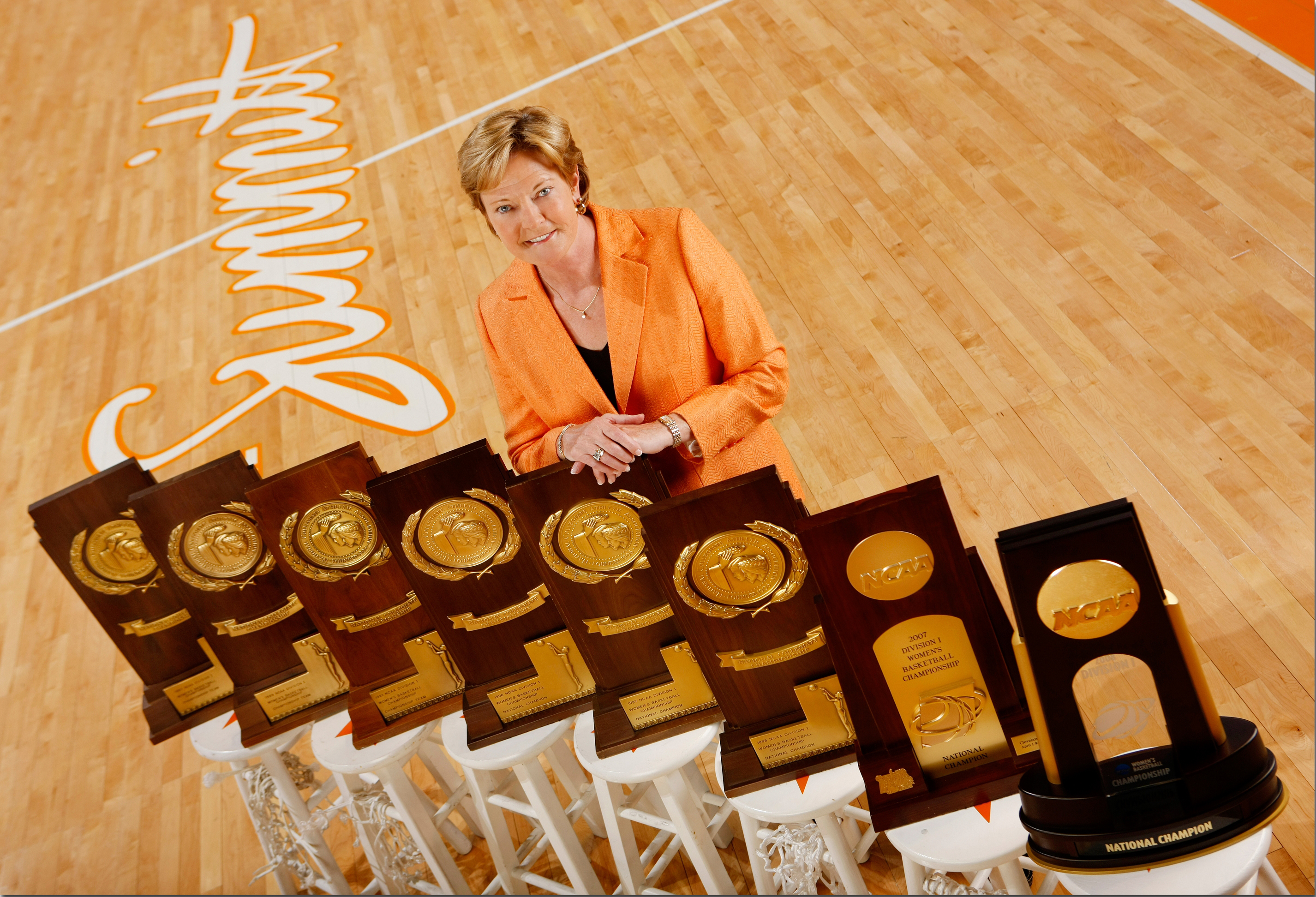
Much of what I have done athletically and now do professionally would not look the same without Pat Summitt.We have lost a pioneer for women’s sports and a legacy coach. While she holds the record for most wins in college basketball, her legacy is about so much more than winning and National Championships. While I only met Pat once very briefly, I feel compelled to honor and thank her. Pat, I and so many others, are grateful for how you made a difference, particularly for girls and women in sport. RIP
the ESPN coverage of the NCAA D-I women’s basketball tournament is well produced so that we can actually SEE these amazing female athletes and their coaches
a majority of the head coaches of women’s basketball are women. In the Women in College Coaching Research Series, 62.8% of head coaches of women’s basketball in the 86 “big time” NCAA D-I schools (many of which are in the tournament) are women.
Based on the 2014-15 data in the Women in College Coaching Research Series, I took the remaining 2015 Sweet 16 teams and filled out the bracket based on the percent of women’s teams at that institution which had a female head coach (see Figure 1). With that data, Maryland and Florida State would be Co-National NCAA D-I Champions (coached by Brenda Frese and Sue Semrau respectively), due to the fact 54.5% of all their women’s teams at both institutions are coached by a woman head coach. Madness!
Figure 1. 2015 Women’s NCAA D-I Winner by Percent of Women Head Coaches of Women’s Teams by Institution
Madness! Of note, 13 of the Sweet 16 women’s teams(81.3%)have a female head coach–that is an over-representation of women head coaches for the best teams in the nation, than are found in women’s D-I basketball in general, given the stat I stated before (62.8%). The Sweet 16 stat is a really interestingstat in that 29 of 64 teams (45.3%) in the full bracket are coached by a female head coach. Based on the data, it appears the female head coaches are proportionately outperforming their male coaching colleagues and are represented in a larger percentage in the Sweet 16, than the initial pool of women coaches in the bracket. More Madness!
To break the tie and declare a national champion, we (thanks Marnie Kinnaird!) looked at the gender composition of the coaching staffs for the Sweet 16 women’s basketball teams (see Figure 2 below).
We weighted the score by position, if a woman occupied the position a school earned the following points: Head Coach = 3pts, Associate (Head) Coach = 2pts, Assistant Coach = 1pt. Males in any position earned zero points. We counted only 4 coaching positions for each institution (except for UNC who had 5).
Based on the data in Figure 2, Notre Dame and Arizona State tied for the “win” with 8pts each (due to the fact both programs have 2 Associate Coaches, which are weighted more heavily than an Assistant Coach, therefore giving them the lead), and Stanford and Iowa tied for second place with 7pts each. Notwithstanding Notre Dame, Arizona State, Stanford and Iowa share an interesting stat–the coaching staff is comprised of all women.
Meaning 4 of the Sweet 16 teams (25%) are coached by all women–prime examples of women mentoring women. Madness!
Figure 2. 2015 Gender Composition of Coaching Staff for Women’s Sweet 16 Women’s Basketball Teams
This data did not break the Co-National Champs tie…both Maryland & Florida State had 5pts! (mini madness!)
Seeing powerful, successful female role models, athletes and coaches, on TV matters!
It provides proof that women can be successful at the highest levels in the coaching profession. It provides visibility to young girls and women who aspire to play college athletics and who may aspire to continue following their love and passion in sport by coaching. It provides evidence and gives boys and young men a picture that women can be, and are, leaders. So thanks to ESPN and espnW for providing excellent coverage, content and production value, so that these amazing women athletes and their coaches can be seen for the role models they are. So here’s to more Madness!
p.s.-If you have an idea on how to break the tie between Maryland and Florida State, tweet me @DrSportPsych
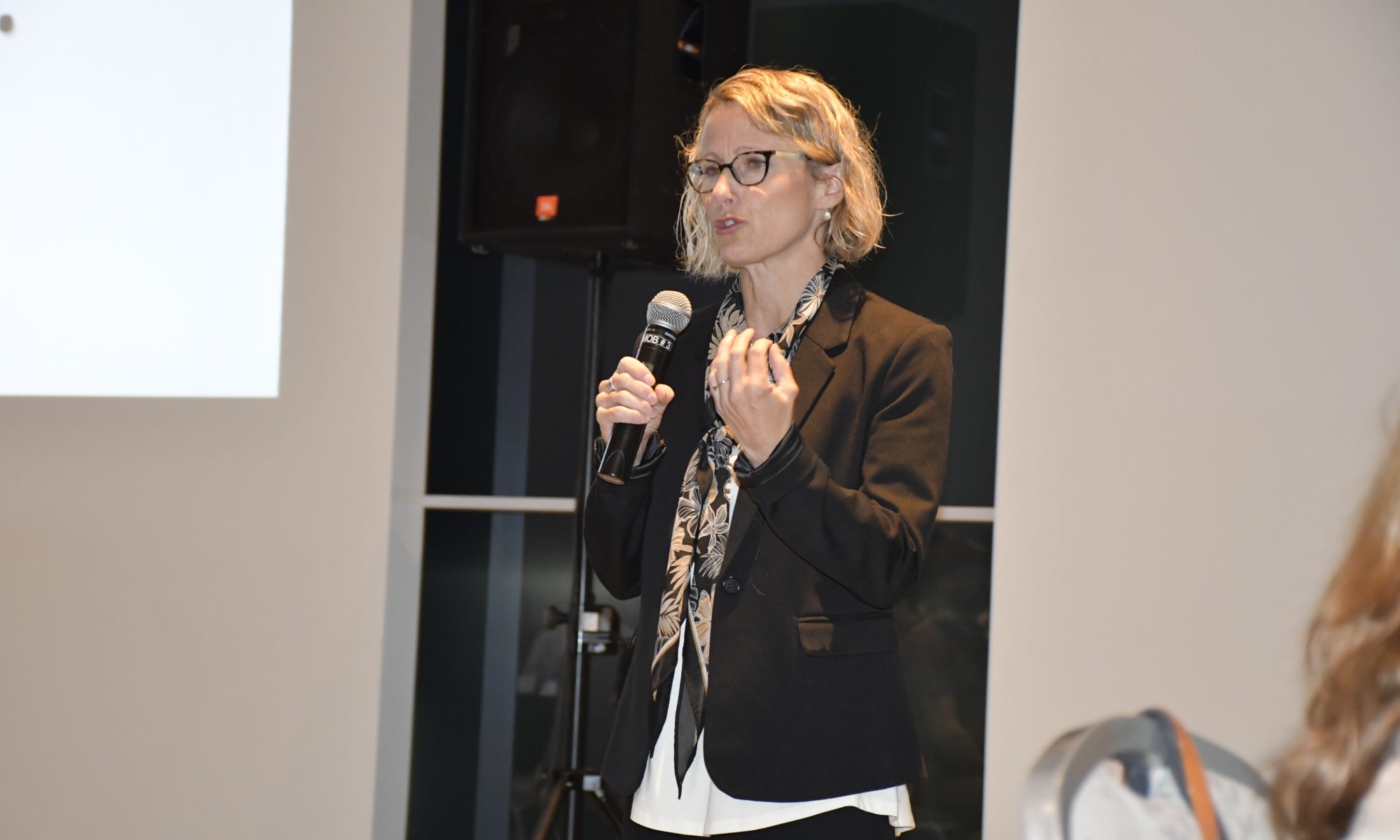
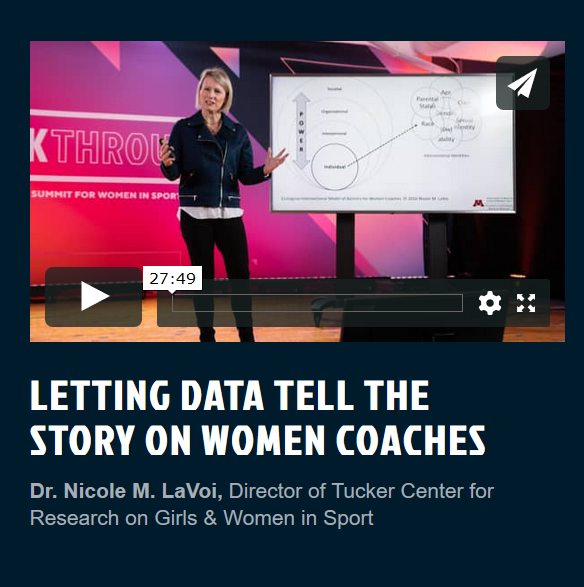 In December I was invited to present
  While girls and women participation in sports since Title IX has exploded, only about 40% of them are coached by women. The film explores supporting research, dispels false narratives, celebrates female coaching pioneers at all levels of competition and highlights stories of success and hardship. Their stories are the universal stories of women coaches who fight many battles to pursue their passion to coach. Produced in collaboration between
  The report includes eleven chapters written by leading multidisciplinary scholars. Evidence-based chapters include psychological, sociological, and physiological dimensions of girls’ physical activity participation, as well as chapters on sports medicine and the influence of mass media of girls’ health and well-being. Because “girls” are not a singular monolithic group, chapters focus on girls’ intersectional identities and include invisible, erased, and underserved populations such as immigrant girls, girls of color, girls who identify as lesbian, transgender and queer/questioning, and girls with cognitive and physical impairments. The report ends with a Best Practices chapter and a Positive Model for Developing Physically Active Girls to guide thought, program development, interventions and research.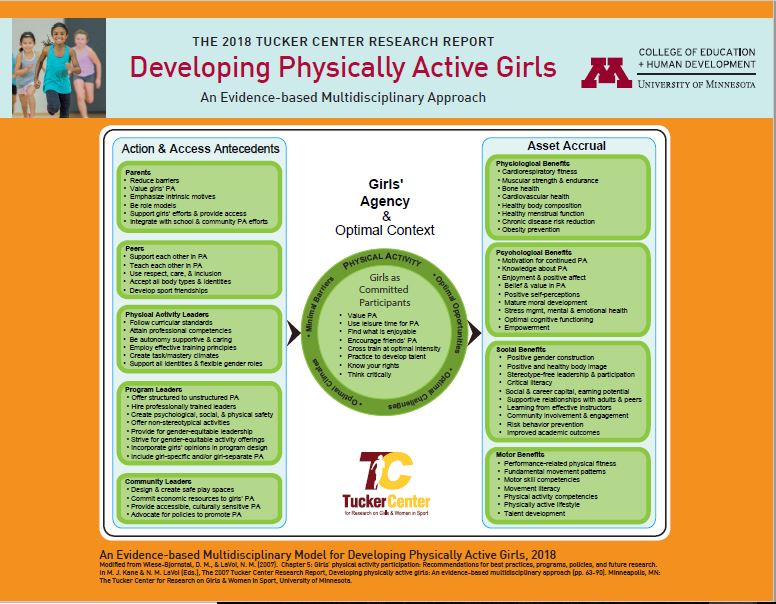


 Much of what I have done athletically and now do professionally would not look the same without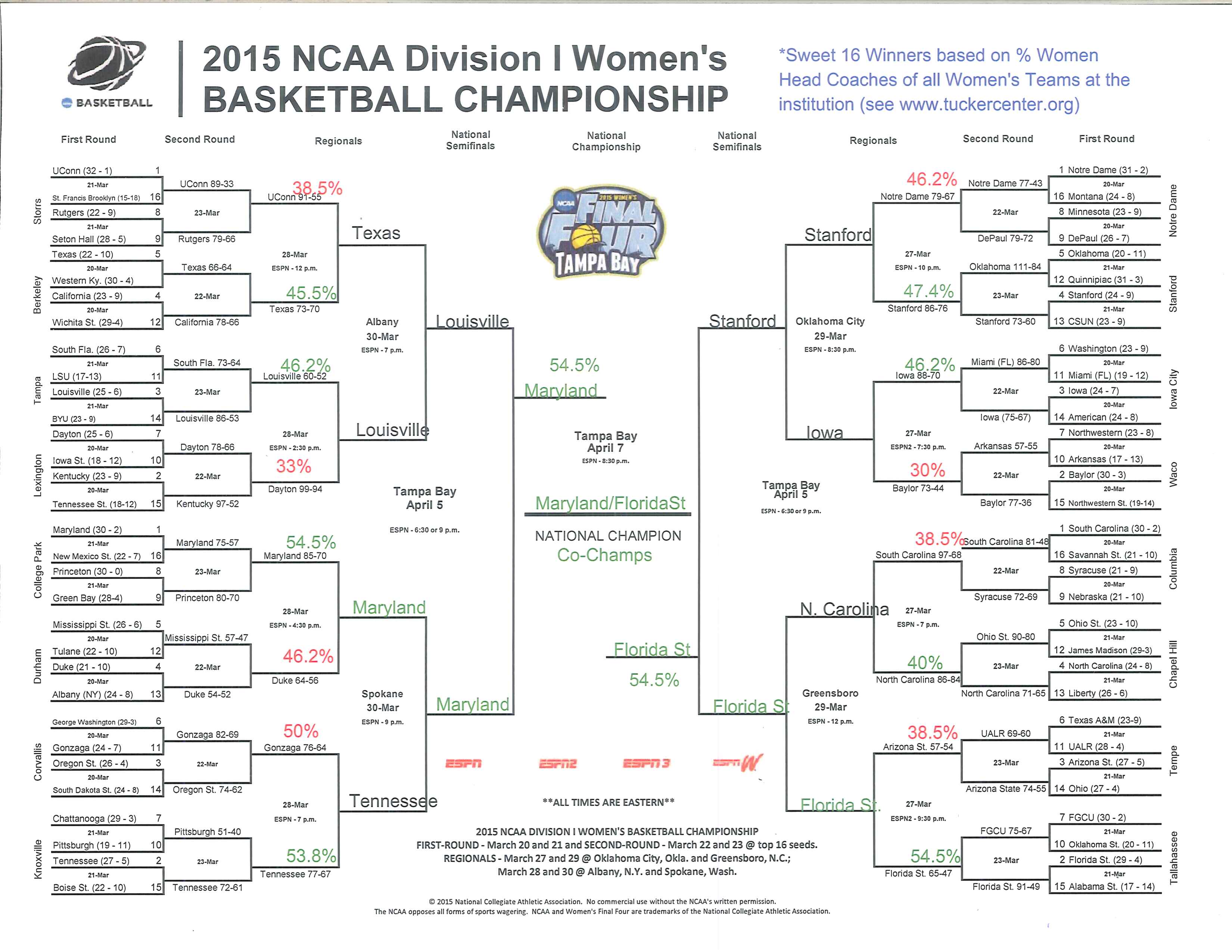

 One Sport Voice