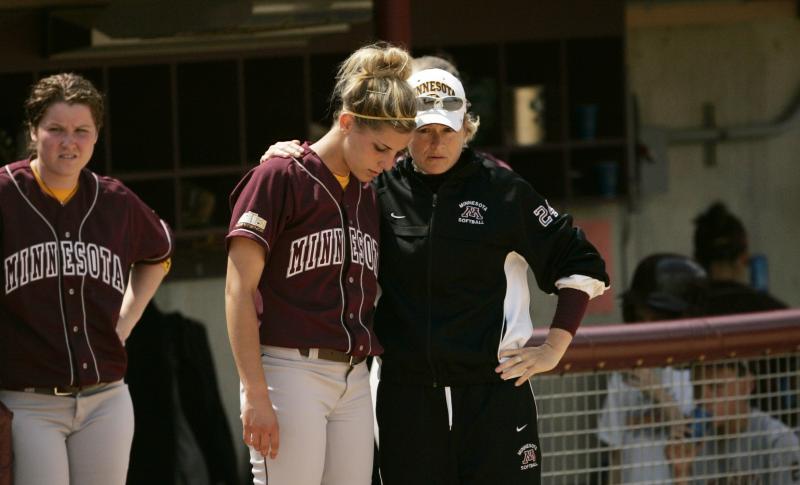
The Scarcity of Female Coaches-Part III

This week marks the 40th anniversary of Title IX. Currently I’m out in Denver for the NCAA Women Coaches Academy (run by the Alliance of Women Coaches) and in the next room is the NCAA/NACWAA Institute for Administrative Advancement where in both rooms the current and future generation of coaches and athletic administrators are being empowered. Seeing this group of women is inspiring and motivates me to continue the work I do to help them in part to succeed and stay in sport careers. Unfortunately they need a lot of support to do so.

As I was getting ready this morning I caught part of the ESPN Outside the Lines piece on “Coaching Conundrum” as to why there is a scarcity of female coaches. The ESPN crew had been out in Atlanta filming at the Alliance of Women Coaches annual Huddle in last May. While the ESPN piece is great for raising awareness about the scarcity of female coaches, it only scratched the surface of this complex question. An espnW piece on “The Glass Wall” is a much more in depth treatment female coaches.

I have written previously about this issue (Part 2  here and Part 1 here), but I want to elaborate a bit more on the eve of the Title IX anniversary.

The barriers for female coaches reside at four levels.

1. Individual (perception of lack of competence or confidence, choose not to coach, perception of time commitment to fulfill role)

2. Interpersonal (family & domestic commitments, lack of support from administration, negative recruiting from colleagues)

3. Organizational (lack of opportunity for professional development, lack of family-friendly policies, limited opportunities for advancement, lack of female role models in positions of power)

4. Societal-Cultural. This is the level that rarely gets discussed, is the hardest to change, and has to do with stereotypes of women, gender and leadership. The traits of effective leadership we mostly highly value in US society align with a male/masculine leadership style. If women don’t adopt or conform to this style (firm, authoritarian, assertive, loud, in control, competitive) they are perceived to be incompetent and weak. If they do adopt this style, the are often labeled a bitch because she is not conforming to a stereotypical female leadership style (caring, quiet, nurturing, passive, collaborative). The key here is that the association with gender and leadership is constructed and arbitrary, but has a dramatic effect on the careers of female coaches. If those in positions of power are mostly men (and they are!) and they are not aware of their own uncritical acceptance of leadership beliefs, and largely believe that male coaches are more competent than females…this will result in most likely a male being hired into the position. The result?–The current structure of sport and male power does not get challenged and females remain marginalized and in the minority, and because men continue to dominant the sport landscape and occupy the most important positions, society at large continues to believe that men are inherently more competent to coach.

Effective leadership is not gendered. Being competent, knowledgeable, facilitating optimal performance, treating people with care and respect, being organized, communicating well, are not inherent to males or females.

Female coaches need a voice in the sport landscape that is dominated by men. Be part of the critical mass and join the Alliance of Women Coaches.

Look for a full length article I wrote with a graduate student on this topic coming out in July 2012 in the inaugural issue of Sports Coaching Review titled “Barriers and support for female coaches: An ecological model.”

Great Resources for the Public about Title IX

Marking the 40 year anniversary of Title IX, a landmark piece of civil rights federal legislation, many organizations are holding conferences, raising awareness and educating the public on the importance, history and current issues pertaining to this important law. I’ve included some key Title IX resources below.

The espnW team, a site that connects female fans to the sports they love and follow, has created an entire microsite full a great content about Title IX that is well worth checking out, including a recent story by Peter Keating (@PKStatsBlog) titled “The silent enemy of men’s sports” which outlines Title IX is not responsible for the cutting men’s non-revenue sports–the real reason is men’s football. If you look at the statistics, the data is compelling and provides evidence which refutes the myth that Title IX “cuts men’s sports.” A  law doesn’t cut sports, people do, and most of the decisions to cut sports have been made by male athletic directors.

Colleague, lawyer, and Senior Director of Advocacy for the Women’s Sports Foundation Nancy Hogshead-Makar (@Hogshead3au)  suggests people look at the data provided by Knight Commision’s “College Sports 101.” For those still not convinced, and wanting to argue that “football pays for all other sports” I would click here for a telling graph on profits and revenues of big time athletics programs. In 2011 of the 120 Division I-A (Football Bowl Subdivision) schools only 22 were profitable and the other 98 had a median loss of $11.3 million. That is certainly enough money to fund a men’s “non-revenue” sport! In fact Nancy often educates others that “in FBS schools football and men’s basketball eat up 78% of the men’s athletics budget”–meaning all other men’s sports get to split the other 22%.

For those in the great state of MN, the June issue of the Minnesota Women’s Press is dedicated to Title IX including a short column I wrote about the status of women’s sports 40 years after Title IX, and an interview with colleague and Tucker Center Director Mary Jo Kane on pervasive “myths and stereotypes about Title IX.”. One of the myths she debunks that is mentioned above pertains to “Title IX is blamed for hurting men’s sports.” For those outside MN the entire issue is available online!

In November 2011, The Tucker Center for Research on Girls & Women in Sport at the University of Minnesota, the first center of its kind, held a one day conference with gender scholars from across the globe, on important issues facing females in sport contexts including lack of females in positions of power, disproportionate coverage of female athletes in the sport media, and issues of in/exclusion. You can watch videos of the keynotes, see pictures, download posters on the Tucker Center website. In April 2012 the Tucker Center held their spring Distinguished Lecture series featuring a trio of Title IX champions and pioneers Judy Sweet, Deborah Brake and native Minnesotan Peg Brenden (who is also featured in the June issue of MN Women’s Press!). You can watch video the lecture here.

In May 2012 the newly formed Sport Health Activity Research and Policy (SHARP) Center for Women and Girls at the University of Michigan held a 2-day  “Title IX at 40” conference to celebrate and discuss key issues facing females in health, sport and physical activity. You can see videos of keynotes and conference highlights here. (note: SHARP is a partnership between the Women’s Sports Foundation and U-M’s School of Kinesiology and the Institute for Research on Women and Gender.)

Fight the Spread of Bikini Leagues!

If you are a female fan of sport, a fan of women’s sport, or care that female athletes and women’s sports are portrayed as legitimate and athleticism is the primary focus, I need you to be a Sports Minister!

There is a proliferation of “Bikini Leagues.” Starting with the expansion of the Lingerie Football League (which I’ve critiqued numerous times) into Canada, the LFL is trying to expand globally to Australia where it is being met with resistance from the Australian Sports Minister Kate Lundy who stated “As Minister for Sport, I can’t abide a spectacle that degrades women and threatens to undermine the progress of women in sport in Australia. It offends me that the promoters are hiding behind the guise of LFL being a ‘sport’. Lingerie Football objectifies and exploits women by trading on their sexuality to make money pure and simple.I am particularly concerned that young women watching the LFL will form the unfortunate view they can only ever hope to be taken seriously or even noticed in sport if they get their kit off.”

This is precisely why the US needs a Sports Minister!! We don’t, therefore we ALL need to take responsibility to fight Bikini Leagues and the spread of activities branded as sport, that clearly are not.

I am very troubled by LFL expansion efforts as well as the commencement of a Lingerie Basketball League and a Bikini Hockey League.…especially when Women’s Professional Soccer (WPS)–a REAL league, suspended play for 2012. Clearly there is a market for the sexualization of females, but if women refuse to play in these “leagues” there will be no leagues and no product to sell. Women who play or are considering to play in Bikini Leagues (many of whom are legitimate athletes) need to take some individual and collective responsibility.

JUST SAY NO.

DO NOT PLAY.

Do not let yourself be objectified for entertainment under the guise of sport.

Are these leagues going to increase respect for and interest in women’s professional sport? Are these leagues going to garner you respect and legitimacy as an athlete or a person? Are Bikini Leagues good for the individual, women’s sport in general, or society? What messages do Bikini Leagues send young girls about their bodies and self worth? What messages to Bikini Leagues send young boys and males about objectifying and consuming the female body, and respecting females as legitimate athletes?

What can you do to fight Bikini Leagues!?

What other suggestions to you have so that we can all take responsibility in our own ways to fight Bikini Leagues.

Gender Differences in Coaching

Good coaching is good coaching, regardless of athlete gender.

Male and female athletes are much more similar than they are different. There is just as much variability within females and within males, than between males and females. Despite the popular Mars/Venus perspective that females and males are vastly and inherently different, psychological research has not proven this true (see APA keynote from Janet Hyde titled “The Gender Similarity Hypothesis”).  Similarly, despite widespread opinions, anecdotes, quotes from famous coaches (i.e. Anson Dorrance), and popular press “coaching girls” books that are not evidence-based, research in coaching science and sport psychology does not support the idea that coaching males and females is different.

The only statistically significant difference, but has a very small effect size, is that female athletes prefer more democratic leadership styles from their coaches.

The Self Determination Theory states ALL human beings have 3 inherent needs-belongingness, competence and autonomy (I call them The 3C’s = care, competence and choice). Similarity.

Here are some common stereotypes I hear about coaching girls: more emotional, take criticism personally, too sensitive, hold grudges, need to talk and socialize, value relationships more, less competitive, need a cohesive team, lack killer instinct, and are better listeners. I would argue, yes this is true for SOME girls, but it is also true for SOME boys.

A Mars/Venus “difference” approach to coaching exaggerates, promotes, and reinforces outdated and dangerous gender stereotypes that are potentially harmful to BOTH males and females.

For example, if a coach believes or uncritically accepts that boys are inherently more aggressive and competitive, the coach may have different expectations and ways of structuring practices, interacting, communicating, motivating and leading girls. Similarly, if coaches believe boys don’t value connections and friendships, this too erases boys’ need for feeling a sense of belongingness. Coaching based on opinions, beliefs and popular press coaching books of inherent difference is dangerous and can limit the experiences of athletes, regardless of gender.

Coaching science researchers have demonstrated that good coaching is good coaching.

NOTE: If you would like to read a more in depth critique of this topic, please consult: LaVoi, N.M., Becker, E., & Maxwell, H.D. (2007). “Coaching Girls”: A content analysis of best-selling popular press books. Women in Sport & Physical Activity Journal, 15(4), 8-20.

Women’s Basketball Coaches By the Numbers

With March Madness and basketball on the minds of many, I thought I’d provide a “by the numbers” analysis of coaches of women’s basketball. In previous blogs I have outlined, in part, the many barriers female coaches face in entering and staying in coaching at all levels (to read click here and here). Two writers for espnW, Fagan and Cyphers, published an in depth story on this topic titled The Glass Wall: Women continue to shatter stereotypes as athletes. So how come they can’t catch a break as coaches?” that is worth a read.

The 20111 WNBA Champion Minnesota Lynx Head Coach Cheryl Reeve in an article by Fox Sport North, discussed her desire to see more female head coaches in the league. When the WNBA formed in 1997, seven of the eight head coaches were women. Today, the league boasts two all-female staffs, in Indiana and Los Angeles, and six of the 12 head coaches (50%) are women. Of the 33 total coaches, 21 are women, and there are no all-male staffs. The writer of this article makes an interesting point–successful female coaches in the WNBA have primarily been mentored by NBA experienced male coaches. Now female coaches like Reeve can provide visible role models and mentor other females who desire to coach at the professional level.

At the collegiate level some interesting patterns also arise. According to Acosta & Carpenter’s 2012 Women in Intercollegiate Sport Report, basketball is the sport most commonly offered on college campuses and 6 of 10 (60%) of women’s basketball teams are coached by females. This is interesting because only 42.9% of female college athletes in all sports are coached by a female. At the most elite level, the percentage of female head basketball coaches is even higher.

In the Women’s NCAA I basketball tournament, in the Elite 6 of 8 (75%) teams were coached by a female head coach. In the Final Four 3 of 4 (75%) teams were coached by a female head coach. In the championship game both teams (100%) will be coached by a female head coach-Muffet McGraw of Notre Dame, and Kim Mulkey of Baylor.

Is this proof that females are ultimately more successful coaching females when given the opportunity? Is this a sign of the times that the percentage of female head coaches in women’s sport is on the rise? Or is it just a unusual year that makes it seem like the glass ceiling/wall is cracking when it really hasn’t?

Regardless of how you may answer these questions, having McGraw and Mulkey coaching against each other in the NCAA Championship game provides visible role models for young girls and women who aspire to coach, communicates that females can be successful at the highest levels of women’s sport, and helps change gender stereotypes that females are not as competent as their male counterparts.

NOTE: Read a NYT article about pay disparity between head coaches of men’s and women’s basketball. It statesFor Division I basketball, the median salary for coaches of a men’s team in 2010 was $329,300, nearly twice that of coaches for women’s teams, who had a median of $171,600. Over the past four years, the median pay of men’s head coaches increased by 40 percent compared with 28 percent for women’s coaches.” To read full story click here.

Skylar Diggins’ Headband: A Sport Psychology Perspective

I love March Madness. Normally I write a blog to critique sport media in terms of TV coverage amount and quality of between the men and women’s NCAA basketball tournaments. This year I am happy to report the ESPN coverage of the women’s games includes all rounds, full game coverage of all Sweet 16 games, great production quality, highly talented color and in studio commentators, all games in HD, cross brand promotion of espnW, and coverage that looks and feels nearly the same as coverage for the men. YAY.

Diggins sans headband
Diggins' with headband

In the absence of critiquing sport media, I want to discuss “the headband” of University of Notre Dame junior hoop star Skylar Diggins (@SkyDigg4) from a sport psychology perspective.

I’ve watched Notre Dame play on TV 6-8 times this season and have heard “the headband” discussed in every game by commentators. It is also the source of many fan tweets. At the start of the game, Diggins wears a wide white Adidas headband. If she is happy with her play, it stays on. If she is unhappy with her play, she takes it off. Usually it comes off at halftime, but recently she has taken it off as early as the 5th minute. As a fan of Notre Dame, when I see her take off the headband I groan. As someone trained in sport psychology I find it an interesting case study. Here is my analysis of “the headband” ritual using sport psychology research.(note: I have not talked directly to Diggins, about how and why she uses this ritual, nor have a talked to her coaches or teammates about how they perceive her ritual).

Having a competitive ritual helps increase the likelihood of optimal performance in many ways: Athlete’s who have developed and practice detailed. consistent, and controllable competitive rituals are more likely to optimally perform on command regardless of the situation.

THE GOOD: Doing the same thing in the same way helps reduce uncertainty which can lead to less anxiety, provides control for the athlete, focuses attention, focuses emotion, and focuses energy. Diggins has discussed her headband ritual with the public, therefore her opponents likely know of the practice, so it signals to the opponent that she is refocused and coming at them. It also tells her teammates and the public that she isn’t happy with her play, and she can do better.  It might help her teammates feel confident (“We know when Diggins takes off the headband, she means business). From reading tweets, it seems that a majority of fans believe she gets more focused, serious and competitive when the head band comes off.

THE NOT SO GOOD: The problem with this competitive ritual is she is not consistent about WHEN the head band comes off.  Her subjective assessment and mood state dictate when/if it comes off. A good competitive ritual is done the same way at the same time. (For example a free throw ritual, wearing the same socks, tapping your racket on the ground before returning a serve, addressing a golf ball). The downside of this ritual is that she is telegraphing to her opponent and teammates that she isn’t feeling confident and isn’t happy with her play. Taking off the headband may undermine her teammates’ confidence (“Diggins took off the headband, she isn’t feeling it. Here we go again. I better play well now”).

The second downside is she is spending energy with the headband that she could be using to focus on what she needs to do to play better. If starting the game WITH the headband gives her confidence, but it quickly dissipates and results in whipping it off whenever she can during play or at a whistle, I might advise her to rethink “the headband”. If it is her signature but she can’t keep it on the whole game, then maybe she should start the game without it. Just leave it off. Then if she is playing poorly, her teammates and opponents don’t have the benefit of knowing she is vulnerable. She would look the same regardless of how she is playing, and that gives her and her team the advantage. If I were a coach, I’d tell my team when they see Diggins take off the headband to go right at her and to feel confident that we have her rattled. She shouldn’t be giving her opponent so much information that can be used against she and her team.

Mentally tough athletes and those that perform consistently at the upper range of their competitive talent, use positive emotion, feel challenged by equally matched opponents/teams, and see competition as a fun and enjoyable opportunity. “The Headband” appears to be linked to negative emotion such as anger at herself and her play, and this is not a facilitative competitive ritual. Again, I don’t know what is going through her head, but I can see her body language at the times she takes it off and she appears irritated, angry, flustered, frustrated, and not confident. Often it shows in her play. If an athlete is mad at herself, then she is mad at the one person she NEEDS to compete well and is wasting energy. VERY FEW athletes can use anger effectively as a competitive ritual and tool.

Lastly, in all sports, some days competing and playing seems effortless and easy. All your shots drop, your legs feel lively, the hoop seems very large, you see plays unfold, and time seems to slow down. Other days it doesn’t. This cannot be controlled, it just is. What can be controlled is how an athlete reacts to this phenomenon. Athletes that start a game feeling they HAVE to or SHOULD play perfectly all the time, or at a certain level, are setting themselves up for frustration. Instead athletes should focus on what they can control-effort, mental focus (i.e., sticking with the game plan, taking the right shots), sportsmanship, emotion and behaviors.

When Diggins has her swagger going, she looks confident, her body language and facial expressions are very different, she takes control of the floor and leads her team. The Irish are much stronger as a team when she is in this mental frame. The team is good enough to compensate for Diggins when she isn’t, but to win a national championship the Irish need Diggins to play with confidence for the entire game, and I feel that is more possible if she leaves the headband in the locker room. When she takes the headband off, for her it signals she is playing poorly…which could also be a self-fulfilling prophecy and focus her attention on the fact she is playing poorly, rather than focusing on what she can do to play well.

However, at this point in the season it is probably unwise for her to start a new ritual but for her senior year, it may be worth reconsidering “the headband”.

Regardless of this analysis, Diggins is an amazing athlete. I have used “the headband” as an interesting case study to help illustrate how competitive rituals can be facilitative or not of optimal performance.

Title IX Inspiration & Invitation

Happy National Girls & Women in Sport Day!

This year is the 40th anniversary of the passing of Title IX, landmark federal legislation which dramatically increased sport participation opportunities for females in educational contexts. We have many reasons to celebrate this day, and part of that celebration is learning from the pioneering women who have been instrumental in fighting for implementation and preservation of this important law. I want to share with you some of their wisdom.

  • Dr. Mary Jo Kane, Director of the Tucker Center for Research on Girls & Women in Sport at the University of Minnesota often states, “In one generation we’ve gone from girls hoping there WAS a team, to girls hoping they’d MAKE the team.”
  • Merrily Dean Baker, former Athletic Director at the University of Minnesota & Michigan State who also sat on the original committee that helped write guidelines for Title IX in 1972, told us this morning at a NGWSD celebration breakfast about her first foray into marketing women’s sport in the late ’70’s (there was no marketing and promotion of women’s sport at that time). She went to a marketing firm and got them to a campaign pro-Bono, and the theme of their campaign was “Not All Jocks Wear Them.” For obvious reasons, Baker told them that wasn’t quite the right tone.

Kane & Baker’s words highlight the progress that has been made, but gender equality in sports is still not a reality. Drs. Vivian Acosta and Jean Carpenter just released their 35 year update of the Women in Intercollegiate Sport report, in which they detailed that although 100 more female coaches of womenʼs teams are employed than in 2010, the total % of women coaching female athletes barely increased as is currently at 42.9% (in 2010 is was 42.6%).

Female boxers are fighting The International Amateur Boxing Association officials who are discussing whether women fighters should be urged to wear skirts in the ring at the 2012 Games. Many high level organizations around the globe rallied to write a position statement denouncing this rule. It reads:

This position is in line with our organizations’ overall mission of empowering women and advancing sport with the aim of catalyzing a sustainable sporting culture that enables and values the full involvement of women in every aspect of sport. We maintain that uniform guidelines for women athletes should not detract from respect for their dignity and professionalism, nor should they hinder athletic performance. Limiting women’s competition attire to skirts for the sake of accentuating gender or sexuality would detract focus from the athletic abilities and skills of these individuals and mark a step backwards for the sport of boxing and the sport movement as a whole. Women should be actively involved in decisions concerning changes in uniform rules, and these changes should take into consideration issues of gender equality and inclusiveness.

In the Sudan, the Islamic Fiqh Council in Sudan issued a fatwa (religious order) saying that it is forbidden for the country to create a women’s soccer team, deeming it an immoral act.

Today we should join together to celebrate advancements, but remain committed to fighting for social justice and gender equality for girls and women in sport around the globe. The winds of change prevail, but the direction it blows is largely up to us.

Gloria Steinem in a recent lecture for the Clayman Institute of Gender Research at Stanford invited everyone in the audience to do something outrageous for the cause of social justice. My invitation and challenge to you is to do ONE THING in the next calendar year that creates change for girls and women in sport contexts. Steinem closed her lecture by stating: “We must not hold our fingers to the wind. We must be the wind”

To read all the blogs in the 2012 National Women’s Law Center #NGWSD blog carnival, click HERE.