The ‘New’ Look of Caster Semenya

Much has been written about the controversy regarding the sex verification testing of Caster Semenya following the IAAF Championships in August 2009 (to read more go here, here, here, here, & here).

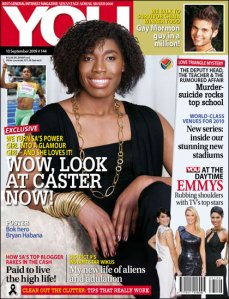
semenya new lookGiven all Semenya has endured, I can’t say I was surprised (albeit saddened) to see an article today titled, “Embattled track star Caster Semenya gets new coach, new look” which also featured the cover of You magazine (pictured here).

It also got me thinking…When a man outperforms his competition by a large margin—such as sprinter Usain Bolt for example—no one asks “Is he really a man?” No one says, “He is so fast, he might be a woman. He should be tested.” But when a woman wins by a lot—such as sprinter Caster Semenya—her sex is immediately questioned, “Is she really a woman?” This appears to be a clear example of marginalizing female athletic performance, homophobia, and sexism. Unfortunately Semenya’s ‘new’ look is not a new phenomenon for female athletes who have fallen under scrutiny as a result of outstanding sport performances.

when you win by a lot

Observation #1: The Bicycle Built for 2

It didn’t take long for me to log my first observation of the new academic year. I was out taking a bike ride and all of a sudden a 2 seated bicycle and its passengers passed me going the other way. I’ve seen many of these bikes over the years, but today for some reason I noticed something different. Those of you who’ve been reading this blog might find this ironic, but today I noticed that when 2 people ride a 2-seater….the woman is ALWAYS riding behind the man (see picture).bicycle_built_for_two_sm When I noticed this today, I shuffled back through past bikers and thought…I don’t recall ever seeing the woman riding first, and a man riding behind. I’ve seen 2 women, 2 men, an adult/child…but when the twosome is man/woman, the woman is always riding second. Is there some kind of physics, momentum, safety, or scientific explanation that I’m not aware of, that dictates why the woman rides in the second seat? Please enlighten me, I’ve never ridden one of these bikes, so perhaps I’m missing something? It appears to me as another inane example of outdated, status quo gender roles which place men in the forefront and women following behind and not in charge of steering their own destinies. The analogies and metaphors are endless…..

Has (Women’s) Tennis Gone to the Dogs?

The U.S. Open Tennis Tournament starts tomorrow. After reading “Pets Are the Portable Part of a Tennis Player’s Entourage” in the August 30, 2009 New York Times online, I winced internally. Even before reading the story, I thought to myself, “I bet this story is all about dogs owned by female professional tennis players.” I read the story waiting and hoping that just one male player with a furry canine tournament companion would be mentioned. Nada. So it left me with many questions.Tennis, Anyone_

Owning a dog is an equal opportunity activity, so why does it appear that only women players have dogs as part of their entourage? The NYT article offers some explanations that are predictable such as companionship, relieves boredom, dogs don’t care if you win or lose their tails always wag, and dogs calm nerves and ease stress to name a few. But the doggie gender gap in pro tennis seems odd to me.

Are male tennis players dog haters? Are the women pros more lonely on tour than the men, therefore travel with dogs to ease the solitary life of tennis travel? Neither of these explanations seem likely or realistic. Do male players in reality travel with dogs but this is not a “media worthy” story? What does it say if a male travels with a dog verses a female player? A dog is an appropriate companion for women but not males? If females have a doggie buddy does it make them appear more feminine? Therefore if a male player had a little Poodle or Yorkie, it might not be perceived as manly–would his competitive nature be called into question? But male players could have a Pitbull or German Shepard or even a Yellow Lab, but I get that traveling with a small dog is much easier and cost effective. Facetiousness aside, why are the dogs of female pro tennis players newsworthy on the eve of a Grand Slam? Is there no other news in women’s tennis? Does coverage of dogs marginalize female players’ athleticism? Does it make them appear less serious and more frivolous…likening them to celebutante Paris Hilton? Does it somehow further construct a brand of femininity that is marketable? What do you think?

Besides news that (women’s) tennis has gone to the dogs, be sure to keep your critical eye on how the media covers two players who have something in common–their parents! Kim Clijsters returns after a two year maternity leave and Roger Federer is a new father of twins. Which player will we hear more “parent talk” about and more discussion of how parenthood affects one’s tennis performance? Any guesses?

note: picture from Free Dog Wallpapers.

A Shirt for Girls?

twisted TweeOk, so school is about to start up and I’m feverishly trying to whittle down the “to do” list, therefore haven’t had as much time to blog. BUT….I saw this over Twitter and had to share it as the most ridiculous, sexualizing, exploitative “shirt” made specifically for infants and preschool girls I’ve seen in a long time—perhaps EV-ER! The maker of Twisted Twee is a woman and the advertising tag line for the shirt is “something for the evening!” I’m speechless.

Note: Imagine a similar trouser concept for boys that would be equally offensive…but I didn’t see that in Suzi Warren’s line.

Sex Testing “Idiocy”

Following South African Caster Semenya’s 800m win at the Track & Field (IAAF) World Championships, a storm of opinions and commentary erupted over her subsequent sex testing/gender verification.

Some of the best I’ve seen is The Nation piece written by Dave Zirin and Sherry Wolf, an MSNBC video exposing the “Twisted, Sexist, Racist, & Heteronormative” Track & Field History, and two blogs by After Atlanta (here and here).

One sport sociology colleague on Facebook asked pertaining to most of the existing media coverage…”Are we in the 1950’s?” As Zirin and Wolf write, this issue is a “minefield of sexism and homophobia”….but thankfully the critical perspective has emerged.

The IOC and (the Lack Of) Gender Equity

600px-Olympic_rings_square.svgI read two well written and illuminating pieces yesterday that outlined the many ways in which the International Olympic Committee (IOC) appears not to support female athletes and gender equity. I thought I would share them here in case you didn’t see them.

Under Rogge, women’s sports are getting short shrift in Olympics, by USA Columnist Christine Brennan.

To walk the walk about supporting women, IOC must pick softball for 2016, by Chicago Tribune reporter Philip Hersh

Multiple Perspectives About “The Injury Epidemic” Facing Female Athletes

Given the continuing discussion about injuries of female athletes, particularly ACL tears, I decided to revisit a blog piece I wrote before One Sport Voice was born.

kneeinjuryIn 2008, a controversial book—Michael Sokolove’s Warrior Girls: Protecting Our Daughters Against the Injury Epidemic in Women’s Sport—was released, along with a companion article which appeared in the May 11 issue of the New York Times Magazine. The premise of the book asserts that “[the] immutable facts of anatomy and physiology? cause girls to incur significantly more sport injuries (e.g., ACL tears, concussions) than their male counterparts, resulting in what Sokolove terms a female “injury epidemic?

As a response to the underlying premise (and purported facts) of Warrior Girls, the Tucker Center for Research on Girls & Women in Sport felt it necessary to provide a scholarly critique from relevant academic disciplines. The TC invited internationally recognized scholars from the U of Minnesota in Public Health, Sports Medicine, Sport Psychology and Sociology to read the book and respond independently. You can read all the pieces, including Sokolove’s detailed responses and rebuttals here. The intellectual exchange is very interesting as it is from multiple persons perspectives, not all of whom agree. I’m going to post my sociological critique below, with some added updated information and thoughts.

A Sociological Perspective on Warrior Girls
Let me begin by stating that sport injuries and sport injury prevention are very real and important issues—for both girls and boys. I am aware of the data which states female athletes are 8 times as likely as male athletes to tear an ACL. However, framing the issue of sport injuries as an inevitable biological difference based on the sex of the athlete is sensationalistic and irresponsible. First, an argument based primarily on biology and physiology altogether ignores that sport performance (and therefore injury) is also shaped by social forces such as coaches’ and parents’ beliefs about what it means to be a “female athlete?” Second, this sort of deterministic approach assumes that males, by definition, are naturally (physically) superior to females. In this framework, male athletes are the norm to which females are constantly compared, and any gender differences are therefore constructed as inherent female deficiencies. The consequence of such biology-is-destiny arguments? Professor Cheryl Cooky, Purdue University, sums it up best: “Concerns regarding the supposed biological limitations of the female body to withstand rigorous athletic competition have historically served to justify restricting girls’ and women’s access to sport”.

Though Sokolove does indicate that we should also be concerned about sport injuries males sustain, rarely, if ever, are books published devoted to the negative consequences of sport participation on the health and well-being of boys and men. Interestingly, a search for a similar book or article on the “epidemic” of male sport injuries yielded nothing, despite published research which indicates that NFL players’ life expectancy is 15-20 years lower than the general American male population and that many suffer ill effects from playing professional football, including obesity, heart disease, chronic pain and crippling arthritis. I prefer Mark Hyman’s blog and book Until It Hurts: Americas Obsession With Youth Sports, as both provide a more gender-balanced approach to youth sport injuries-including much discussion about “Tommy John” syndrome in boys’ baseball.

The anatomy-is-destiny perspective also ignores the reality that some female athletes are stronger, have better motor skills, and are more coordinated than some male athletes, and that risk for injury runs along a continuum, rather than a sex-determined binary. In the final analysis, males and females are more similar than they are different—both compete in sports and both get injured in a variety of sports and physical activities. As a result, concerns relating to all the correlates of sport injury, social and psychological as well as biological and physiological, need to be given equal consideration.

Women Leaders in the WNBA: Gaining Ground or Walking Onto the Glass Cliff?

The Institute for Diversity and Ethics in Sport (TIDES) just released the 2009 Race and Gender Report Card for the WNBA. The WNBA is the only professional league to get an “A+” for both race and gender two years in a row, a feat that remains elusive to any other professional league.

In terms of gender here are some highlights:
+ In 2008, women made gains in terms of percentage as head and coaches, team vice presidents, senior administrators and professional administrators, but lost ground slightly in the League Office. In the 2009 season update, at the beginning of the season, women gained further ground with a 10% increase as head
coaches (46%), a 4% point increase as general managers (to 58%) and a 10% increase as CEO/President (to 43%).
+ Donna Orender remains the only woman president of a professional sports league.
+ The number of women in the CEO/Presidents role for WNBA teams increased from four to five at the start of the 2008 season, and from five to six in 2009.

The TIDES report ushers in good news for women leaders and the WNBA, during a summer in which the floundering economy has taken its toll on the league. The numbers are heartening, but after just reading a book chapter about the “glass cliff” for women in organizations, it left me wondering if the increase of women in all positions of power in the WNBA might not be all positive.

glasscliff_no titleMost everyone is familiar with the glass ceiling metaphor commonly used to describe the often subtle and unseen social-structural gendered barriers that prevent women from reaching the highest echelons of corporate leadership.

The glass cliff is a similar metaphor used to describe the phenomenon of women’s appointments to precarious leadership positions. The glass cliff illuminates the stress experienced by women who have made it through the glass ceiling (i.e., Head Coaches, CEOs, Presidents of WNBA teams) and find themselves in a more vulnerable and precarious position than their male counterparts. Women on the glass cliff often fight an uphill battle for success, without the support, information and resources needed to effectively execute the job.

Researchers have recently uncovered that when organizations are in crisis and have a high risk for failure, women are more often appointed to positions of leadership. Two explanations are offered: 1) women are perceived as particularly well-suited to manage the crisis, or 2) women are appointed to glass cliff positions because those who appoint them want to protect men (or expose women).

Are women being appointed to more positions of power in the WNBA, so failure of the league (if it happens…and I hope it doesn’t!) can in turn be attributed to women?

[photo credit to liikennevalo and knowhr.com]

Stilettos & Heels: “Helping” Female Athletes Transition to the Real World

Today the NCAA Double-A-Zone blog posted information on two programs that are helping prepare female student-athletes for the real world.

cinderella_nikeKansas’ “Hoop 2 Heels” and Oklahoma’s “Sooner Stilettos” aim to help female athletes transition from athletics to the professional world by learning etiquette, networking with women in positions of power, developing skills, and building resumes. The programs also provide female role models for the student-athletes. Fantastic idea! Access and exposure to female role models in positions of leadership and power is particularly important to girls and young women, as they have fewer such role models in their lives than do their male counterparts—and this is especially true in sport contexts. Such programs may also help females more successfully navigate the confusing (and gendered) professional labyrinth, and make the process of participating, gaining access, and reaching the highest levels of power a bit more obtainable.

Unfortunately, the chosen names of both of the programs only serve to reinforce traditional notions of femininity which continue to limit females in all contexts. Being a successful professional in the real world has nothing to do with donning heels and conforming to feminine norms. In fact, based on the data women who act in traditionally feminine ways (i.e., nurturing, warm, caring) are perceived as less competent.

Perhaps renaming the programs “From Basketballs to Briefcases” would be more appropriate and helpful.

The uncertain, vulnerable, scandal-prone land of [women’s] sports??

To cap off a week of weird sport media, I’ll end the week with this piece on ESPN.com that discusses the “state of uncertainty for women’s sports.”

The author documents the “state” of women’s sport, which in turn will influence the opinion of some, and nudge others to believe that the “historic meltdown of women’s sports” is imminent.

The problem is the journalist does not document similar “uncertainties” in mens’ sport such as lack of parity in leagues, changes in personnel, controversies, retirements, changes in sponsorship and endorsements, “bad” seasons, teams that don’t make money, mismanagement, lack of ‘star’ power, and financial difficulties driven by a bad economy which are hurting ALL leagues and male and female athletes alike! The sensationalist and inflammatory language that is used also helps inflame the sensibilities of those who already think women’s sports are unwatchable and not consumable, and potentially drive away fence-sitters. Who wants to attend or watch something that is about to crumble? Do you buy an plane ticket of an airline that just had a catastrophic crash? NO! You pick another airline.

plane-belt-extender-aHe goes on to write that, “The modern women’s pro sports movement has proven dangerously vulnerable to market conditions and scandal.” Is this to say that men’s sports are not prone to the same? I haven’t seen a similar piece on men’s sports….anyone? For everyone out there who believes in women’s sport…keep buying those tickets, the women’s sport plane is not likely to crash anymore than the mens’, both might be on a steep decent, but buckle up and ride it out.

UPDATE: In fact some argue the “WNBA: Not Just a Punch Line Anymore”