Latest “Women in Intercollegiate Sport” Report Now Available

The most recent version of Acosta & Carpenter’s longitudinal (33 years!) research on Women in Intercollegiate Sport is now available on their website. Some good news highlights:

  • 42.6% of women’s teams are coached by a female head coach, a number that has remained stable over the last four years
  • HIGHEST EVER number of paid assistant coaches of women’s teams, 57.6% which are female
  • HIGHEST EVER number (n= 12,702) of females employed in intercollegiate athletics

Given that basketball is the most popular collegiate sport acording to Acosta & Carpenter, and it is March Madness, you can also download the most recent Academic Progress/Graduation Success Rate Study of Division I NCAA Women’s and Men’s Basketball Tournament Teams

Director of The Institute of Diversity and Ethics in Sport (TIDES), Richard Lapchick states in the report, “Nineteen women’s tournament teams had a 100 percent graduation rate for their teams. Women do much better academically than men. Furthermore, the academic success gap between African‐American and white women’s basketball student‐athletes is smaller, although still significant, than between African‐American and white men’s basketball student‐athletes.”

Keeping it real with some data during March Madness…

The (Men’s) Bracket

In my last blog, I surmised that when the bracket for the Men’s NCAA basketball tournament was released, it would not be labeled as “The Men’s” NCAA Tournament Bracket 2010, unlike the women’s bracket.  Sure enough…I was right. To see “the bracket” click here.

(Women’s) ESPN Basketball Bracket Shows

It’s time for March Madness! I love this time of year! I just watched the ESPN selection and the ESPN-U follow up show for the women. Here is the bracket in case you want to download it. I have some cheers and jeers.

Cheers!

  • I was excited the online ESPN bracket didn’t have the qualifying “Women’s” in front of  NCAA Tournament Bracket 2010.
  • ESPN did a great feature on Baylor’s Brittney Griner, that focused primarily on her SKILLS, numerous ways she can dunk, and how her ability and talent are setting a new standards of excellence for women’s basketball.
  • I loved the fact there were four very qualified women–Doris Burke, Rebecca Lobo, Kara Lawson, and Carolyn Peck--hosting the shows, along with Trey Wingo.

Jeers!

  • The .pdf version of the ESPN bracket however, was labeled as the “Women’s”. I will bet my 2010-11 pay cut that when the men’s bracket is complete, there will be no “Men’s” label on any bracket. Why? Because the men’s bracket is the real bracket, and the women’s bracket must be defined and qualified as the lesser bracket by labeling it the “women’s”. This is a common pattern of marginalizing women’s sports documented over time by sport media scholars. Another example is the NBA and WNBA.
  • The presence of the female sport commentators was undermined both at the very beginning and end of the ESPN-U show by the following comments:

a. At the opening of the follow-up show on ESPN U, after Trey Wingo (seated in the middle, with 2 women on each side) introduced each of his four co-hosts, Carolyn Peck made a comment that the ensemble was like Charlie’s Angels. To that end Wingo asked if that made him “Charlie”, and the banter went on for another 20 seconds with the women confirming that his wan indeed Charlie and they were the Angels.

b. At the end of the follow-up show on ESPN U, as Trey Wingo was signing off and repeated all the names of his female co-hosts, his very last comment was “Look at Doris’ shoes, she went shopping!” and then the camera cut out.

Why is this problematic? Because both comments undermine the credibility of highly qualified and experienced female sport media journalists by focusing on highly feminine roles and symbols of femininity.  Given these four women are clear statistical minorities in their field, they are under a constant barrage of scrutiny their male colleagues do not have to endure. They also have to look feminine enough so they do not feed the flame of enduring homophobia in women’s basketball.

Stay tuned for more March Madness!

The “Best” of 2009 and the State of Girls & Women in Sports

As 2009 comes to an end, there are some trends for those who care about sports–particularly sports for females–that you should keep an eye on in the months to come. Many groups and organizations that have been cornerstones of advocacy, programming, outreach and research for girls and women in sports are in trouble or on the rumored brink of existing no more.  Yes, girls and women in sports have made major advances in participation in the last 35+ years, but gender equity has yet to be achieved, we now have fewer females in positions of power in sport leadership, and sportswomen are constantly under attack. Some stories from the past year put the fact that fighting for gender equity in participation, leadership, and media coverage, to name a few, are not issues of the past.

Under what criteria do organizations decide to shut down or “put out” important programs that make a difference in the lives of sporting girls and women? Who decides what is “out” and what is included?  Who is left out, and who continues to play, lead, and enjoy the benefits of sports, and be portrayed in what ways by the media?  What constitutes “A Real Life Out Clause?” This is real life and the consequences of the decisions of those in positions of power will continue to shape the future of sport for females in 2010 and beyond.

Consider the following, some of these topics I’ve written about in previous blogs, some I have not:

The Melpomene Institute for Women’s Health Research is struggling to survive in this economy.

The National Association for Girls and Women in Sport (NAGWS) “strives to be one of the premiere organizations dedicated to advocacy, education and the promotion of girls and women in sport”. There were rumors this year that AAHPERD, the parent organization of NAGWS, was discussing whether or not to keep or disband NAGWS. So far it appears it has survived.

It Takes a Team (ITAT) is being discontinued as a programming and outreach arm of the Women’s Sport Foundation. ITAT’s purpose was to “address LGBT issues in high school and college athletics… and make sport teams safe and respectful for all athletes regardless of their sexual orientation or gender identity”. To read more about  ITAT ‘s “outing” go to former ITAT Director Pat Griffin’s blog post. Be sure the program is not being eliminated because homophobia in sports has been eliminated and is no longer an issue. Homophobia still exists and affects all athletes, coaches, administrators and those involved in sports.

The International Olympic Committee voted not to allow and include ski jumping for females, and endures as a sexist organization.

ESPN sports journalist Erin Andrews, one of the few in the profession, endured a terrible event where she was stalked and sexually harassed. Sportswomen also continue to be sexualized or erased in all types of media-print, broadcast and social.

In 2009 major “newsworthy” stories in women’s sport included “girls behaving badly” such as “extraneous and loud grunting” by one WTA player, a verbal attack on a line judge by another, and”overly aggressive” play by a collegiate soccer player, and the drunk driving of a WNBA MVP …not reports of stellar athleticism. Lest we not forget the obsession of the sex verification of runner Caster Semenya…which only came about because she was FAST, really fast.

Early last spring, when Tennesee Head Women’s Basketball Coach Pat Summitt won her 1,000th game, and Auriemma’s UConn Huskies won another national championship many speculated if they should coach men…the obvious pinnacle of any coach’s career. Interestingly, but perhaps not surprising, Summitt did NOT appear in Sports Illustrated “Coaches of the Decade“, but Auriemma did.

The WNBA lost a team, the Sacramento Monarchs, and another very successful team the Detroit Shock moved to Tulsa. I fear the WNBA is teetering on the brink of collapse in 2010, I hope I’m wrong. The WNBA now has 10 teams.

With 10 teams, The Lingerie Football League debuted its inaugural season in 2009 in cities across the US. According to the LFL website, the mission of the LFL includes: “the LFL will offer the ultimate fan experience providing unyielding access to players, teams and game action.” I fear the LFL will thrive and survive, I hope I’m wrong.

Women’s collegiate sports will never achieve gender equity unless real reform occurs unilaterally at the highest administrative level of institutions of higher learning. This was a clear message of the Knight Commission Report on Intercollegiate Athletics released in late 2009.

Earlier this year I critiqued a piece on ESPN.com titled The State of Uncertainty of Women’s Sports. I’m not certain if there is stability or uncertainty or both pertaining to women’s sports. What I do know, and these stories above (and many others not included here) provide evidence, that the work for those who care about sports for females is never done. We must work together to ensure girls and women in sports are not left out, or pushed out.

Stay tuned in 2010 for more information, and certainly more critiques, of these important issues. I’d also encourage you to visit the Women Talk Sports Network and read blogs by colleagues who also write about these issues here, here, here, here, here, and here.

Other WomenTalkSports posts of “Best of ’09”:

A Whole Lot of Head-Shaking Sport News

I’ve purposely stayed out of commenting about Tiger Woods. It’s just low hanging fruit. What is left to say? But I will say the most interesting thing to me is that everyone is shocked that a golfer could behave so badly–especially Tiger Woods.  Sadly, Woods is yet another example of elite male athletes behaving badly and thinking they are above acting in responsible or moral ways. When one constructs his squeaky clean, family man image on a house of cards, it will eventually fall down.

Speaking of men behaving badly….In youth sport, some Canadian hockey dads were arrested in a hotel bar for “disorderly conduct, resisting arrest and obstructing governmental administration” during which one pulled down his pants. They were there for youth hockey tournament in which their sons were playing. And we question if professional athletes should be role models?

On another note, I found NBA commissioner David Stern’s comments about the likelihood of women eventually playing in the NBA within 10 years paternalistic. Many females in the basketball world have long believed women would and can play with men at the highest levels, but when a male validates this fact…then it must be true! Many of the NBA players have also commented, including LeBron James who referred to the WNBA players as “girls”. Given WNBA franchise Sacramento Monarchs will no longer exist, perhaps the NBA will be one of the only viable options of employment for players and coaches.

To round out sport news this week, Danica Patrick will race in the NASCAR series. Evidently this is good for NASCAR as Patrick’s sex appeal (not skill) will likely boost sagging attendance.

Things That Make You Go Hmmmm…More on Social Media & Women’s Sport

Following the  Tucker Center lecture and new blog about the impact of social media and women’s sport, it didn’t take too long for me to be in the middle of a real life example. Life works in ironic ways sometimes, doesn’t it? This example is meant to continue the conversation about this emerging and important topic.

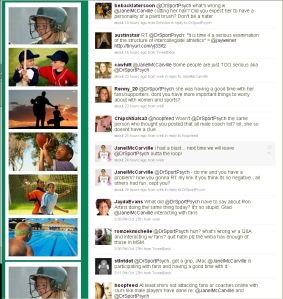
9uwom0322w.lOn Tuesday I was at my computer and looked over the TweetDeck and saw that WNBA player Janel McCarville was live on her UStream channel JMACTV. I’d heard about Candace Parker using UStream but hadn’t checked it out yet, so clicked on the link and….ta dah!…there was Janel. As a Minnesotan, two-time Gopher Alum and now Gopher faculty, huge fan of women’s basketball, and advocate/scholar of women’s sport, I’ve been a long time fan of Janel McCarville (no hate Janel, only love!). Who can forget the Whalen/McCarville dynasty in The Barn!

Janel !I thought, “This is really cool… instant access to an elite female athlete“, as I watched her looking at and responding to the comments and questions from the 60+ fans watching her. I shouted through my office door to my two graduate students to “check this out”. Then I took a harder look and wrinkled my brow, “Is she in the bathroom?” I asked them, “and is she really cutting her own hair?” (see screen shot)  Somehow I was a bit disturbed by this. I immediately wasn’t so sure this was cool anymore—or good for women’s sports. So given this subject has been top of mind, I tweeted about it—twice (see screen shot below).mccarville tweets

I continued to watch for about 10mns, and then shut down for the day. I continued to think about it over the next day or so.  In the course of “doing my warm up activities” for the day (aka surfing), I looked at my @ replies on Twitter and saw that my tweets had incited quite a bit of outrage, and a direct response from Janel herself! (see screen shot right, it will enlarge if you click on it).mccarville tweet responses The tone of the responses was “lighten up, this is just silly and fun and everyone but YOU thinks this is great”. Fair enough. I responded to Janel via Twitter:  “@JanelMcCarville No anger, just continuing conversation re: women’s sport & social media, both pro/con. See http://bit.ly/352s8T“. But I felt badly for criticizing her and it bothered me.

I learned a few valuable lessons which may be instructive as we all move forward and think about how to use social media effectively to positively promote women’s sports.

First, if social media is truly a two-way conversation, then I should of phrased my tweet “What is your opinion about @JanelMcCarville’s UStream videocast?”

Second, attacking people on Twitter is just in poor taste and not classy. My apologies Janel. This has played out for KC Chiefs NFL player Larry Johnson this week, as he is paying the price literally and in the media and  for using a homophobic slur. It will continue to occur with increased frequency as social media becomes part of the way we communicate.

Third, shortly thereafter I read a great piece by Q McCall of www.swishappeal.com on Feministing.com titled,  Is there a “feminist responsibility” to support women’s sports? It put into context some of the guilt I felt. Why was I attacking a female athlete?  I’m supposed to support women’s sport. But on the other hand, as a feminist, scholar, and advocate of women’s sport  I often feel I have the responsibility to wave the red flag and point out when I see something that may not be a “good thing”.  Perhaps my role is to raise the issue, provide an alternative viewpoint, and promote respectful discussion.

It also got me thinking about where female athletes and women’s sport might be headed in terms of social media. If everyone  “loves it” (all 66 viewers)—is this our new model of promoting women’s sport? Is that what fans really want to see? Is this how fans want to interact with athletes? Where is the line between “good access” and access that, to borrow from C + C Music Factory,  “Makes You go Hmmmm”? As was pointed out to me,  Ron Artest of the LA Lakers, got his hair cut that same day…which garnered media attention. But if the men do it, should the women follow? Should we always be trying to emulate our male counterparts? (I’m not suggesting that is why Janel chose to UStream, she’d have to tell us the inspiration). Is it possible male athletes use social media differently because of disparate patterns of traditional media coverage? What are the similar and different ways elite male and female athletes use social media? How can female athletes take control and use social media in positive ways to combat sexism, inequalities, and disparities that are well documented in sport contexts? Is this a responsibility they should bear? In conclusion, I highlight Janel not to criticize or judge, but to provide an exemplar real-life issue to promote discussion about social media and women’s sports.

I don’t have the answer, only a lot of questions. What do you think?

Weekend Gender Observations

Notre Dame Football3This past weekend I traveled back to Notre Dame (ND) for the Michigan State football game. I go back every other year to catch a game and see former colleagues. While I was there I observed a few things I had to share related to how females are marginalized and gender is (re)produced in subtle and not to subtle ways. Here are the Top 5:

1. On Friday morning I played golf at the beautiful links style ND Warren Golf Course. When I worked at ND I would decide to golf after work and show up at the course and be assigned a tee time with a group that had room for one more. Mostly I played with all men. As we stood on the tee box, I would invariable get “advice” from one or more of the men on how to play, how to hit a drive etc….They would tee off first, and then we’d go up to the “Ladies Tees” where I would hit. When I play frequnetly I can hit a 200 yard drive which often surpasses some of the mens’ drives. After that I didn’t get any more advice. I wondered, do men give other men advice on the first tee? Why do men feel compelled to give females paternalistic advice on how to play golf when they have no idea how skilled she may or may not be?

2. One of the traditions of ND football is the Friday night pep rally. While at the pep rally, a distinguished alum and former NFL player was challenging the crowd to cheer loudly for the Irish. He said he was told to keep it “PC”. He told the crowd they should stand the whole game to show support. He then told the players to be tough and not let Michigan State control the game in “their house.” He said if the players wanted to be weak and soft he told them, “You should go to school across the street” (meaning attend the all-women’s sister school St. Mary’s College). To my surprise, a few people in the crowd booed him.

3. While wandering around campus I came across the 2008-09 ND men’s & women’s basketball schedule posters (see picture). 2008-09 nd posters Given the research on portrayals of female athletes we have conducted in the Tucker Center, I noticed immediately that ALL the male athletes were in uniform, in action, and on the court. Some of the female athletes were in uniform, in action, and on the court but the dominant image was the “team shot.” These two posters convey very different messages about athletic competence.

4. On my way home I was checking Facebook and email on my phone when I saw a Facebook post that read: “Eagirls v. New Orleans“…meaning the Eagles were playing the New Orleans Saints. This person felt the Eagles were not playing well, which meant they were playing like girls.

5. Last but not least and related to #1 above…I wandered into an airport book store to find a new book to read on the way home. I came across a book written by man titled, Act Like a Lady, Think Like a Man. I was curious so I picked it up. I’d encourage you to take a look at the table of contents, depending on your perspective you’ll find it infuriating, entertaining or informative.

I think these example speak for themselves. Comments?

A strange day in the world of sport media

You know how people claim “bad things happen in threes” well after the last 24 hours of things I’ve seen and read in the sport media, I believe it!

1. “The Erin Andrews Peep Show” which if you haven’t heard about by now, then you’re not reading or watching the sport media (To read about what happened and the critical analysis “it” go to the Sports, Media, & Society blog, After Atlanta blog, or a post on Feministing.com titled “A long History of Objectifying Erin Andrews”.) Unfortunately as After Atlanta points out, nearly 20 years ago we had the Lisa Olson “incident” in the Patriots’ locker room, which documents a long history of sexual harassment and objectification of female sport journalists who dare to cover and/or write about male athletes. What I found almost as irksome is the public’s reaction to USA Today sport columnist Christine Brennan’s tweets (@cbrennansports) about the issue in which she said female sport journalists shouldn’t “play to the frat boys” but write or respond as if she were talking to a “12 year old girl sitting on her couch.” Brennan’s remarks were misconstrued and she herself was called “sexist”. Anyone who knows or has followed Christine Brennan knows this is ridiculous! But on the flip side, as Marie Hardin (one of the leading experts on media & gender) points out, female sport journalists in her research often play the blame game when a female colleague is discriminated against. However, which ever side you fall, I think much of the public response to Brennan was yet another example of the sanctioning of female sport journalists…in part, the the traffic over both these issues crashed the server at Women Talk Sports! Even that is sad…that BAD and icky news about women’s sport and female sport journalists have people searching those terms and THEN click upon Women Talk Sports.

2. Then I read on the @womentalksports Twitter an unedited USOC headline: “Can an Olympic athlete be a pimp?” The first line of the story reads, “A lot of women will need to have a lot of sex with a lot of men to get Logan Campbell to the 2012 Olympic Games.Yes, you read that right. Campbell, to cut a long story short, is a New Zealand taekwondo athlete who has opened a brothel to finance his ambition of winning an Olympic medal in London…He has more than a dozen women handing over half their earnings to him. It is, in his words, ‘a good moneymaking industry.’ ” I think this story speaks for itself, but the most disturbing part as it pertains to sport media is that the story was ON THE OFFICIAL WEBSITE OF THE U.S. OLYMPIC COMMITTEE.

3. And to round out the trifecta of sexist sport stories, an article about Bernadette Locke Mattox one of only three women in NCAA history to have coached in Division I men’s basketball. “Cool!”, I thought given my research on the dearth of female coaches at all levels….and then I read it. Rick Pitino hired Mattox because “he needed a woman to burnish the image of Kentucky basketball and to emphasize academics, career planning and integrity,” and the assistants reported she smelled good….but “she was just one of the guys.” You leave the article feeling like Pitino hired a pseudo-mother for “his boys” and her pioneering position and obvious skill as a coach were lost. This type of blatant gender bias in sport media is one of the many contributing factors as to why coaching men remains off limits to women at all levels (~2-4% of boys and men are coached by females at every level) and female coaches are routinely perceived as less competent than their male counterparts according to research.

Tomorrow is a new day….

A Sign of Things to Come?: Recent Departures in Women’s Basketball

I’ve read about three recent occurrences that have me thinking. While two may be related, all three may be a sign of things to come. departuresI’m talking about the recent departures of two male WNBA Head Coaches “to pursue possibilities in the NBA” and the second-ever early departure of Rutger’s Epiphanny Prince to “play basketball professionally in Europe before entering the 2010 W.N.B.A. draft” (Schuye LaRue was the first-ever woman to leave early from Virginia after her sophomore year in 2001 to go play abroad before getting drafted in the second round by the Los Angeles Sparks in 2003…thanks @hoopfeed!)

Successful Bill Laimbeer left the Detroit Shock after three games, and the not so successful Don Zierden left the Minnesota Lynx three days before their home opener to return to coaching in the NBA. While WNBA league officials and the departing coaches were assuring fans their departures were not a sign of trouble for the league, I’m not so convinced. I hope I’m wrong. What it does signal is that despite your success as a male coach in the WNBA, you can still get “called up” or return to the NBA. Would a successful—or better yet an unsuccessful—female coach ever get the same call? (maybe if your name is Pat Summitt, but I’m pretty sure that one’s gender is not a predictor of effective coaching so in theory many women should get said call)

As for Prince forgoing her senior year of ball at Rutgers to play professionally…One one hand, why not go and start making money immediately?—males have been doing it for years as has been pointed out. Prince states she “plans to buy her mother a house and support an A.A.U. team in Brooklyn”, so the move seems to be primarily financially motivated. On the other hand now that the seal is broken, will droves of other young women follow suit maybe never to return to finish their degrees? (and I’m not saying Prince won’t finish, but highlighting the possibility). Is this a trend we want female athletes to perpetuate? In essence, Prince’s move is no different than those of Laimbeer or Zierden….all three are leaving one basketball team, to pursue what is perceived as a better, bigger, and more lucrative opportunity with another team.

I’m not sure if this collective trend signals a sign of the times or is a sign of things to come….or both. And if it is of things to come….what “things” are we really talking about?

Update: To read more about various perspectives about Laimbeer click here or here.

To read more about what Gina Auriemma says about Prince’s departure, click here or read Altavilla’s blog. The NY Times also weighs in with an article titled “She’s Turning Pro, but Is It Progress?”

Does Sex Sell Women’s Sport?

I’ve been wanting to write a blog about this topic for awhile and a recent interview given by my colleague and the Director of the Tucker Center for Research on Girls & Women in Sport Professor Mary Jo Kane on the Edge of Sports Radio with Dave Zirin provided me with a perfect opportunity!

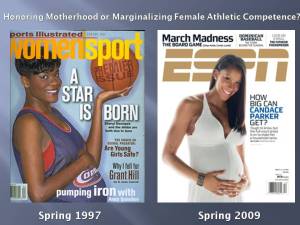
In the interview with Zirin she discusses research, conducted with Heather Maxwell (Ph.D.), in which their findings refute the idea that sex sells women’s sports. Kane also discusses how the notion of “sex sells” is related to depictions of motherhood and female athletes—like the magazine covers of Sheryl Swoopes and Candace Parker pictured here, homophobia and Pat Griffin’s idea of The Glass Closet, and her thoughts on the Women’s Final Four sport media coverage. (Note: Motherhood and elite female athletes is a popular blog topic lately..see Maria Hardin’s blog and the Pretty Tough blog)Swoopes and Parker_pregnant

I also think Kane’s interview helps us think through why some female athletes feel it is important to “have it all” (i.e., be sexy, feminine, AND athletic)…which I’ve touched upon in a previous blog about social media.

The interview is less than 5 minutes and well worth your while to hear one of the leading experts on sport media, Title IX, gender, and women’s sports talk critically and share cutting edge research. In the end, as Zirin says, “Sex sells sex“. Sex does NOT sell women’s sports.