 There seems to be much discussion over Twitter and how it might be “the answer” to successfully marketing and promoting women’s sports. Jayda Evans (Seattle Times columnist & Twitter-er) wrote about it, the Women’s Professional Soccer League is using it, and Megan Hueter, Co-founder of Women Talk Sports, has two recent blogs about the importance of social media for women’s sport (A recent blog is about Twitter and an earlier blog was about Facebook). I responded to Megan’s blog, and she responded back (scroll down on her blog about Facebook to see our exchange). I enjoyed this dialogue and have been thinking about this issue ever since.
I get that social media is a platform to market women’s sports in a saturated market, and it is accessible, current, relevant, provides athlete-generated content etc…I got it. I love social media, really I do, so this is not a critique of social media or those that love it, promote it, and live for it. I have a Blog (obviously), a Facebook page, am connected to colleagues through LinkedIn, and recently conquered my Twitter fascination. However, even with my love for social media I’m reluctant to make claims about the effectiveness of it in promoting female athletes and women’s sports. It is the researcher in me—I’m critical and skeptical until I see the proof (i.e., empirical data).
I have seen ZERO research that demonstrates if, and how, social media tangibly and effectively promotes and markets women’s sports. I queried one of our very smart graduate students who is immersed in this research, and she didn’t know of any either. We will stand corrected if it exists. Just because everyone is all atwitter about Twitter doesn’t mean it “works” or will “save” women’s sports.
 Here is what we generally DO know about Twitter and sport:
1. Twitter exists and is rapidly growing in popularity
2. Some people, but not many (~5% of the population), are currently using Twitter
3. Some professional athletes are included in that 5%
4. Many professional sport leagues have a Twitter presence
Here is the $1,000,000 question: Has Twitter lead to an increase in—attendance, ticket sales, merchandise sales, sponsorships, media coverage in mainstream sport media, number of teams in women’s professional leagues, or any measurable interest in or consumption of women’s sports? Right now, Twitter is a good listening tool and provides a way to listen to brand champions of women’s sport (i.e., the core, loyal consumer). But other than that, show me the data. It might be doing some good, but has anyone thought about the flip side?…. that social media might not be good for female athletes or women’s sports? So how might Twitter and other social media (including those not invented yet) be “bad” you ask? Well here are a few things to ponder.
It is a well known fact that female athletes receive only 6-8% of coverage in traditional sport media. This statistic has remained consistent over the last 20 years, despite increases in girls and women participation in sport. When female athletes are covered in traditional sport media, they are often portrayed in ways that marginalize or minimize athletic competence and highlight sexy, hetero, feminine aspects of the female body or identity.
A perfect example of this is the March 23, 2009 ESPN magazine cover of pregnant WNBA Rookie of the Year Candace Parker in which the opening sentence discusses that Parker “…is beautiful. Breathtaking, really, with flawless skin, endless legs and a C cup…” If you want a thorough, and I think well done, sociological critique of this article read this blog which appears in Contexts. I did a little mini investigation after I saw the Parker cover and found: In five years (2004- March 2009) females athletes have appeared on 5 of 168 ESPN covers (3.6%…less than the average) and when they do….well see for yourself.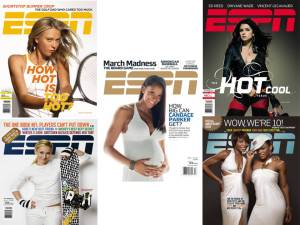
While social media is changing the role of sport journalists, sport media scholar Marie Hardin argues this is both good an bad. I add it is good if it changes coverage patterns of female athletes, but I would add it is bad if it becomes expected that female athletes have to be partially or largely responsible for promoting themselves as well-rounded “girls next door” through social media as a way to “save” their leagues or bolster their own “brand”. Why isn’t it just enough for Candace Parker to play basketball to the best of her abilities? The NBA doesn’t ask Kobe Bryant to be more than a great basketball player do they?
Could it be possible that social media, including Twitter, is just another means to replicate the ways in which traditional sport media marginalizes and sexualizes female athletes? Twitter’s existence does nothing to challenge the status quo or existing structural inequalities between men’s and women’s sports…especially since it is an “opt in” platform.
Another point to ponder: How are female athletes and professional leagues presenting themselves on Twitter? Stay tuned for results on cutting edge research two of our graduate students are just completing on this very question—this is cool stuff! In the meantime, I’ll give you one example that occurred on the 2009 WNBA draft day which caught my eye and highlights my previous point. I saved three (of many) Tweets written by draftees, the WNBA, and other attendees who were collectively discussing “how we look and what to wear” rather than “how we play” on Draft Day 2009. 
What everyone should do who cares about this issue and the cause of women’s sport, is think less about hyping social media and more about how social media can be used to create real social change and lead to sustainability (meaning…show me not only the data, but the $$$$) of women’s professional sport leagues…and more importantly, how can we prove and measure “success”?

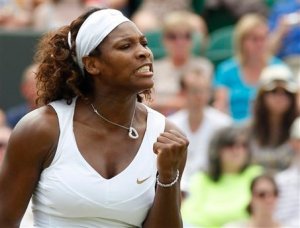 Using flattery and sham transparency (I know you’ll call me sexist, so I’ll do it first, but I’ll say it anyway) to buffer sexist (or racist, misogynistic, homophobic) remarks is a classic diffusing technique used by those who make them. A real “fan” would not make such remarks as research demonstrates that sexist remarks have negative implications for the target’s (i.e. Serena) well-being and can lead to self-objectification. A real fan, let alone a sportswriter, would not focus on Serena’s “back pack” no matter how big or small it is perceived to be, and no matter how much it is perceived to help or hinder her play. The problem here is that instead of focusing on Serena Williams’ play and accomplishment, Whitlock is trivializing both. Whitlock uses his personal views to prescribe what he thinks is “hot and attractive”, perpetuates a narrow conception of beauty, reinforces the idea that only “in shape” women are attractive, and in the end proclaims that only attractive female athletes are worthy of being watched during prime time TV on Centre Court.





 One Sport Voice