What Do Fans of Women’s Sport Want to See?

Leading up to the Winter Olympics in Vancouver the US Women’s National Hockey Team has been training here in Blaine, MN and going on tour to play exhibition games to prepare. I had the opportunity to support the team and watch two games over the winter break. While at the game I saw the program (Thanks to The Good Dr.!) and immediately felt my blood pressure rising. This program, which was being sold at both the games I attended, looks nothing like the team’s online media guide. The program starts out appropriately as you can see with the Team Roster picture. As you flip through the program, you see pictures of the team in “street clothes” and get a synopsis about “The Player” and “The Person” in the “Get To Know ‘Em” centerfold section (scroll down to see pictures of program pages). Why is this problematic?

For decades sport media researchers have demonstrated that female athletes (compared to their male counterparts) are much more likely to be pictured out of uniform, off the ice/court, and in poses that depict femininity and/or sexiness. Where are the pictures of the team IN THEIR UNIFORMS and IN ACTION? These women are some of the best female hockey players in the world!

Marketing the athlete-person duality of female athletes has become the default strategy for a majority of sport marketers in the last five years. Where did this strategy come from? Who decided this was the status quo? Is it based on research pertaining to what is effective in marketing female athletes and women’s sport? Is this what fans of women’s sport want to  see? I want to to see the evidence! Some of the evidence that I and colleagues have collected indicates that fans of women’s sports and female athletes attend because of the athleticism, not because the athletes are cute “girls next door” or look good in a sundress.

So here is my question: Are the “Get To Know ‘Em” pictures, what fans want to see or have fans been sold these images so they do not know any different?

My logic: If marketers continually pitch the athlete-person duality, this is what fans see and expect, and it becomes the norm, so fans think they like this approach. But what if consumers only saw images of female athletes IN ACTION, IN UNIFORM, DOING WHAT THEY DO BEST? Would that become the expected and the norm? I really want to know when and who decided that to successfully market elite female athletes that a “personal”/ human interest component has to be included. It is also not coincidental that a good portion of the “Team Tidbits” in the bottom picture below reinforce very feminine, traditional roles for women.

NOTE: In the Qwest Tour program, in which these 3 images were taken from,  I counted only 4 action shots in the entire 37 pages program.

RELATED NOTE: Do fans really want to see pictures of tennis player Venus Williams’ flesh-colored underwear? I would argue they do not, but when the media covers and makes it “newsworthy” then fans and general sport consumers are told this is important and begin to pay attention. I am wagering that more people know about V. Williams’ underwear than how she is playing in the Australian Open. Newsflash: female tennis players have been wearing “flesh colored” underwear for years. However, when the “flesh” color matches that of an African American skin tone it becomes international news.

US Women's National Hockey Team Roster page
US Women's National Hockey Team "Get to Know 'Em"
US National Women's Hockey Team Tidbits

Vonn isn’t “heavy” she’s a great athlete!

In the last week Austrian coaches claimed downhill skier and USA Olympian (and fellow Minnesotan!) Lindsay Vonn was heavy, which they said gives her a competitive advantage. Really? Are you sure she isn’t one of the best skiers because she is an amazing athlete who trains hard?

I was called by local WCCO TV reporter Heather Brown to comment on this issue. I didn’t know where to start, there were just so many angles of this story. Here are my thoughts:

1. From a sport psychology perspective, the Austrian coaches could of purposely leaked the comment to the media to distract Vonn’s attention away from optimal performance. That appears to have backfired, as Vonn responded as a mentally tough athlete would by choosing not to comment much and use it for fuel to further motivate her. Vonn’s response was that of a champion. She couldn’t control what was said, but the did control how she responded. Point Vonn!

2. From a sport media perspective, the comment about Vonn’s weight is yet another example of how the focus on female athlete’s appearance seems to be more important than her performance. Serena Williams is constantly being criticized for being “too big and muscular” and people seem confused as to how a woman so “big” can be so good. Yes we do hear comments about male athlete’s bodies, but it is rarely about appearance…it is about strength, power, speed. I doubt we will hear an Austrian coach discuss Bode Miller’s weight. When a female athlete dominates her sport and her body doesn’t conform to the traditional feminine norm,  she comes under surveillance. Think of South African sprinter Caster Semenya from this summer.

The Vonn comment is a bit unique because the coach said her “extra weight” gives her a competitive advantage. It reminded me of similar comments made about Danica Patrick, when opponents claimed she had a unfair competitive advantage because she weighed less than the males drivers.  The point is, comments about a female athlete’s weight is a way to minimize her performances, and “explain” why she excels rather than attributing winning to athleticism.

3. Lastly, the weight comment conveys to young girls and female athletes that emphasis is placed on what the body looks like, than what it can do. Constant media messages like the Vonn comment socializes girls and women into becoming obsessed on physical appearance, rather than on health, well-being, and optimal performance.

As head into the Vancouver Olympics keep a close eye on how the media constructs Lindsey Vonn as the poster girl for the team.

Note: to read the transcript from Brown’s piece click here

The “Best” of 2009 and the State of Girls & Women in Sports

As 2009 comes to an end, there are some trends for those who care about sports–particularly sports for females–that you should keep an eye on in the months to come. Many groups and organizations that have been cornerstones of advocacy, programming, outreach and research for girls and women in sports are in trouble or on the rumored brink of existing no more.  Yes, girls and women in sports have made major advances in participation in the last 35+ years, but gender equity has yet to be achieved, we now have fewer females in positions of power in sport leadership, and sportswomen are constantly under attack. Some stories from the past year put the fact that fighting for gender equity in participation, leadership, and media coverage, to name a few, are not issues of the past.

Under what criteria do organizations decide to shut down or “put out” important programs that make a difference in the lives of sporting girls and women? Who decides what is “out” and what is included?  Who is left out, and who continues to play, lead, and enjoy the benefits of sports, and be portrayed in what ways by the media?  What constitutes “A Real Life Out Clause?” This is real life and the consequences of the decisions of those in positions of power will continue to shape the future of sport for females in 2010 and beyond.

Consider the following, some of these topics I’ve written about in previous blogs, some I have not:

The Melpomene Institute for Women’s Health Research is struggling to survive in this economy.

The National Association for Girls and Women in Sport (NAGWS) “strives to be one of the premiere organizations dedicated to advocacy, education and the promotion of girls and women in sport”. There were rumors this year that AAHPERD, the parent organization of NAGWS, was discussing whether or not to keep or disband NAGWS. So far it appears it has survived.

It Takes a Team (ITAT) is being discontinued as a programming and outreach arm of the Women’s Sport Foundation. ITAT’s purpose was to “address LGBT issues in high school and college athletics… and make sport teams safe and respectful for all athletes regardless of their sexual orientation or gender identity”. To read more about  ITAT ‘s “outing” go to former ITAT Director Pat Griffin’s blog post. Be sure the program is not being eliminated because homophobia in sports has been eliminated and is no longer an issue. Homophobia still exists and affects all athletes, coaches, administrators and those involved in sports.

The International Olympic Committee voted not to allow and include ski jumping for females, and endures as a sexist organization.

ESPN sports journalist Erin Andrews, one of the few in the profession, endured a terrible event where she was stalked and sexually harassed. Sportswomen also continue to be sexualized or erased in all types of media-print, broadcast and social.

In 2009 major “newsworthy” stories in women’s sport included “girls behaving badly” such as “extraneous and loud grunting” by one WTA player, a verbal attack on a line judge by another, and”overly aggressive” play by a collegiate soccer player, and the drunk driving of a WNBA MVP …not reports of stellar athleticism. Lest we not forget the obsession of the sex verification of runner Caster Semenya…which only came about because she was FAST, really fast.

Early last spring, when Tennesee Head Women’s Basketball Coach Pat Summitt won her 1,000th game, and Auriemma’s UConn Huskies won another national championship many speculated if they should coach men…the obvious pinnacle of any coach’s career. Interestingly, but perhaps not surprising, Summitt did NOT appear in Sports Illustrated “Coaches of the Decade“, but Auriemma did.

The WNBA lost a team, the Sacramento Monarchs, and another very successful team the Detroit Shock moved to Tulsa. I fear the WNBA is teetering on the brink of collapse in 2010, I hope I’m wrong. The WNBA now has 10 teams.

With 10 teams, The Lingerie Football League debuted its inaugural season in 2009 in cities across the US. According to the LFL website, the mission of the LFL includes: “the LFL will offer the ultimate fan experience providing unyielding access to players, teams and game action.” I fear the LFL will thrive and survive, I hope I’m wrong.

Women’s collegiate sports will never achieve gender equity unless real reform occurs unilaterally at the highest administrative level of institutions of higher learning. This was a clear message of the Knight Commission Report on Intercollegiate Athletics released in late 2009.

Earlier this year I critiqued a piece on ESPN.com titled The State of Uncertainty of Women’s Sports. I’m not certain if there is stability or uncertainty or both pertaining to women’s sports. What I do know, and these stories above (and many others not included here) provide evidence, that the work for those who care about sports for females is never done. We must work together to ensure girls and women in sports are not left out, or pushed out.

Stay tuned in 2010 for more information, and certainly more critiques, of these important issues. I’d also encourage you to visit the Women Talk Sports Network and read blogs by colleagues who also write about these issues here, here, here, here, here, and here.

Other WomenTalkSports posts of “Best of ’09”:

Benchmarking Women’s Leadership

Since it is finals and I don’t have much brain power left after grading to come up with clever original blog material, I’m sharing links to information already out there you may not know about.

The White House Project, just released a new report title Benchmarking Women’s Leadership which can be downloaded for free by clicking here.

Related to women in sport leadership, a research topic of mine and which you can read more about within previous blog posts, see pages 101-112 of the report.

Speechless Over Serena

I just got word via the BBC that “Serena Williams has been fined and given a suspended three-year ban from the US Open for her tirade at a line judge”

I really hope this is a bad joke. Three years? That seems a bit harsh doesn’t it? Would a male players be fined and suspended the same amount? I think players who have tested positive for an illegal substance, say steroids, have been banned for less time!

What does this say about the intersections of class, race and gender in the game of tennis in the 21st century? Who plays and under what conditions? Who is punished (or not) and for what transgressions? Who decides, under what conditions, using what criteria to determine “major offence of aggravated behaviour”. I’m speechless.

Mother-Baby Workout Solution!

This morning I saw a segment on my local TV affiliate about a program called StrollerStrides, “a total fitness program for new moms that they can do with their babies”. The program seemed like a perfect physical activity solution for mothers with stroller-age children, and also solves many of the barriers to physical activity many women face due to afforadabilty, accessibility and availability.

StrollerStrides workouts are conducted by certified instructors in large indoor public spaces (mostly shopping malls in off hours) which cuts expensive gym memberships. Mothers can work out alongside the strollered child which cuts the need for childcare. It also provides  mothers with a social support system and affords the opportunity to get out of the house to a safe, warm space (this is key during Minnesota winters for those of you who don’t live here!) to get physical activity. The workout combines strength, flexibility and cardio components along with fun songs and activities that engage the children and keep their attention.

It also got me thinking what a better way to start a love of physical activity for infants! Researchers have proven time and again that parents are very important physical activity role models for their children. If parents are active and value and believe that being active is an important part of life, their children are more likely to be active. I also recently came across another resource from the Canadian Association for the Advancement of Women in Sport & Physical Activity, Mothers in Motion, a program “dedicated to physical activity promoters working with mothers of low socioeconomic status”.

Many women must overcome a host of barriers in order to be physically active, which is why females are less active than their male counterparts at all ages and within all types of physical activity. Assisting women in starting and sustaining physical activity can lead to a host of positive physical and mental health outcomes. You can also read more about Developing Physically Active Girls, a report I helped to co-author and produce in my role as the Associate Director of the Tucker Center for Research on Girls & Women in Sport.

Picture from StrollerStrides

Social Media for Female Athletes as Contested Terrain

imblanced scaleCurrently I’m at the North American Society for the Sociology of Sport (NASSS) in Ottawa. I’ve heard A LOT of great research and ideas that much head is spinning a bit.  I was in a session today that crystallized some thoughts about social media and women’s sports, and the dialogue that is occuring. Social media is a contested terrain-meaning that it is a site where struggle is occurring on many levels. Some of the issues that have arisen during the dialogue happening in many places (like here, here, and here) encompasses such questions as:  Who will control social media? Who decides? Is social media good or bad for women’s sports? I have some additional thoughts, albeit jumbled, I’ll add here to add to the conversation.

Social media is both good and bad, both positive and negative. It challenges and reproduces gender stereotypes. It allows female athletes and advocates of women’s sport to control the message and it is also a residual of traditional media (meaning social media has converged with traditional sport media…like ESPN channel and its social media correlate ESPN.com so therefore it really is not different). Social media is a space to promote women’s sport in the abasence of traditional media coverage and it is a site of unedited and unmediated backlash towards women’s sports. It is a powerful tool to promte women’s sports and also a tool that can hinder its progress.

Discussing social media in binary terms of good/bad erases the fact that women’s sports are forced to turn to and use social media as a way to promote themselves and their sport because of the lack of coverage in mainstream media. I think that is the bigger issue.  How can we tap into more progressive notions and mobilize ourselves to create social change–both in mainstream and social media.

However, this notion is predicated on the idea that everyone involved in women’s sports is on the same page. This is just not true. Diverse viewpoints  fosters rich dialogue and how issues are taken up varies,  for example: “Serena on the cover of ESPN magazine is beautiful” to “Serena is setting back women’s sport”.

Here is my question: Is it possible to create social change and challenge the system if we’re not all on the same page? Who’s page counts? Who decides?

What do you think?

Found! Pictures of REAL Female Coaches

DSC_7517In a previous blog I was lamenting about the scarcity of pictures of real female coaches, especially at the youth level. I’m pleased to report I found some! A photographer for the University of Minnesota’s College Education of Human Development Connect Magazine shot some GREAT pictures of females coaches for a story they ran recently on some of our research. To read the story “The Sporting Life: Research Helps Families Adjust to an Increase in Youth Athletics” and see the pictures of two great female coaches in action, on the field, and in coaching attire click here (and scroll down to the link below the picture that states “enlarge picture and launch slide show”).

Most remarkable is that in some of the pictures, Coach Kari Ornes is pictured coaching high school boys! Even though females coaching males at all levels of competition occurs about 2% of the time-you never see it. We need more pictures of this nature to be taken and portrayed in traditional and new media outlets. Both Kari and Julie are part of the We Coach advisory board and two exemplary female coaches!

Things That Make You Go Hmmmm…More on Social Media & Women’s Sport

Following the  Tucker Center lecture and new blog about the impact of social media and women’s sport, it didn’t take too long for me to be in the middle of a real life example. Life works in ironic ways sometimes, doesn’t it? This example is meant to continue the conversation about this emerging and important topic.

9uwom0322w.lOn Tuesday I was at my computer and looked over the TweetDeck and saw that WNBA player Janel McCarville was live on her UStream channel JMACTV. I’d heard about Candace Parker using UStream but hadn’t checked it out yet, so clicked on the link and….ta dah!…there was Janel. As a Minnesotan, two-time Gopher Alum and now Gopher faculty, huge fan of women’s basketball, and advocate/scholar of women’s sport, I’ve been a long time fan of Janel McCarville (no hate Janel, only love!). Who can forget the Whalen/McCarville dynasty in The Barn!

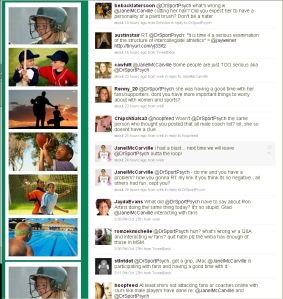
Janel !I thought, “This is really cool… instant access to an elite female athlete“, as I watched her looking at and responding to the comments and questions from the 60+ fans watching her. I shouted through my office door to my two graduate students to “check this out”. Then I took a harder look and wrinkled my brow, “Is she in the bathroom?” I asked them, “and is she really cutting her own hair?” (see screen shot)  Somehow I was a bit disturbed by this. I immediately wasn’t so sure this was cool anymore—or good for women’s sports. So given this subject has been top of mind, I tweeted about it—twice (see screen shot below).mccarville tweets

I continued to watch for about 10mns, and then shut down for the day. I continued to think about it over the next day or so.  In the course of “doing my warm up activities” for the day (aka surfing), I looked at my @ replies on Twitter and saw that my tweets had incited quite a bit of outrage, and a direct response from Janel herself! (see screen shot right, it will enlarge if you click on it).mccarville tweet responses The tone of the responses was “lighten up, this is just silly and fun and everyone but YOU thinks this is great”. Fair enough. I responded to Janel via Twitter:  “@JanelMcCarville No anger, just continuing conversation re: women’s sport & social media, both pro/con. See http://bit.ly/352s8T“. But I felt badly for criticizing her and it bothered me.

I learned a few valuable lessons which may be instructive as we all move forward and think about how to use social media effectively to positively promote women’s sports.

First, if social media is truly a two-way conversation, then I should of phrased my tweet “What is your opinion about @JanelMcCarville’s UStream videocast?”

Second, attacking people on Twitter is just in poor taste and not classy. My apologies Janel. This has played out for KC Chiefs NFL player Larry Johnson this week, as he is paying the price literally and in the media and  for using a homophobic slur. It will continue to occur with increased frequency as social media becomes part of the way we communicate.

Third, shortly thereafter I read a great piece by Q McCall of www.swishappeal.com on Feministing.com titled,  Is there a “feminist responsibility” to support women’s sports? It put into context some of the guilt I felt. Why was I attacking a female athlete?  I’m supposed to support women’s sport. But on the other hand, as a feminist, scholar, and advocate of women’s sport  I often feel I have the responsibility to wave the red flag and point out when I see something that may not be a “good thing”.  Perhaps my role is to raise the issue, provide an alternative viewpoint, and promote respectful discussion.

It also got me thinking about where female athletes and women’s sport might be headed in terms of social media. If everyone  “loves it” (all 66 viewers)—is this our new model of promoting women’s sport? Is that what fans really want to see? Is this how fans want to interact with athletes? Where is the line between “good access” and access that, to borrow from C + C Music Factory,  “Makes You go Hmmmm”? As was pointed out to me,  Ron Artest of the LA Lakers, got his hair cut that same day…which garnered media attention. But if the men do it, should the women follow? Should we always be trying to emulate our male counterparts? (I’m not suggesting that is why Janel chose to UStream, she’d have to tell us the inspiration). Is it possible male athletes use social media differently because of disparate patterns of traditional media coverage? What are the similar and different ways elite male and female athletes use social media? How can female athletes take control and use social media in positive ways to combat sexism, inequalities, and disparities that are well documented in sport contexts? Is this a responsibility they should bear? In conclusion, I highlight Janel not to criticize or judge, but to provide an exemplar real-life issue to promote discussion about social media and women’s sports.

I don’t have the answer, only a lot of questions. What do you think?

Top 5 Take Aways: Social Media & Women’s Sports

Social Media Pic_iStock_000009648196XSmall

On Monday, October 19 I took part in the Tucker Center Distinguished Lecture Series on The Impact of Social Media on Women’s Sports-which you can view in its entirety here. There were so many great ideas  and critical thinking from so many perspectives that I’m still processing, but here are my Top 5 as of now.

1. Women’s sport marketing & promotions have always been viral and no one is really sure how to measure return on investment. Social media should be about building relationships and you can’t always measure the impact of relationship building.  (@DigitalMaxwell, Dr. Heather Maxwell)

2. The success of female sports journalists depends on the success of women’s sports, but half of female sport journalists surveyed don’t feel a responsibility to cover women’s sports. They don’t want to be pigeon-holed.(@mariahardinpsu, Dr. Marie Hardin)

3. Is it fair to place the burden of marketing & promoting women’s sports on the shoulders of the female athletes-especially those in “non-traditional” sports like ice hockey? Is this the new model we are left with as social media envelops traditional sport media (where female athletes get 6-8% of the coverage)? (@angelaruggiero, Angela Ruggiero, US Women’s National Ice Hockey Team)

4. Interest in women’s sport is being measured by “click throughs” in online editions of newspapers & websites. So if people don’t click on women’s sport stories, it is interpreted as “non interest”. Those who support women’s sports have to CLICK the stories that we can find!  (Rachel Blount, Sports Columnist, Star Tribune)

5. Time remains to take control of social media and use it effectively to grow women’s sports, but time is running out (Rachel Blount, Sports Columnist, Star Tribune)

If you watched it what were your thoughts?