Clarifying “The Myth About Exercise”

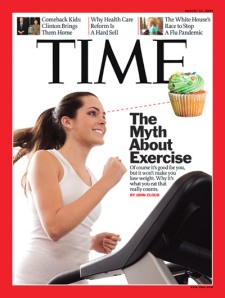
TIME Cover_myth about exercise Every Saturday I look forward to the TIME magazine in my mail. I know I can read it all online, but there is something satisfying about print media. As someone trained in sport science (aka, Kinesiology) this week’s cover story by John Cloud “The Myth About Exercise” intrigued me. After reading it, I was more than surprised, a bit irritated, and wondered if this wasn’t just more sensationalistic journalism. The premise of the article was based on “some recent studies” that found exercise does not help one lose weight or isn’t as important as we’ve been led to believe.

What?! Have we been lied to all these years? A friend who regularly works out read the article and promptly said, “THAT was depressing and made me never want to work out again.” I wondered how many others were thinking similar thoughts.

The TIME article, based in part on the findings of ONE clinical trial, found that in a group of 464 overweight women assigned to four conditions—women who exercised did not lose significantly more weight than those who did not exercise…and some women in each of the four conditions gained weight.

Dr. Timothy Church, Chair of Health Wisdom at LSU and lead author of the clinical trial, outlines the process of exactly how exercise might psychologically work against us:
1. exercise stimulates hunger
2. when we exercise we often “reward” ourselves with food [see my blog post about this issue in youth sport]
…or both. My astute friend mentioned previously, pointed out this premise assumes that those who don’t exercise don’t reward themselves with food.

Cloud offers an additional explanation based on another study with UK children he’d written about earlier this year
3. One might be more sedentary during non-exercise times than if one didn’t exercise at all

At first read, these findings and the TIME article may be perceived as a green light to bolster couch potato status, and only pay attention to what you eat–and this is dangerous. Exercise matters…but more importantly researchers have demonstrated movement matters!

Weight management is a simple energy equation: energy in (food) < energy out (exercise + energy expended daily to move about, live, & breathe) = maintain or lose weight.

If you take in more than you expend, you gain weight. Given that our metabolism slows 10% every decade (i.e., meaning you burn 10% less calories/energy), even if you ate exactly the same as you did as a teenager…you’d gain weight. True, exercise is only HALF of the equation, but a still needed half.

With billions of dollars tied up in the health and diet industry and new products and advice generated daily, I’ve joked for years that I’m going to write a one-page best seller—Move More, Eat in Moderation (© 2009 nmlavoi). Alas, I fear this would not be a best-seller nor make me enough money to become a full time blogger….Americans want the easy route, the quick fix, and watching what you eat and factoring movement into one’s daily plan takes a bit of effort.

TAKE HOME: The research cited in the TIME article is mostly one-sided, although it does raise some interesting questions. Many other researchers have found that exercise/movement IS important, can lead to a host of positive outcomes, and can provide a buffer to chronic diseases associated with obesity. This is a perfect example of why a critical perspective can be valuable….so…off the couch!

To promote healthy eating, and active living in a society in which obesity rates continue to grow, attention to both is critical. This well-placed article in a well known weekly magazine may do more fan the flame of weight loss mythology, than help.

p.s. The tired gendered cliché of “woman running for something sweet” on the cover did not escape notice

UPDATE 8/10/2009: To prove my point about sensationalist health journalism, today a University of Minnesota colleague Gary Schwitzer, a longtime health journalist “sounded the alarm this week after analyzing hundreds of medical news reports from the past three years” in an article in The New York Post.

Multiple Perspectives About “The Injury Epidemic” Facing Female Athletes

Given the continuing discussion about injuries of female athletes, particularly ACL tears, I decided to revisit a blog piece I wrote before One Sport Voice was born.

kneeinjuryIn 2008, a controversial book—Michael Sokolove’s Warrior Girls: Protecting Our Daughters Against the Injury Epidemic in Women’s Sport—was released, along with a companion article which appeared in the May 11 issue of the New York Times Magazine. The premise of the book asserts that “[the] immutable facts of anatomy and physiology? cause girls to incur significantly more sport injuries (e.g., ACL tears, concussions) than their male counterparts, resulting in what Sokolove terms a female “injury epidemic?

As a response to the underlying premise (and purported facts) of Warrior Girls, the Tucker Center for Research on Girls & Women in Sport felt it necessary to provide a scholarly critique from relevant academic disciplines. The TC invited internationally recognized scholars from the U of Minnesota in Public Health, Sports Medicine, Sport Psychology and Sociology to read the book and respond independently. You can read all the pieces, including Sokolove’s detailed responses and rebuttals here. The intellectual exchange is very interesting as it is from multiple persons perspectives, not all of whom agree. I’m going to post my sociological critique below, with some added updated information and thoughts.

A Sociological Perspective on Warrior Girls
Let me begin by stating that sport injuries and sport injury prevention are very real and important issues—for both girls and boys. I am aware of the data which states female athletes are 8 times as likely as male athletes to tear an ACL. However, framing the issue of sport injuries as an inevitable biological difference based on the sex of the athlete is sensationalistic and irresponsible. First, an argument based primarily on biology and physiology altogether ignores that sport performance (and therefore injury) is also shaped by social forces such as coaches’ and parents’ beliefs about what it means to be a “female athlete?” Second, this sort of deterministic approach assumes that males, by definition, are naturally (physically) superior to females. In this framework, male athletes are the norm to which females are constantly compared, and any gender differences are therefore constructed as inherent female deficiencies. The consequence of such biology-is-destiny arguments? Professor Cheryl Cooky, Purdue University, sums it up best: “Concerns regarding the supposed biological limitations of the female body to withstand rigorous athletic competition have historically served to justify restricting girls’ and women’s access to sport”.

Though Sokolove does indicate that we should also be concerned about sport injuries males sustain, rarely, if ever, are books published devoted to the negative consequences of sport participation on the health and well-being of boys and men. Interestingly, a search for a similar book or article on the “epidemic” of male sport injuries yielded nothing, despite published research which indicates that NFL players’ life expectancy is 15-20 years lower than the general American male population and that many suffer ill effects from playing professional football, including obesity, heart disease, chronic pain and crippling arthritis. I prefer Mark Hyman’s blog and book Until It Hurts: Americas Obsession With Youth Sports, as both provide a more gender-balanced approach to youth sport injuries-including much discussion about “Tommy John” syndrome in boys’ baseball.

The anatomy-is-destiny perspective also ignores the reality that some female athletes are stronger, have better motor skills, and are more coordinated than some male athletes, and that risk for injury runs along a continuum, rather than a sex-determined binary. In the final analysis, males and females are more similar than they are different—both compete in sports and both get injured in a variety of sports and physical activities. As a result, concerns relating to all the correlates of sport injury, social and psychological as well as biological and physiological, need to be given equal consideration.

Women Leaders in the WNBA: Gaining Ground or Walking Onto the Glass Cliff?

The Institute for Diversity and Ethics in Sport (TIDES) just released the 2009 Race and Gender Report Card for the WNBA. The WNBA is the only professional league to get an “A+” for both race and gender two years in a row, a feat that remains elusive to any other professional league.

In terms of gender here are some highlights:
+ In 2008, women made gains in terms of percentage as head and coaches, team vice presidents, senior administrators and professional administrators, but lost ground slightly in the League Office. In the 2009 season update, at the beginning of the season, women gained further ground with a 10% increase as head
coaches (46%), a 4% point increase as general managers (to 58%) and a 10% increase as CEO/President (to 43%).
+ Donna Orender remains the only woman president of a professional sports league.
+ The number of women in the CEO/Presidents role for WNBA teams increased from four to five at the start of the 2008 season, and from five to six in 2009.

The TIDES report ushers in good news for women leaders and the WNBA, during a summer in which the floundering economy has taken its toll on the league. The numbers are heartening, but after just reading a book chapter about the “glass cliff” for women in organizations, it left me wondering if the increase of women in all positions of power in the WNBA might not be all positive.

glasscliff_no titleMost everyone is familiar with the glass ceiling metaphor commonly used to describe the often subtle and unseen social-structural gendered barriers that prevent women from reaching the highest echelons of corporate leadership.

The glass cliff is a similar metaphor used to describe the phenomenon of women’s appointments to precarious leadership positions. The glass cliff illuminates the stress experienced by women who have made it through the glass ceiling (i.e., Head Coaches, CEOs, Presidents of WNBA teams) and find themselves in a more vulnerable and precarious position than their male counterparts. Women on the glass cliff often fight an uphill battle for success, without the support, information and resources needed to effectively execute the job.

Researchers have recently uncovered that when organizations are in crisis and have a high risk for failure, women are more often appointed to positions of leadership. Two explanations are offered: 1) women are perceived as particularly well-suited to manage the crisis, or 2) women are appointed to glass cliff positions because those who appoint them want to protect men (or expose women).

Are women being appointed to more positions of power in the WNBA, so failure of the league (if it happens…and I hope it doesn’t!) can in turn be attributed to women?

[photo credit to liikennevalo and knowhr.com]

A strange day in the world of sport media

You know how people claim “bad things happen in threes” well after the last 24 hours of things I’ve seen and read in the sport media, I believe it!

1. “The Erin Andrews Peep Show” which if you haven’t heard about by now, then you’re not reading or watching the sport media (To read about what happened and the critical analysis “it” go to the Sports, Media, & Society blog, After Atlanta blog, or a post on Feministing.com titled “A long History of Objectifying Erin Andrews”.) Unfortunately as After Atlanta points out, nearly 20 years ago we had the Lisa Olson “incident” in the Patriots’ locker room, which documents a long history of sexual harassment and objectification of female sport journalists who dare to cover and/or write about male athletes. What I found almost as irksome is the public’s reaction to USA Today sport columnist Christine Brennan’s tweets (@cbrennansports) about the issue in which she said female sport journalists shouldn’t “play to the frat boys” but write or respond as if she were talking to a “12 year old girl sitting on her couch.” Brennan’s remarks were misconstrued and she herself was called “sexist”. Anyone who knows or has followed Christine Brennan knows this is ridiculous! But on the flip side, as Marie Hardin (one of the leading experts on media & gender) points out, female sport journalists in her research often play the blame game when a female colleague is discriminated against. However, which ever side you fall, I think much of the public response to Brennan was yet another example of the sanctioning of female sport journalists…in part, the the traffic over both these issues crashed the server at Women Talk Sports! Even that is sad…that BAD and icky news about women’s sport and female sport journalists have people searching those terms and THEN click upon Women Talk Sports.

2. Then I read on the @womentalksports Twitter an unedited USOC headline: “Can an Olympic athlete be a pimp?” The first line of the story reads, “A lot of women will need to have a lot of sex with a lot of men to get Logan Campbell to the 2012 Olympic Games.Yes, you read that right. Campbell, to cut a long story short, is a New Zealand taekwondo athlete who has opened a brothel to finance his ambition of winning an Olympic medal in London…He has more than a dozen women handing over half their earnings to him. It is, in his words, ‘a good moneymaking industry.’ ” I think this story speaks for itself, but the most disturbing part as it pertains to sport media is that the story was ON THE OFFICIAL WEBSITE OF THE U.S. OLYMPIC COMMITTEE.

3. And to round out the trifecta of sexist sport stories, an article about Bernadette Locke Mattox one of only three women in NCAA history to have coached in Division I men’s basketball. “Cool!”, I thought given my research on the dearth of female coaches at all levels….and then I read it. Rick Pitino hired Mattox because “he needed a woman to burnish the image of Kentucky basketball and to emphasize academics, career planning and integrity,” and the assistants reported she smelled good….but “she was just one of the guys.” You leave the article feeling like Pitino hired a pseudo-mother for “his boys” and her pioneering position and obvious skill as a coach were lost. This type of blatant gender bias in sport media is one of the many contributing factors as to why coaching men remains off limits to women at all levels (~2-4% of boys and men are coached by females at every level) and female coaches are routinely perceived as less competent than their male counterparts according to research.

Tomorrow is a new day….

Family Meals on the Run: Is the mini-van the new dinner table for families involved in youth sports?

Did you know that researchers of the University of Minnesota have found that sitting down as a family at the dinner table appears to play an important role in promoting healthful eating in kids? Among children ages 11 to 18 who eat meals with their family consume less snack foods, higher amounts of fruits, vegetables, grains and nutrient-dense foods than those who eat separately. Additionally, family meals are related to healthy weight control (and less prevalence of eating disorders for girls. More on the girl-specific findings here), better academic achievement (GPA), and less substance abuse in children.

mini van dinner tableHowever, sitting down at the family dinner table is not a reality for many families involved in youth sports (especially with multiple children!). This week my college tennis teammates got together with our families for a picnic. One of my friends with 3 children in youth sports all under age 10 said, “I don’t even know what sitting down at the table together looks like anymore! This is our dinner table (pointing to her “cooler” that looked much like a giant padded purse).” So it got me thinking—

Do the benefits of family meals ONLY accrue when families sit down together at the dinner table? From some data I’ve been collecting, 15% of youth sport parents report youth sports “never” interfere with family meal time, and 7% report it “frequently” interferes—leaving a majority of parents to claim it “somewhat” interferes. Is the mini-van the new dinner table for families involved in youth sports? I feel a future research project brewing…

Silent Sidelines: A Band Aid Approach To Controlling Youth Sport Parents

sideline parents arm around_iStock_000002126386XSmallMany strategies are commonly discussed to help change parental behavior on youth sport sidelines. Such strategies include: developing and enforcing a code of conduct; appointing a volunteer sideline monitor; leveling fines for inappropriate spectator behaviors; restricting spectator interaction with athletes (e.g., fans are required to sit on the opposite side of the soccer field from the coaches and team); restricting attendance (e.g., parents are not allowed to attend competitions or practices), and/or encouraging parents to suck on a lollipop if they feel like screaming at the referee or coaching from the sidelines.

Another strategy that gets quite a bit of attention is restricting spectator behaviors—i.e., “Silent Sidelines” or “Silent Sundays” (see the 2009 Toronto Star article or the 2004 NYT article). After reading yet another article lauding Silent Sidelines I felt compelled to give a critique of this and other strategies. In short, putative parental strategies are a terrible idea and provide a Band Aid solution to a deeper internal, chronic wound—the problems which arise on sidelines as youth sport becomes increasingly professionalized (Note: poor sport behavior of parents is not a new phenomena. For a balanced historical account, read Until It Hurts: America’s Obsession With Youth Sports by Mark Hyman and read his blog on youth sport parents). While reversing the professionalization of youth sport is beyond my capabilities (for now at least!), changing parental sideline behaviors IS possible.

BandAidsMany of these Band Aid strategies are employed without any research-based evidence of effectiveness or consultation from the sport science community. For example, barring parents from competition is not an optimal or effective solution because research indicates that a majority of children and adolescents enjoy when parents attend and watch competitions and parents are a vital source of support for children. The mere act of signing a “code of conduct” does not change behavior because it does not address the underlying or preceding feelings or thoughts of parents. To change behavior, parents must be provided with evidence of how their sideline behaviors—what a colleague and I call “background anger”—affects not only their child, but everyone else in the sport landscape. This information can provide motivation that increases the likelihood of behavioral change. Research seems to indicate that potential negative outcomes from exposure to youth sport background anger may include—anxiety, stress, decreased performance, loss of focus due to distraction by parents, confusion, embarrassment, frustration, less enjoyment, burnout and perhaps even dropout of sport altogether.

The important point here is that a Band Aid approach to changing the climate of youth sport sidelines addresses only the behavior (i.e., don’t yell = complete silence or silence by lollipop). An effective strategy promotes change through education and provides parents with research-based information as to what triggers angry parental responses, why it is important for example, not to yell on the sidelines, and how this behavior can affect everyone. For an exemplar educational program visit the University of Notre Dame’s Play Like a Champion Educational Series website and stay tuned for new research on the emotional experiences of sport parents and background anger from myself and colleagues of the Minnesota Youth Sport Research Consortium.

The Role of Fathers in the Lives of Youth Athletes

DAd & Son golfers_iStock_000004230306XSmallA great deal of research outlines how important father’s are in the lives of their child athletes. Here is a quick summary five positive findings (there are many more of course!):

1. Fathers typically take on the direct and active roles in sport-i.e. “the coach”. Fathers are the majority of coaches in youth sport and by most recent estimates, fathers comprise 80% of more of all youth sport coaches.
2. Fathers can be important active role models for their children. Active dads increase the likelihood of active kids.
3. Fathers’ values, beliefs, & expectations greatly influence the actives lives of their children. For example, children’s perceptions of their father’s beliefs in their sport ability can predict the child’s belief in their own abilities. This is important because children who feel competent and perceive they are good at sport, are more likely to keep playing!
4. When fathers focus on the learning and enjoyment inherent in (most) youth sport, children are more likely to stay in sport, demonstrate better sportsmanship, worry less, and have more fun.
5. Most of all sport provides a meaningful opportunity for fathers to spend quality time with their children in a context most children love and enjoy!

For some great information about the role of fathers in the lives of their children, check out The Dad Man-a.k.a Joe Kelly-who also writes a blog called Dads & Daughters. TCRR-Cover-cover

For a summary of research on the influence of sport parents in the lives of girls, including fathers, you can download a free copy of The 2007 Tucker Center Research Report: Developing Physically Active Girls (see pages 26-28).

Happy Father’s Day and thanks to all the dads who positively influence their own and other people’s children in youth sport contexts.

New Twitter research: Help in marketing women’s sport?

A new study from Harvard provides information to those banking on Twitter to help market, promote, and sustain women’s sports. Here are some snippets if you don’t want to read the entire article or the post on Harvard Business Publishing:
1. “Just 10% of Twitter users generate more than 90% of the content”…superchirpthese people are called “super users”. Super Users can now make money through a just launched service called Super Chirp

2. “…very, very few people tweet and the Nielsen data says very, very few people listen consistently.”

3. “Among Twitter users, the median number of lifetime tweets per user is one”

and my favorite bit….Tweet bird

4. “…an average man was almost twice as likely to follow another man than a woman, despite the reverse being true on other social networks. The sort of content that drives men to look at women on other social networks does not exist on Twitter,” said Mr. Heil (one of the researchers). “By that I mean pictures, extended articles and biographical information.”

Twitter may be reaching a certain audience, but probably not males who don’t opt in and follow women’s sport.

Take home message for female athletes and women’s professional sport leagues: Use sexy pictures you download onto TwitPic to garner millions of followers (given the stack of research on how female athletes are sexualized in the sport media, such a picture shouldn’t be hard to find), then start charging your followers money to follow your Tweets. Voila!...instant revenue!

Given Heil’s findings, this may unfortunately lend some credence to the “sex sells” women’s sport debate (for more on this debate click here and here). But… I still contend that sex sells sex, not women’s sport.

Does Sex Sell Women’s Sport?

I’ve been wanting to write a blog about this topic for awhile and a recent interview given by my colleague and the Director of the Tucker Center for Research on Girls & Women in Sport Professor Mary Jo Kane on the Edge of Sports Radio with Dave Zirin provided me with a perfect opportunity!

In the interview with Zirin she discusses research, conducted with Heather Maxwell (Ph.D.), in which their findings refute the idea that sex sells women’s sports. Kane also discusses how the notion of “sex sells” is related to depictions of motherhood and female athletes—like the magazine covers of Sheryl Swoopes and Candace Parker pictured here, homophobia and Pat Griffin’s idea of The Glass Closet, and her thoughts on the Women’s Final Four sport media coverage. (Note: Motherhood and elite female athletes is a popular blog topic lately..see Maria Hardin’s blog and the Pretty Tough blog)Swoopes and Parker_pregnant

I also think Kane’s interview helps us think through why some female athletes feel it is important to “have it all” (i.e., be sexy, feminine, AND athletic)…which I’ve touched upon in a previous blog about social media.

The interview is less than 5 minutes and well worth your while to hear one of the leading experts on sport media, Title IX, gender, and women’s sports talk critically and share cutting edge research. In the end, as Zirin says, “Sex sells sex“. Sex does NOT sell women’s sports.