Did You Know? Videos: Hot Topics in Coaching

I put together a few Did You Know? powerpoints and turned them into short videos (1:22-1:34 in length).

One is about the scarcity of female coaches in youth sport and the other is about gender differences & similarities in coaching.

I’d love your feedback as this is a bit a work in progress. Here is what I’d like feedback on:

  • Content
  • Length
  • How could these best be used?
  • What other topics would you like to see in a DYK?
  • Any other feedback you feel is relevant.

Thanks in advance. I look forward to hearing your thoughts.

(thanks to Austin Stair Calhoun for overlaying the cool music!)

The Power of Images

Today over my Facebook news feed I got a piece from TED. TED is a non-profit devoted to Ideas Worth Spreading. TED believes passionately in the power of ideas to change attitudes, lives and ultimately, the world. So TED is building a clearinghouse of knowledge and inspiration from the world’s most inspired thinkers, and also a community of curious souls to engage with ideas and each other.

Today’s piece was from Jonathan Klein, president of CNN, in which he discusses the power of images.

I have thought a great deal about this in the last year and a half, as a result of reading two good books Slide:ology and presentation zen. The authors of both books have challenged me to think about how I visually represent concepts when I give a lecture or workshop.

For example when I talk to coaches about writing a coaching philosophy, I use this image to portray that one’s philosophy is always changing and provides a road map for where you want to go as a coach and with one’s team.

Klein ends his TED presentation with showing  the one image he has hanging in his office. What would your image be?

picture from http://www.alltelleringet.com/

One Year of One Sport Voice in the Blogosphere

One Sport Voice is one year old!

Nearly one year ago at the urging a few tech saavy women around me, I decided to begin blogging. I wanted to, but needed a push. I desired to blog to create an outlet for sharing my thoughts and critical perspective on everyday things, hone my thinking and writing, and have a place to share with a wider audience some of the work I do that usually only shows up in academic journals. I felt I had a unique perspective about sports to share, and one not usually represented in many media outlets. I also wanted to answer Dave Zirin’s call he made in Contexts for academics, particularly sport sociologists, to “get off the bench.”

I am so glad for starting to blog for the following reasons, I have…

  • met and connected with an entire network of creative, smart, and sports-minded women I would have never had the opportunity to meet if I didn’t start blogging (Thanks in part to Women Talk Sports Network!).
  • sharpened how I make my arguments, including improving my ability to see and accept both sides of an issue.
  • learned how to accept criticism of my work and my perspective, and not take it personally.
  • learned that a critical perspective of sports is not a common one outside the ivory tower of academe.
  • passed on what I have learned to my students and used my blogs as teachable moments in the classroom. This has helped connect abstract concepts to real life material, which I find enhances learning and increases student engagement.
  • been invited to participate in blog panels and talk about my experiences in blogging.
  • learned that everything I write is public, for better or worse…misspelled words, bad grammar, incorrect information and all!
  • encouraged other women to make their voices heard in the blogosphere and claim what they know or think.
  • thought about how easily I can be “found” on the WWW and how that is both good (i.e., brand recognition, marketing, relevancy) and bad (i.e., stalking, safety, can’t filter who reads or follows) for me personally and professionally.
  • wondered who is reading my blog and the reasons behind what drives them to continue to visit.
  • felt elated, proud, attacked, silenced, hesitant, skeptical, surprised, edified, and everything in between!
  • (I hope) become a better writer, teacher, and researcher.
  • thought about how digital media can both empower and further oppress marginalized groups who get so little attention in mainstream print and digital media.
  • been honored and have enjoyed when blog readers send me stories they think I might turn into blog fodder or want to hear my “take” on a certain issue (keep sending me things!).
  • wondered if I will run out of things to say.

…and most of all I have felt compelled to continue to blog.  Thank you for reading this blog–One Sport Voice. I hope you will visit often, comment when you feel moved to do so, and encourage others to do the same.

2010 Olympic Sport Media Gaffes…So Far

During the first week of media coverage of the 2010 Vancouver Olympics, a few interesting things emerged in terms of sport media coverage and sport commentators.

1. It has been noted elsewhere by colleagues at the John Curley Center for Sport Media and Pat Griffin that commentators (and female athletes themselves!) continually call the adult female athletes “girls”, rather than women. I have yet to hear male athletes referred to as “boys”. They outline why this is problematic in a very clear and concise way, and is worth a read.

2. Despite the fact the first-ever Pride House for LGBT athletes and friends at the Vancouver Winter Olympics (which does not have any official affiliation with International Olympic Committee or the Canadian Olympic organization), sport media commentators continue to make derogatory remarks about certain athletes masculinity and femininity (or more accurately, the lack thereof). This is particularly true when it comes to US men’s figure skater Johnny Weir, the target of many stereotypical jokes. I watch The Today Show on NBC most mornings and it never fails that Matt Lauer, Meridith Vieira and Al Roker will make a joke or imply something about an athlete’s sexual orientation–listen for it!

3. If you’re watching ski jumping, you probably won’t hear a word from sport commentators about female ski jumpers, as the IOC voted last year to not allow them to compete.  Much of the general public has no idea about this issue, as evidenced by the Huffington Post article a friend sent me last week. She thought I’d “want to know” and she was  surprised and a bit outraged these women were denied the opportunity to compete. I had to laugh, as I (and many others) have been following this story for some time it seemed like old news.

NOT the Same: Vonn v. Kitt Sports Illustrated Covers

Sports Illustrated Covers of Olympic Skiers

In rebuttal to the “Vonn Watch” Sports Illlustrated cover blog post I made, many people commented and pointed out that A.J. Kitt was similarly posed in 1992 and no one called it sexual. I don’t recall  the media buzz, so I’ll have to take their word on this point, but I’m inclined to believe it to be true.

Many argued the cover of Kitt was “exactly the same” which provided evidence that male athletes, particularly skiers, can be similarly portrayed in the media.

I would argue from a sport media research perspective that these covers, while at first glance appear to be “exactly the same”, they are in fact not similar in many key facets. The reason why the Kitt photo is unlikely to be interpreted as sexualized, while the Vonn cover might, is the focus on this post.

1. Kitt is literally “in action” doing his sport, Vonn is posed in a tuck position–she is not literally skiing.

2. Kitt has his helmet on, Vonn does not. Skiers don’t ski without their helmets.

3. Kitt is looking down the hill as he would DURING COMPETITION, Vonn is posed looking sideways (not downhill) into the camera.

4. Kitt appears to be actually in context on the mountain, Vonn in her picture appears to be super imposed with the mountains in the background. (However, I am not certain of this)

5. Kitt is leaning down the hill which connotes forward motion during his event, Vonn is static and while she is in a tuck position there are many other positions she performs in the course of a race that could of been used that might be construed as less sexualized.

Another point many made on the blog about this photo comparison, is that we had to “see Vonn without her helmet” because otherwise no one would know who she is because skiing is such an obscure sport. However, Kitt is pictured with his helmet on where we can’t see his face. He is identified by a caption. I would argue skiing is no more or less obscure today than it was in 1992. Therefore, the argument that we need to “see Vonn’s face” to know who she is does not hold up.

I will make one last point that might lend credence to the sexualized argument (albeit subliminally). There is one ironic twist to the Vonn cover photo if you didn’t catch it prior. Someone who works in the media pointed out to me that if you look at how the text in the bottom right corner aligns, you can clearly see the word “AsS” is spelled out vertically (start with the capital “A” in America and look down to the next line of text). Is this coincidental?

Is it great that a female was on the cover of the Sports Illustrated Olympic preview issue–YES! Could the photo chosen been a better representation of the great athleticism and talent of Lindsey Vonn–YES!

Social Media for Female Athletes as Contested Terrain

imblanced scaleCurrently I’m at the North American Society for the Sociology of Sport (NASSS) in Ottawa. I’ve heard A LOT of great research and ideas that much head is spinning a bit.  I was in a session today that crystallized some thoughts about social media and women’s sports, and the dialogue that is occuring. Social media is a contested terrain-meaning that it is a site where struggle is occurring on many levels. Some of the issues that have arisen during the dialogue happening in many places (like here, here, and here) encompasses such questions as:  Who will control social media? Who decides? Is social media good or bad for women’s sports? I have some additional thoughts, albeit jumbled, I’ll add here to add to the conversation.

Social media is both good and bad, both positive and negative. It challenges and reproduces gender stereotypes. It allows female athletes and advocates of women’s sport to control the message and it is also a residual of traditional media (meaning social media has converged with traditional sport media…like ESPN channel and its social media correlate ESPN.com so therefore it really is not different). Social media is a space to promote women’s sport in the abasence of traditional media coverage and it is a site of unedited and unmediated backlash towards women’s sports. It is a powerful tool to promte women’s sports and also a tool that can hinder its progress.

Discussing social media in binary terms of good/bad erases the fact that women’s sports are forced to turn to and use social media as a way to promote themselves and their sport because of the lack of coverage in mainstream media. I think that is the bigger issue.  How can we tap into more progressive notions and mobilize ourselves to create social change–both in mainstream and social media.

However, this notion is predicated on the idea that everyone involved in women’s sports is on the same page. This is just not true. Diverse viewpoints  fosters rich dialogue and how issues are taken up varies,  for example: “Serena on the cover of ESPN magazine is beautiful” to “Serena is setting back women’s sport”.

Here is my question: Is it possible to create social change and challenge the system if we’re not all on the same page? Who’s page counts? Who decides?

What do you think?

Things That Make You Go Hmmmm…More on Social Media & Women’s Sport

Following the  Tucker Center lecture and new blog about the impact of social media and women’s sport, it didn’t take too long for me to be in the middle of a real life example. Life works in ironic ways sometimes, doesn’t it? This example is meant to continue the conversation about this emerging and important topic.

9uwom0322w.lOn Tuesday I was at my computer and looked over the TweetDeck and saw that WNBA player Janel McCarville was live on her UStream channel JMACTV. I’d heard about Candace Parker using UStream but hadn’t checked it out yet, so clicked on the link and….ta dah!…there was Janel. As a Minnesotan, two-time Gopher Alum and now Gopher faculty, huge fan of women’s basketball, and advocate/scholar of women’s sport, I’ve been a long time fan of Janel McCarville (no hate Janel, only love!). Who can forget the Whalen/McCarville dynasty in The Barn!

Janel !I thought, “This is really cool… instant access to an elite female athlete“, as I watched her looking at and responding to the comments and questions from the 60+ fans watching her. I shouted through my office door to my two graduate students to “check this out”. Then I took a harder look and wrinkled my brow, “Is she in the bathroom?” I asked them, “and is she really cutting her own hair?” (see screen shot)  Somehow I was a bit disturbed by this. I immediately wasn’t so sure this was cool anymore—or good for women’s sports. So given this subject has been top of mind, I tweeted about it—twice (see screen shot below).mccarville tweets

I continued to watch for about 10mns, and then shut down for the day. I continued to think about it over the next day or so.  In the course of “doing my warm up activities” for the day (aka surfing), I looked at my @ replies on Twitter and saw that my tweets had incited quite a bit of outrage, and a direct response from Janel herself! (see screen shot right, it will enlarge if you click on it).mccarville tweet responses The tone of the responses was “lighten up, this is just silly and fun and everyone but YOU thinks this is great”. Fair enough. I responded to Janel via Twitter:  “@JanelMcCarville No anger, just continuing conversation re: women’s sport & social media, both pro/con. See http://bit.ly/352s8T“. But I felt badly for criticizing her and it bothered me.
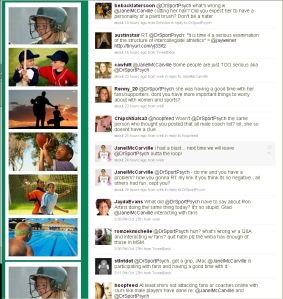
I learned a few valuable lessons which may be instructive as we all move forward and think about how to use social media effectively to positively promote women’s sports.

First, if social media is truly a two-way conversation, then I should of phrased my tweet “What is your opinion about @JanelMcCarville’s UStream videocast?”

Second, attacking people on Twitter is just in poor taste and not classy. My apologies Janel. This has played out for KC Chiefs NFL player Larry Johnson this week, as he is paying the price literally and in the media and  for using a homophobic slur. It will continue to occur with increased frequency as social media becomes part of the way we communicate.

Third, shortly thereafter I read a great piece by Q McCall of www.swishappeal.com on Feministing.com titled,  Is there a “feminist responsibility” to support women’s sports? It put into context some of the guilt I felt. Why was I attacking a female athlete?  I’m supposed to support women’s sport. But on the other hand, as a feminist, scholar, and advocate of women’s sport  I often feel I have the responsibility to wave the red flag and point out when I see something that may not be a “good thing”.  Perhaps my role is to raise the issue, provide an alternative viewpoint, and promote respectful discussion.

It also got me thinking about where female athletes and women’s sport might be headed in terms of social media. If everyone  “loves it” (all 66 viewers)—is this our new model of promoting women’s sport? Is that what fans really want to see? Is this how fans want to interact with athletes? Where is the line between “good access” and access that, to borrow from C + C Music Factory,  “Makes You go Hmmmm”? As was pointed out to me,  Ron Artest of the LA Lakers, got his hair cut that same day…which garnered media attention. But if the men do it, should the women follow? Should we always be trying to emulate our male counterparts? (I’m not suggesting that is why Janel chose to UStream, she’d have to tell us the inspiration). Is it possible male athletes use social media differently because of disparate patterns of traditional media coverage? What are the similar and different ways elite male and female athletes use social media? How can female athletes take control and use social media in positive ways to combat sexism, inequalities, and disparities that are well documented in sport contexts? Is this a responsibility they should bear? In conclusion, I highlight Janel not to criticize or judge, but to provide an exemplar real-life issue to promote discussion about social media and women’s sports.

I don’t have the answer, only a lot of questions. What do you think?

Stereotypical Media Representations of Female Athletes Starts Early

boy & girlToday I was preparing for a WeCoach workshop and was looking for some images on IStock.com. Pictured here is a classic example of how the (re)production of gender stereotypes starts early and in ways we might not even notice because they seem so innocuous. Ironically, shortly after I found these images I read the AAUW blog on Why Media Representation Matters which touched upon the newly released The Shriver Report-A Woman’s Nation. So far, I’ve read the Executive Summary of A Woman’s Nation, and in light of the Tucker Center’s Distinguished Lecture on the potential impact  of social media on women’s sport and the story released today by the New York Post suggesting that ESPN encourages “sexual insensitivity”,  I was struck by the assertion that outdated gender stereotypes will only change if women rise within the ranks and launch new media of their own. So what are we waiting for?

Top 5 Take Aways: Social Media & Women’s Sports

Social Media Pic_iStock_000009648196XSmall

On Monday, October 19 I took part in the Tucker Center Distinguished Lecture Series on The Impact of Social Media on Women’s Sports-which you can view in its entirety here. There were so many great ideas  and critical thinking from so many perspectives that I’m still processing, but here are my Top 5 as of now.

1. Women’s sport marketing & promotions have always been viral and no one is really sure how to measure return on investment. Social media should be about building relationships and you can’t always measure the impact of relationship building.  (@DigitalMaxwell, Dr. Heather Maxwell)

2. The success of female sports journalists depends on the success of women’s sports, but half of female sport journalists surveyed don’t feel a responsibility to cover women’s sports. They don’t want to be pigeon-holed.(@mariahardinpsu, Dr. Marie Hardin)

3. Is it fair to place the burden of marketing & promoting women’s sports on the shoulders of the female athletes-especially those in “non-traditional” sports like ice hockey? Is this the new model we are left with as social media envelops traditional sport media (where female athletes get 6-8% of the coverage)? (@angelaruggiero, Angela Ruggiero, US Women’s National Ice Hockey Team)

4. Interest in women’s sport is being measured by “click throughs” in online editions of newspapers & websites. So if people don’t click on women’s sport stories, it is interpreted as “non interest”. Those who support women’s sports have to CLICK the stories that we can find!  (Rachel Blount, Sports Columnist, Star Tribune)

5. Time remains to take control of social media and use it effectively to grow women’s sports, but time is running out (Rachel Blount, Sports Columnist, Star Tribune)

If you watched it what were your thoughts?

Where are the Photographs of Female Coaches?

As part of my research and outreach I’m always trying to track down pictures of female coaches, specifically at the youth level, that don’t look “staged”. I’ve looked in most all the photo websites like IStock Photo, and when you type in “female coaches”…well just try it and see for yourself. The choices are really pathetic—similar to the  image you see here (not from IStock). coach-mom_baseballIn fact, if you only looked at the pictures you can find on these type of sites– or anywhere for that matter— you’d wonder if legitimate female coaches exist at youth or interscholastic levels.

I’ve had my colleagues and graduate students look as well, in case I was missing something or not searching correctly or in the right spots. Same result. When I needed images for the website of my new initiative to increase the number of female coaches, We Coach: Educating & Empowering Through Sport, I had to email female coaching friends  for images of themselves.

This blog was inspired when I got notice today from WordPress.com that I could have access to pictures on PicApp.com, a site I had not previously been aware of. I immediately went to their site and typed in “coaches” and 3,829 images on 64 pages came up. Here is an example of what you will see–male coaches in action, in uniform, on the field looking competent and in charge. [picapp src=”e/5/7/a/Georgia_Southern_v_69ab.jpg?adImageId=5443390&imageId=6769230″ width=”234″ height=”150″ /] [picapp src=”6/1/2/f/Pistons_vs_Hawks_f5db.JPG?adImageId=5556926&imageId=6783389″ width=”234″ height=”159″ /]What you will not see are pictures of female coaches. I gave up looking for a female coach after the 5th page of images (sigh). (NOTE: I wrote this blog last night, and when I went in today the first images are from the Women’s Sport Foundation Annual Salute to Women’s Sport, including a few of Pat Summitt, the most winning-est coach in collegiate basketball. However, the images of Summitt are not in action, on the court, or in coaching attire, which sends a very different message about coaching competence compared to the images of the male coaches on the page)

Next I typed in “female coaches” resulting in 475 images on 8 pages. The first image is picture of Nadal signing autographs—not sure what this picture has to do with female coaches? The second image is this woman, who in my opinion doesn’t exactly look like a coach.
[picapp src=”c/f/b/e/Rafael_Nadal_Pre_41d7.jpg?adImageId=5557660&imageId=5606384″ width=”234″ height=”316″ /] [picapp src=”9/0/3/e/PicImg_Sarah_Gronert_in_f773.JPG?adImageId=5558108&imageId=4527814″ width=”234″ height=”332″ /]
The ironic part is the search for “female coaches” elicited more pictures of male coaches than female coaches, but when you search for “coaches” only pictures of real male coaches in action show up. (Note: the pics of Summitt mentioned previously do NOT appear on the “female coaches” page)

If you have the skills, passion, and time…please take some high resolution, pictures of female coaches in uniform, and “in action”. When I say “in action” I mean in action while coaching. Take pictures of what it looks like to coach in a REAL game, match, meet, or practice. When you do, make them available somewhere and let me know where to find them! Or if you know of a site with good images of female coaches not at the collegiate level, please enlighten me.

The scarcity of images that portray athletic competence of female athletes is well documented and I’ve written about it previously, but the same portrayal pattern exists for female coaches. A lack of legitimate images virtually and literally erases female coaches which is not good for anyone. Where are the pictures of female coaches?