The “Best” of 2009 and the State of Girls & Women in Sports

As 2009 comes to an end, there are some trends for those who care about sports–particularly sports for females–that you should keep an eye on in the months to come. Many groups and organizations that have been cornerstones of advocacy, programming, outreach and research for girls and women in sports are in trouble or on the rumored brink of existing no more.  Yes, girls and women in sports have made major advances in participation in the last 35+ years, but gender equity has yet to be achieved, we now have fewer females in positions of power in sport leadership, and sportswomen are constantly under attack. Some stories from the past year put the fact that fighting for gender equity in participation, leadership, and media coverage, to name a few, are not issues of the past.

Under what criteria do organizations decide to shut down or “put out” important programs that make a difference in the lives of sporting girls and women? Who decides what is “out” and what is included?  Who is left out, and who continues to play, lead, and enjoy the benefits of sports, and be portrayed in what ways by the media?  What constitutes “A Real Life Out Clause?” This is real life and the consequences of the decisions of those in positions of power will continue to shape the future of sport for females in 2010 and beyond.

Consider the following, some of these topics I’ve written about in previous blogs, some I have not:

The Melpomene Institute for Women’s Health Research is struggling to survive in this economy.

The National Association for Girls and Women in Sport (NAGWS) “strives to be one of the premiere organizations dedicated to advocacy, education and the promotion of girls and women in sport”. There were rumors this year that AAHPERD, the parent organization of NAGWS, was discussing whether or not to keep or disband NAGWS. So far it appears it has survived.

It Takes a Team (ITAT) is being discontinued as a programming and outreach arm of the Women’s Sport Foundation. ITAT’s purpose was to “address LGBT issues in high school and college athletics… and make sport teams safe and respectful for all athletes regardless of their sexual orientation or gender identity”. To read more about  ITAT ‘s “outing” go to former ITAT Director Pat Griffin’s blog post. Be sure the program is not being eliminated because homophobia in sports has been eliminated and is no longer an issue. Homophobia still exists and affects all athletes, coaches, administrators and those involved in sports.

The International Olympic Committee voted not to allow and include ski jumping for females, and endures as a sexist organization.

ESPN sports journalist Erin Andrews, one of the few in the profession, endured a terrible event where she was stalked and sexually harassed. Sportswomen also continue to be sexualized or erased in all types of media-print, broadcast and social.

In 2009 major “newsworthy” stories in women’s sport included “girls behaving badly” such as “extraneous and loud grunting” by one WTA player, a verbal attack on a line judge by another, and”overly aggressive” play by a collegiate soccer player, and the drunk driving of a WNBA MVP …not reports of stellar athleticism. Lest we not forget the obsession of the sex verification of runner Caster Semenya…which only came about because she was FAST, really fast.

Early last spring, when Tennesee Head Women’s Basketball Coach Pat Summitt won her 1,000th game, and Auriemma’s UConn Huskies won another national championship many speculated if they should coach men…the obvious pinnacle of any coach’s career. Interestingly, but perhaps not surprising, Summitt did NOT appear in Sports Illustrated “Coaches of the Decade“, but Auriemma did.

The WNBA lost a team, the Sacramento Monarchs, and another very successful team the Detroit Shock moved to Tulsa. I fear the WNBA is teetering on the brink of collapse in 2010, I hope I’m wrong. The WNBA now has 10 teams.

With 10 teams, The Lingerie Football League debuted its inaugural season in 2009 in cities across the US. According to the LFL website, the mission of the LFL includes: “the LFL will offer the ultimate fan experience providing unyielding access to players, teams and game action.” I fear the LFL will thrive and survive, I hope I’m wrong.

Women’s collegiate sports will never achieve gender equity unless real reform occurs unilaterally at the highest administrative level of institutions of higher learning. This was a clear message of the Knight Commission Report on Intercollegiate Athletics released in late 2009.

Earlier this year I critiqued a piece on ESPN.com titled The State of Uncertainty of Women’s Sports. I’m not certain if there is stability or uncertainty or both pertaining to women’s sports. What I do know, and these stories above (and many others not included here) provide evidence, that the work for those who care about sports for females is never done. We must work together to ensure girls and women in sports are not left out, or pushed out.

Stay tuned in 2010 for more information, and certainly more critiques, of these important issues. I’d also encourage you to visit the Women Talk Sports Network and read blogs by colleagues who also write about these issues here, here, here, here, here, and here.

Other WomenTalkSports posts of “Best of ’09”:

Benchmarking Women’s Leadership

Since it is finals and I don’t have much brain power left after grading to come up with clever original blog material, I’m sharing links to information already out there you may not know about.

The White House Project, just released a new report title Benchmarking Women’s Leadership which can be downloaded for free by clicking here.

Related to women in sport leadership, a research topic of mine and which you can read more about within previous blog posts, see pages 101-112 of the report.

Speechless Over Serena

I just got word via the BBC that “Serena Williams has been fined and given a suspended three-year ban from the US Open for her tirade at a line judge”

I really hope this is a bad joke. Three years? That seems a bit harsh doesn’t it? Would a male players be fined and suspended the same amount? I think players who have tested positive for an illegal substance, say steroids, have been banned for less time!

What does this say about the intersections of class, race and gender in the game of tennis in the 21st century? Who plays and under what conditions? Who is punished (or not) and for what transgressions? Who decides, under what conditions, using what criteria to determine “major offence of aggravated behaviour”. I’m speechless.

Mother-Baby Workout Solution!

This morning I saw a segment on my local TV affiliate about a program called StrollerStrides, “a total fitness program for new moms that they can do with their babies”. The program seemed like a perfect physical activity solution for mothers with stroller-age children, and also solves many of the barriers to physical activity many women face due to afforadabilty, accessibility and availability.

StrollerStrides workouts are conducted by certified instructors in large indoor public spaces (mostly shopping malls in off hours) which cuts expensive gym memberships. Mothers can work out alongside the strollered child which cuts the need for childcare. It also provides  mothers with a social support system and affords the opportunity to get out of the house to a safe, warm space (this is key during Minnesota winters for those of you who don’t live here!) to get physical activity. The workout combines strength, flexibility and cardio components along with fun songs and activities that engage the children and keep their attention.

It also got me thinking what a better way to start a love of physical activity for infants! Researchers have proven time and again that parents are very important physical activity role models for their children. If parents are active and value and believe that being active is an important part of life, their children are more likely to be active. I also recently came across another resource from the Canadian Association for the Advancement of Women in Sport & Physical Activity, Mothers in Motion, a program “dedicated to physical activity promoters working with mothers of low socioeconomic status”.

Many women must overcome a host of barriers in order to be physically active, which is why females are less active than their male counterparts at all ages and within all types of physical activity. Assisting women in starting and sustaining physical activity can lead to a host of positive physical and mental health outcomes. You can also read more about Developing Physically Active Girls, a report I helped to co-author and produce in my role as the Associate Director of the Tucker Center for Research on Girls & Women in Sport.

Picture from StrollerStrides

The LFL Sells Sex, Not Sport

During the recent sport sociology conference (NASSS) I heard inspired critiques of  sport and had many great conversations about sport media and female athletes. Ironically, I returned home today to this tweet by the Lingerie Football League.

RT @MyLFL: “THE LINGERIE FOOTBALL LEAGUE’S OFFICIAL WEBSITE WWW.LFLUS.COM IS OFFICIALLY ONE OF THE FASTEST GROWING WEBSITEShttp://bit.ly/2YQYvj”

As you know, I’ve written previously about the LFL and I’ve been keeping an eye on what is happening with the league. At the NASSS conference I heard some great audience reception research on why sex does not sell women’s sport, sex sells sex. More specifically, sexy images and sexy female athletes sell sex to young male consumers ages 18-35. I would be really interested to see the market research—who are the consumers and fans of the LFL? (any guesses?)

The LFL is a perfect example of how sex can and does sell sex. The numbers prove it. Arguably, the LFL is not sport it is a dramatic spectacle aimed at entertainment and consumption of the female body.  No where in any of the promotional materials is the athletic competence of LFL “athletes” highlighted or portrayed in any serious way. The  sexualization of the LFL women is overt and aimed at appealing to male sexual fantasy. In fact their website promotes the LFL as “True Fantasy Football” which merges two primary desires and interests of many (not all) US men— football and sex.

If you watch the many videos of LFL games posted on the website, you will see continuous images of women tackling each other, acting violent, and slamming each other to the ground.  Yet one women (New Mexico soccer player Elizabeth Lambert) acts aggressive and pulls a ponytail and we have a national outcry (see the video and read examples of indicative responses on Perez Hilton’s blog).  Male athletes act aggressively and unsportsmanlike all the time (remember Zidane’s head butt in the World Cup? or Florida football team member Brandon Spikes fingers through the face mask? , both of which were similarly caught on national TV). Yet, the sanctions for Lambert were severe and quick (permanent dismissal from the team), while Zindane and Spikes punishments were much less in scope and severity.

What is our take home? Females can act aggressively as long as they are sexy, but if a real female athlete acts outside of the rules in real sport, she will be met with quick and severe sanctions…not only within her sport but will be berated by the public…while male athletes can “act like men” with comparatively less fanfare.

What is most interesting to me is the societal discussion and the media’s construction of Lambert’s transgression, rather then the event itself.

Found! Pictures of REAL Female Coaches

DSC_7517In a previous blog I was lamenting about the scarcity of pictures of real female coaches, especially at the youth level. I’m pleased to report I found some! A photographer for the University of Minnesota’s College Education of Human Development Connect Magazine shot some GREAT pictures of females coaches for a story they ran recently on some of our research. To read the story “The Sporting Life: Research Helps Families Adjust to an Increase in Youth Athletics” and see the pictures of two great female coaches in action, on the field, and in coaching attire click here (and scroll down to the link below the picture that states “enlarge picture and launch slide show”).

Most remarkable is that in some of the pictures, Coach Kari Ornes is pictured coaching high school boys! Even though females coaching males at all levels of competition occurs about 2% of the time-you never see it. We need more pictures of this nature to be taken and portrayed in traditional and new media outlets. Both Kari and Julie are part of the We Coach advisory board and two exemplary female coaches!

Things That Make You Go Hmmmm…More on Social Media & Women’s Sport

Following the  Tucker Center lecture and new blog about the impact of social media and women’s sport, it didn’t take too long for me to be in the middle of a real life example. Life works in ironic ways sometimes, doesn’t it? This example is meant to continue the conversation about this emerging and important topic.

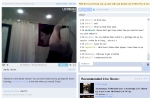
9uwom0322w.lOn Tuesday I was at my computer and looked over the TweetDeck and saw that WNBA player Janel McCarville was live on her UStream channel JMACTV. I’d heard about Candace Parker using UStream but hadn’t checked it out yet, so clicked on the link and….ta dah!…there was Janel. As a Minnesotan, two-time Gopher Alum and now Gopher faculty, huge fan of women’s basketball, and advocate/scholar of women’s sport, I’ve been a long time fan of Janel McCarville (no hate Janel, only love!). Who can forget the Whalen/McCarville dynasty in The Barn!

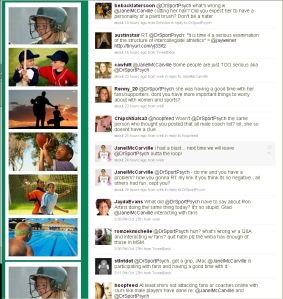
Janel !I thought, “This is really cool… instant access to an elite female athlete“, as I watched her looking at and responding to the comments and questions from the 60+ fans watching her. I shouted through my office door to my two graduate students to “check this out”. Then I took a harder look and wrinkled my brow, “Is she in the bathroom?” I asked them, “and is she really cutting her own hair?” (see screen shot)  Somehow I was a bit disturbed by this. I immediately wasn’t so sure this was cool anymore—or good for women’s sports. So given this subject has been top of mind, I tweeted about it—twice (see screen shot below).mccarville tweets

I continued to watch for about 10mns, and then shut down for the day. I continued to think about it over the next day or so.  In the course of “doing my warm up activities” for the day (aka surfing), I looked at my @ replies on Twitter and saw that my tweets had incited quite a bit of outrage, and a direct response from Janel herself! (see screen shot right, it will enlarge if you click on it).mccarville tweet responses The tone of the responses was “lighten up, this is just silly and fun and everyone but YOU thinks this is great”. Fair enough. I responded to Janel via Twitter:  “@JanelMcCarville No anger, just continuing conversation re: women’s sport & social media, both pro/con. See http://bit.ly/352s8T“. But I felt badly for criticizing her and it bothered me.

I learned a few valuable lessons which may be instructive as we all move forward and think about how to use social media effectively to positively promote women’s sports.

First, if social media is truly a two-way conversation, then I should of phrased my tweet “What is your opinion about @JanelMcCarville’s UStream videocast?”

Second, attacking people on Twitter is just in poor taste and not classy. My apologies Janel. This has played out for KC Chiefs NFL player Larry Johnson this week, as he is paying the price literally and in the media and  for using a homophobic slur. It will continue to occur with increased frequency as social media becomes part of the way we communicate.

Third, shortly thereafter I read a great piece by Q McCall of www.swishappeal.com on Feministing.com titled,  Is there a “feminist responsibility” to support women’s sports? It put into context some of the guilt I felt. Why was I attacking a female athlete?  I’m supposed to support women’s sport. But on the other hand, as a feminist, scholar, and advocate of women’s sport  I often feel I have the responsibility to wave the red flag and point out when I see something that may not be a “good thing”.  Perhaps my role is to raise the issue, provide an alternative viewpoint, and promote respectful discussion.

It also got me thinking about where female athletes and women’s sport might be headed in terms of social media. If everyone  “loves it” (all 66 viewers)—is this our new model of promoting women’s sport? Is that what fans really want to see? Is this how fans want to interact with athletes? Where is the line between “good access” and access that, to borrow from C + C Music Factory,  “Makes You go Hmmmm”? As was pointed out to me,  Ron Artest of the LA Lakers, got his hair cut that same day…which garnered media attention. But if the men do it, should the women follow? Should we always be trying to emulate our male counterparts? (I’m not suggesting that is why Janel chose to UStream, she’d have to tell us the inspiration). Is it possible male athletes use social media differently because of disparate patterns of traditional media coverage? What are the similar and different ways elite male and female athletes use social media? How can female athletes take control and use social media in positive ways to combat sexism, inequalities, and disparities that are well documented in sport contexts? Is this a responsibility they should bear? In conclusion, I highlight Janel not to criticize or judge, but to provide an exemplar real-life issue to promote discussion about social media and women’s sports.

I don’t have the answer, only a lot of questions. What do you think?

Stereotypical Media Representations of Female Athletes Starts Early

boy & girlToday I was preparing for a WeCoach workshop and was looking for some images on IStock.com. Pictured here is a classic example of how the (re)production of gender stereotypes starts early and in ways we might not even notice because they seem so innocuous. Ironically, shortly after I found these images I read the AAUW blog on Why Media Representation Matters which touched upon the newly released The Shriver Report-A Woman’s Nation. So far, I’ve read the Executive Summary of A Woman’s Nation, and in light of the Tucker Center’s Distinguished Lecture on the potential impact  of social media on women’s sport and the story released today by the New York Post suggesting that ESPN encourages “sexual insensitivity”,  I was struck by the assertion that outdated gender stereotypes will only change if women rise within the ranks and launch new media of their own. So what are we waiting for?

Top 5 Take Aways: Social Media & Women’s Sports

Social Media Pic_iStock_000009648196XSmall

On Monday, October 19 I took part in the Tucker Center Distinguished Lecture Series on The Impact of Social Media on Women’s Sports-which you can view in its entirety here. There were so many great ideas  and critical thinking from so many perspectives that I’m still processing, but here are my Top 5 as of now.

1. Women’s sport marketing & promotions have always been viral and no one is really sure how to measure return on investment. Social media should be about building relationships and you can’t always measure the impact of relationship building.  (@DigitalMaxwell, Dr. Heather Maxwell)

2. The success of female sports journalists depends on the success of women’s sports, but half of female sport journalists surveyed don’t feel a responsibility to cover women’s sports. They don’t want to be pigeon-holed.(@mariahardinpsu, Dr. Marie Hardin)

3. Is it fair to place the burden of marketing & promoting women’s sports on the shoulders of the female athletes-especially those in “non-traditional” sports like ice hockey? Is this the new model we are left with as social media envelops traditional sport media (where female athletes get 6-8% of the coverage)? (@angelaruggiero, Angela Ruggiero, US Women’s National Ice Hockey Team)

4. Interest in women’s sport is being measured by “click throughs” in online editions of newspapers & websites. So if people don’t click on women’s sport stories, it is interpreted as “non interest”. Those who support women’s sports have to CLICK the stories that we can find!  (Rachel Blount, Sports Columnist, Star Tribune)

5. Time remains to take control of social media and use it effectively to grow women’s sports, but time is running out (Rachel Blount, Sports Columnist, Star Tribune)

If you watched it what were your thoughts?

What do Online College Coach Biographies Tell Us About Inclusivity?

See a guest column I wrote with graduate student Austin Stair Calhoun for the Women’s Sports Foundation, It Takes a Team newsletter titled: What Can Online Intercollegiate Coach Biographies Tell Us About Inclusivity and Tolerance of Diverse Sexual Orientations?

In a previous blog I posted our pilot study poster and results about this project. We’re currently finishing the data collection and analysis (with undergraduate Alicia Johnson, Minnesota State) for a full-scale national study which replicates the pilot. Stay tuned!