
 Read the piece I wrote for Minnesota Hockey on this topic, by clicking here.
Football Bowl Winners…A Slightly Different Approach
Now that the 2013-14 Football Bowl Series has come to a close and winners declared, I am posting bowl winners based on a slightly different approach.
The winners of 7 arguably most prestigious bowls in this graphic (click on it to make it larger) are based on the institution’s commitment to gender equity in its hiring of women head coaches for women’s teams for 2013-14.
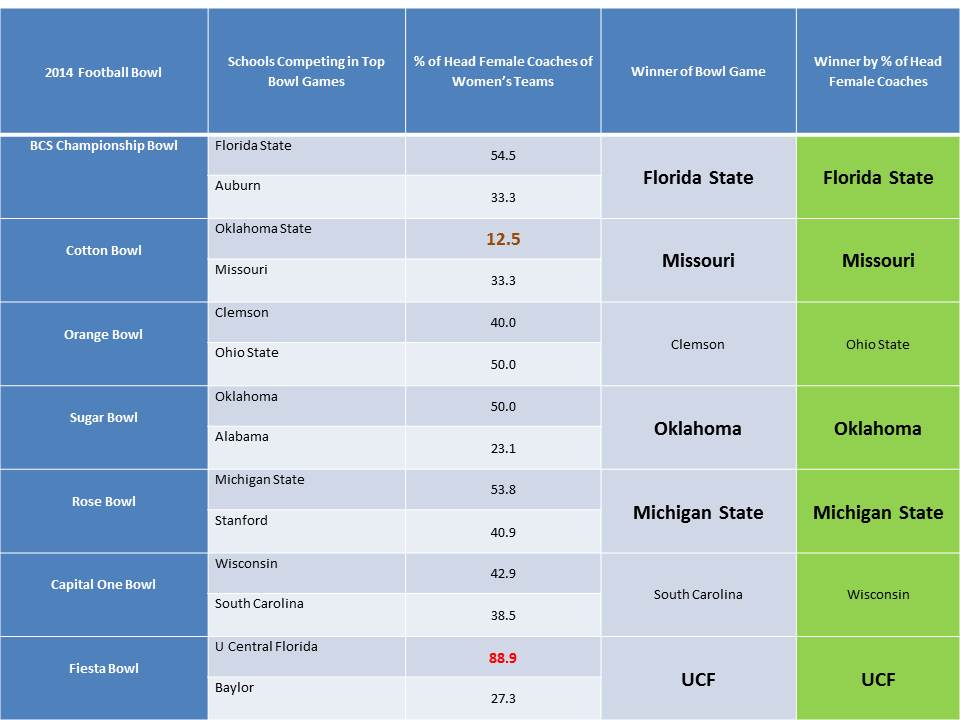
So if you are a fan of Ohio State and Wisconsin…you have something to cheer about, even though your teams lost their bowl game, your institutions have a higher percentage of female head coaches (FHC) of women’s teams than did your opponents!
Sorry Florida State (54.5%)… yes you beat Auburn (33.3%) both on the field and by % of FHC and even though they didn’t play in the title game, University of Central Florida is the real National Champion as 8 of 9 (88.9%) of their women’s teams are coached by women head coaches! Well done UCF!
Oklahoma State, you lost to Missouri (33.3%) both on the field and in % of female head coaches, but you are the winner the Toilet Bowl as only ONE of 8 (12.5%) of your women’s teams are coached by a woman…you can do better, A LOT better! However OK State to be fair, in 2012-13 NONE (0%, ZERO) of your women’s teams were coached by women, so you are moving in the right direction!
This data is taken from 2014 Women in College Coaching Report Card. (note: UCF is not included in the sample, but data was calculated separately from the UCF Athletics Web site)
RELEASED: New Reports on Women College Coaches
Did you know that in the 40+ years after the passage of Title IX, female sport participation is at an all-time high but the percentage of women coaching women at the collegiate level has declined from 90+% in 1974 to near an all-time low today of 40%? While the number of collegiate coaching opportunities is also at a record high, only 20% of all college coaching positions for men’s and women’s teams are filled by women.
T oday we (meaning the Tucker Center & the Alliance of Women Coaches) released a research series, 2 report cards and infographic on the status of women college coaches at 76 of the biggest NCAA D-I athletics programs. This work is the culmination of many people’s efforts. The purpose of this initiative is to increase the number of women in the coaching profession, generate awareness, and hold institutions accountable. I hope you will check out the reports and infographic and read the article Christine Brennan wrote in USA Today about the report.
Here are some key take-aways from the reports:
- As the position became more visible and arguably powerful from graduate assistants, to assistant coaches, to head coaches, women occupied those positions less frequently.
- In one academic year the percentage of women head coaches declined from 40.2% to 39.6%
- Only ONE school, Cincinnati at 80%, was awarded an A for the percent of women head coaches

- An equal number of schools got above average grades of A’s and B’s as got F’s (11 each). To see which schools passed and failed, or where your school stacked up, click on the infographic.
- Two sports had 100% female head coaches (field hockey, synchronized swimming) while five sports had ZERO (0%) (water polo, bowling, skiing,, sailing, squash)
- The B1G Ten (46.1%) conference had the most female head coaches of the 6 conferences we examined (ACC, Big East, Big 12, SEC, PAC 12), the SEC had the lowest (33.3%)

- 66 of 886 head coach positions turned over from 2012-13 to 2013-14. Out of those 66 positions 74.2% of all coach vacancies were filled by men resulting in a net gain of five head male coaches, thus the decline in the percentage of women head coaches.
- 7 schools increased the % of female head coaches in one academic year, while 13 decreased.

To read more about why this research matters, grading criteria, methodology and more specifics on processes go to the reports.
Help “Prove” Interest in Women’s Sport!

[disclaimer] I’m writing this blog as my role as Associate Director of the Tucker Center for Research on Girls & Women in Sport at the University of Minnesota …and because the topic of media portrayals of female athletes and the lack of media coverage for women’s sport is a special interest and line of research of mine.
One myth I often hear is: “no one is interested in women’s sport.” I know that is not true, I can see firsthand that a lot of people are interested! So I started taking pictures of “interest” when I attended women’s sporting events like the Minnesota Lynx or Gopher Women’s Hockey and Volleyball.

To help create a true narrative about women’s sport, we at the Tucker Center are launching the #HERESPROOF Project. The purpose is to collect worldwide evidence of interest in women’s sport that will help dispel this untrue and damaging myth. Join us and use #HERESPROOF on Twitter, Instagram, Facebook or any of your favorite social media!

This project is in advance of our documentary premiere, Media Coverage and Female Athletes—a collaborative project with tpt MN that airs December 1, 2013 at 7:00 pm CST.
Female Coaches in High School Sports: Data Released
You don’t need to look far or drill down very deep in a Google Search on ‘female coaches’ to find out two facts.
1. Female coaches at all competitive levels have declined since Title IX passed in 1972
2. Female coaches are the minority in almost every workplace
Many are familiar with the longitudinal work of Vivian Acosta and Linda Carpenter, who have tracked the number of females in positions of power in intercollegiate athletics for the past 35 years. Based on their data we know that in 1972 over 90% of female college athletes were coached by women, and in 2012 that number is near an all time low at 42.9%. To date a similar nationwide analysis for high school sports did not exist.Colleague Cindra Kamphoff, PhD and I decided to change that by analyzing a 2010 national data set of high school coaches we obtained from a reputable coaching directory. Some interesting, but not surprising, patterns emerged. Here are three key findings:
 1. 27% of all high school head coaches are female
2. Females coached of girls’ teams (39.6%) more often than boys’ teams (7.5%)
3. In basketball, the most popular** high school sport (and therefore the most visible, prestigious, important, valued, and known) females coached girls’ (28.1%) teams more often than boys’ (0.2%) teams.
Based on the data, female head coaches are often statistical tokens (<15% of a workforce) and marginalized (i.e., assigned to coach the less important and visible teams) in high school athletics. Tokens often experience or are subjected to scrutiny, pressure to over-perform to gain credibility, discrimination, harassment, and a host of negative workplace outcomes, and this is supported in the vast literature on barriers and support for female coaches which I’ve previously written about on this blog.
**most popular as indicated by the National Federation of High Schools
NOTE: Complete and refined analysis will continue. Please note these numbers represent a 3-5% variance, are not exact, but provide an initial picture into power, leadership, and high school sports.
Bobby Knight’s Validation is not Needed or Wanted for Women’s Sport
This weekend I enjoyed watching many Regional games for the NCAA Women’s College World Series (WCWS) on ESPN and BTN. I love watching the array of talented female athletes getting prime time TV coverage, as it so rarely happens! Sport media coverage of the WCWS seems to be expanding and improving in production quality. One step forward! ↑
However, why does ESPN air interviews of Bobby Knight discussing his appreciation of women’s sport during women’s sport broadcasts? One step back ↓ I saw his softball segment aired at least twice over the weekend, and he also appeared in ESPN segments during the 2013 Women’s NCAA Basketball March Madness and Final Four programming discussing Brittney Griner.
I thought it offensive during the basketball tournament, but when he appeared again during the WCWS it really made me pause…and then it made me outraged. Bobby Knight is no fan or advocate of women’s sport or women in general. Why do I find this offensive?
 1. in 1988 in an interview with Connie Chung, Knight stated, “I think that if rape is inevitable, relax and enjoy it” (NOTE: He was not sanctioned nor fired from his post as head men’s basketball coach at Indiana for his comment)
2. Despite his coaching record and reverence by some, he has a history of abusive behaviors toward athletes that are well documented. While he did not coach women, his abuse of male athletes should not be overlooked or forgotten. There are PLENTY of coaches, male or female, to interview that are real advocates of women’s sport and treat their athletes with care and respect. Why give a controversial coach a voice? Why give Knight any airtime during the two most important and premiere college women’s sport events that are broadcast on ESPN? (I’ll come back to this momentarily)
3. In early 1989 shortly after Knight’s rape comment, my college tennis coach at Gustavus Adolphus College ‘arranged’ (i.e., we stalked Knight in 2 hotel lobbies until midnight waiting for him to return post game, and then our coach pounced on him and convinced him to talk to his team) for our team to ‘meet’ Knight after Indiana played Minnesota here in Minneapolis. None of us wanted to meet Knight as we were well aware of his comment and one of our teammates had been raped the year prior. The thought of facing Knight was traumatic for her and angering to the rest of us. Knight reluctantly agreed and we were treated to a short ‘pep talk’ that included offensive comments like, “Girls shouldn’t play sports like basketball because they don’t look feminine – just sports like tennis where they run around in skirts and look cute” and “female athletes should look like females when they play and wear some make-up, like lipstick and nail polish.” If you knew my teammates, all amazing and strong women, it is unfathomable how Knight escaped that night unscathed. It remains to date one of our most memorable moments as a team. I know his offensive comments and dismissive behavior in part shaped who I am today, and what I do…trying to make a difference in the lives of girls and women through sport.
I am offended due to my personal experience with Knight in addition to his historical record of disregard for women. Here is what is bothering me today: Why would ESPN give Knight airtime during the two most important and premiere college women’s sport events shown on TV? Why does his voice matter in the landscape of women’s sport? What does it say that a major sport network continues to give Knight airtime and treat him with respect when he has a history of abusive behavior as a coach? (especially in light of the Mike Rice/Rutgers coach abuse scandal, where you could argue Rice’s behavior is an emulation of Knight) What does it say about ESPN and their value of and commitment to respectful coverage of women’s sport? Who decided Knight should be interviewed and what criteria did he use? ( I say ‘he” because a large majority of positions of power in sport media are held by men)
In short, giving Knight airtime during premiere college women’s sport events marginalizes female athletes and is offensive to those who are true fans. It sends the message that women’s sport needs a powerful and (arguably) successful male figure to validate its existence. Women’s sport and female athletes do not need, and I would argue by and large do not WANT, Bobby Knight’s validation or appreciation. The whole thing feels patriarchal and patronizing.
Sport and media are inextricably linked–what is communicated (and not) to audiences is important, and this is no exception. Knight appearing on ESPN when he did is about preserving and perpetuating male power and privilege in the world of sport. What better way to undermine amazingly talented female athletes who are the best in their respective sport, playing on ESPN in prime time, than to interview someone with a history of disrespect for female athletes and women in general.
Two steps back… ↓↓
Supports for Female Coaches II: Stay in the Game Early
 Read my monthly blog post “Supports for Female Coaches II: Stay in the Game Early” for the Women in Coaching blog by clicking here.
If you missed “Supports for Female Coaches Part I” click here.
Female coaches–if you haven’t signed up yet for The Alliance of Women Coaches Huddle event June 12-14, 2013 yet, you should! I’ll see you there.
3 Simple Ways to Support Women’s Sport
With many exciting developments recently in women’s sport such as the start of the National Women’s Soccer League (NWSL), an extended and expanded WNBA & ESPN TV deal, the WNBA draft airing for the first time in prime time, an announcement from espnW about the Nine for IX series about women’s sport to run this summer, and exciting Women’s Final Four during March Madness, it feels as if there is a perceptible shift that women’s sport is being taken, marketed, and promoted seriously. I am optimistic, but action is still needed.
 If you want sustainable women’s sport, and even better yet, GROWTH…there are 3 simple things you can do. These aren’t new ideas, but they are worth saying again.
1. WATCH. When women’s sport is on the TV, tune in. If you aren’t going to be home and have a DVR or DVD (not sure those exist anymore!) tape it! Don’t forget to watch the Nine for IX series!
2. BUY TICKETS. If you have a college or professional team in your area, buy season tickets. Last week Minnesota Lynx head coach Cheryl Reeve spoke at a TeamWomenMN event I was attending and she had a great idea. She said she is supporting the NWSL by finding the nearest team to Minneapolis (we don’t have NWSL team here…yet) and is buying a season ticket. Even through she probably won’t get to many games, she will donate her ticket to an undeserved girl, so she can attend. If you can’t go to all the games, buy a full package and split it with someone or share your tickets with friends, colleagues, neighbors or family. To read a great piece on espnW about how the NWSL will succeed by Julie Foudy, click here.
3. CLICK & SHARE. Set your Google Alerts or sign up for an RSS feed, to scan stories about women’s sport, your favorite team or athletes, or sports journalist. Once you get your list, make sure to click on the stories! Clicks = interest = increased ability to attract sponsorships = good for women’s sport. Click, read, and then share a good story via Twitter or Facebook.
If you watch, buy and click…or complete the trifecta, women’s sport will more likely be a winner.
Statues of Female Leaders?
 Over the weekend while perusing news, I saw two images of giant statues of male leaders. The first was of the late former North Korean leaders Kim Il Sung and Kim Jong Il (L). The second picture was a statue of late Pope John Paul II (R)– billed as the world’s tallest at 13.8-meter/45.3-foot.
Maybe it was the synchronicity of a short time span that made me think, but I wondered….Where are the giant statues of female leaders (dead or alive!)?
I thought back to all the statues I’ve seen live or virtually, I couldn’t think of one giant statue of a living or former female leader (note: other than the Virgin Mary, who arguably is not a leader in the way I am discussing here). If you’ve seen one or know of one, please let me know. There have been numerous female leaders around the globe, so I am hoping you have knowledge that such statues of women exist.
Why does the lack of giant female leaders matter? First, a statue is a literal symbol of power…past, present and future power. Second, a statue is a visible representation of what is important, valued, and relevant. Third, it communicates who is most important in a society…and more importantly who is not important. If boys and girls only see statues of men, it socializes youth to believe that only men are capable, competent and deserving of leadership positions. An absence of women in power becomes normal and expected. Fourth, it celebrates male leadership in a public space, communicating to the masses that the accomplishments of these men must be many and great, and are to be celebrated uncritically and problematically. Fifth, size matters….the grand scale of these and other such statues signifies that men are bigger and therefore have more value, than women.
I have a feeling this trend is also replicated and true of sport statues. The sport statues I have seen are of male coaches and athletes…so if you know of any sport statues of female coaches and/or athletes let me know. Just as with seeing females in visible position of power and seeing female athletes ON TV, in print or digitally is important, statues of females represent an important aspect of power rarely considered.
Today is National Equal Pay Day 2013-See Data on College Female Coaches
I’m re-posting a poster on Economic Inequality & Female Coaches in honor of Equal Pay Day 2013. #EqualPayDay

 One Sport Voice