Serena’s Shirt Exposes Wimbledon Sexism

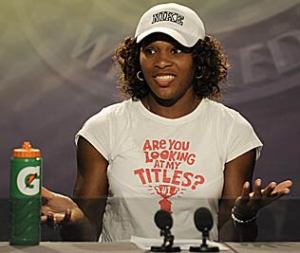
If you haven’t seen the t-shirt Serena Williams sported in her post-match Wimbledon press conference, then you are missing out.Titles2_serena Given the attention to attractiveness, court assignments, body parts (i.e., “back packs”) sex sells women’s tennis controversy at Wimbledon, Williams clearly has the last say. Perhaps it was in jest, but the point of the t-shirt which contrasts her athletic achievements (11 Grand Slam Titles) with a primary focus on her body, mocks the attention given to the feminine, attractive, sexualized nature of the dialogue surrounding her (and other female athletes) play over the fortnight. To hammer this point home….Just think if Roger Federer wore shorts to his press conference with print on the front asking “Are you looking at my trophy?”

For more critique, read the NPR piece “The Nation: Sexism On Centre Court” written by Dave Zirin in which Tucker Center Director Mary Jo Kane is quoted.

Serena Williams “Oversized Back Pack” Critiqued

When I read this column about Serena Williams by sportswriter Jason Whitlock, I had to include it in the blog for obvious reasons. The column wasn’t about Serena’s third Wimbledon Championship or 11th Grand Slam title, but a critique of how good she could be if she would rid of her “unsightly layer of thick, muscled blubber, a byproduct of her unwillingness to commit to a training regimen and diet that would have her at the top of her game year-round”. Whitlock couches his comments by saying he is really a big Serena fan, that she “has limitless potential” and that people are going to accuse him of being sexist…but really he just has her best interest in mind.

Britain Wimbledon TennisUsing flattery and sham transparency (I know you’ll call me sexist, so I’ll do it first, but I’ll say it anyway) to buffer sexist (or racist, misogynistic, homophobic) remarks is a classic diffusing technique used by those who make them. A real “fan” would not make such remarks as research demonstrates that sexist remarks have negative implications for the target’s (i.e. Serena) well-being and can lead to self-objectification. A real fan, let alone a sportswriter, would not focus on Serena’s “back pack” no matter how big or small it is perceived to be, and no matter how much it is perceived to help or hinder her play. The problem here is that instead of focusing on Serena Williams’ play and accomplishment, Whitlock is trivializing both. Whitlock uses his personal views to prescribe what he thinks is “hot and attractive”, perpetuates a narrow conception of beauty, reinforces the idea that only “in shape” women are attractive, and in the end proclaims that only attractive female athletes are worthy of being watched during prime time TV on Centre Court.

When you read about a sportswriter discussing the “back pack” of a highly accomplished male athlete and the writer’s preference for the “size” of the male athlete’s back pack let me know…Nike_BackPack_LARGE

UPDATE: Listen to Dave Zirin’s Edge of Sports radio spot in which Zirin rails Jason Whitlock’s column.

Wimbledon’s Centre Court = Babe Central?

While I was out of town participating in the Up2Us Regional Sports-based Youth Development Conference hosted by the LA84 Foundation, a graduate student forwarded me an article link I felt compelled to share (thanks EH!).

A nydailynews.com article ran yesterday titled “Wimbledon turns Centre Court into Babe Central, giving players spotlight based on looks, not talent” which outlines that “hot, attractive” lower-ranked players were scheduled to play on Centre Count, and top-ranked players like Serena Williams were relegated to play on less prestigious courts. In the article All England Club spokesman Johnny Perkins was quoted as saying “good looks are a factor” when scheduling matches on Centre Court, in large part it seems due to television coverage.

Wimbledon Thought Process2

Greg Couch writes more about the “babe factor in tennis” on his blog where he states, “A few days ago, Maria Sharapova played Gisela Dulko, and on Wimbledon’s official website, the report of the match said, “As Sharapova and Dulko ran and stretched and lunged, most of the male spectators could not have cared less about their topspin forehands and would no more have recognized a western grip from a western movie — this match was about hormones, pure and simple.”

Unfortunately, it is also “pure and simple” another example of sport media and women’s sport promoting “sexy” athletes (which you could also read as White, feminine, & ponytailed) over athletic competence–which reinforces notions of what matters, what sells, and what is valued. If you want to read a new book out about this issue see D. Daniels (2009) “Polygendered and Ponytailed:The Dilemma of Femininity and the Female Athlete”.

Highest Paid v. Hottest Athletes

msftMSN.com recently posted two articles that represent a perfect example of gender inequality and sexist and marginalizing media coverage of female athletes. The articles speak for themselves….

First visit MSN Sports Hottest 30 Sportswomen , posted on June 23, 2009. (I looked for a companion piece on “The 30 Hottest SportsMEN”… to no avail)

Next visit the story posted June 21, 2009 on MSN titled World’s Highest-Paid Athletes (no female athletes here!)

A Sign of Things to Come?: Recent Departures in Women’s Basketball

I’ve read about three recent occurrences that have me thinking. While two may be related, all three may be a sign of things to come. departuresI’m talking about the recent departures of two male WNBA Head Coaches “to pursue possibilities in the NBA” and the second-ever early departure of Rutger’s Epiphanny Prince to “play basketball professionally in Europe before entering the 2010 W.N.B.A. draft” (Schuye LaRue was the first-ever woman to leave early from Virginia after her sophomore year in 2001 to go play abroad before getting drafted in the second round by the Los Angeles Sparks in 2003…thanks @hoopfeed!)

Successful Bill Laimbeer left the Detroit Shock after three games, and the not so successful Don Zierden left the Minnesota Lynx three days before their home opener to return to coaching in the NBA. While WNBA league officials and the departing coaches were assuring fans their departures were not a sign of trouble for the league, I’m not so convinced. I hope I’m wrong. What it does signal is that despite your success as a male coach in the WNBA, you can still get “called up” or return to the NBA. Would a successful—or better yet an unsuccessful—female coach ever get the same call? (maybe if your name is Pat Summitt, but I’m pretty sure that one’s gender is not a predictor of effective coaching so in theory many women should get said call)

As for Prince forgoing her senior year of ball at Rutgers to play professionally…One one hand, why not go and start making money immediately?—males have been doing it for years as has been pointed out. Prince states she “plans to buy her mother a house and support an A.A.U. team in Brooklyn”, so the move seems to be primarily financially motivated. On the other hand now that the seal is broken, will droves of other young women follow suit maybe never to return to finish their degrees? (and I’m not saying Prince won’t finish, but highlighting the possibility). Is this a trend we want female athletes to perpetuate? In essence, Prince’s move is no different than those of Laimbeer or Zierden….all three are leaving one basketball team, to pursue what is perceived as a better, bigger, and more lucrative opportunity with another team.

I’m not sure if this collective trend signals a sign of the times or is a sign of things to come….or both. And if it is of things to come….what “things” are we really talking about?

Update: To read more about various perspectives about Laimbeer click here or here.

To read more about what Gina Auriemma says about Prince’s departure, click here or read Altavilla’s blog. The NY Times also weighs in with an article titled “She’s Turning Pro, but Is It Progress?”

To Grunt or Not To Grunt: A Question of Gender Discrimination?

tennis ballDuring the 2009 French Open Tennis Tournament Portuguese teen tennis star Michelle Larcher de Brito made a stir with her elongated “shrieks” when she strikes the ball. Wimbledon officials are now considering making a rule banning loud grunting for female players. While she claims it is just “part of the game” opponents and fans say otherwise.

As a former collegiate tennis player and coach, I get the distracting and annoying nature of loud grunting by an opponent. That is one side of the issue. Another side of this issue is the problematic and gendered nature of this discussion and pending rule.

First, male players on tour also grunt upon impact, therefore a rule should be equally applied to both men and women. However, there has been no parallel discussion of a rule application to the men’s tournament (although Connors, and Agassi were criticized for their noises). Second, the way Larcher de Brito’s grunts are being constructed in the media as “shrieks”,”screams”, and “annoying squeals”… it appears that males players grunts are expected. Third, this isn’t the first time the discussion of a “grunt/shriek rule” for female tennis players has surfaced. If you recall, in the ’90’s Monica Seles was the original purveyor of loud grunting on impact…and while there was much grumbling then, no rules were enacted. Maria Sharapova was also criticized early on for her grunting, but that seemed to subside as she took over the Kournikova mantle as the “poster girl” of the WTA.

Many scholars have documented how female athletes have to constantly negotiate the tension between the movements, noises, muscles, and bodies that are needed to perform optimally and adhering to a narrow ideal of femininity. Clearly, loud shrieking is NOT feminine and therefore is troubling and must be regulated (i.e., “make the offending women act more ladylike so we can enjoy the match!).

Update to post: June 24, 2009: NPR weighs in on issue “Tennis, The Grunting Game?” in which sports journalist Christine Brennan gives her take, and another commentary by Frank Deford “It’s Time For Tennis Players To Make Some Noise”. You can also read Pat Griffin’s take on her blog.

New Twitter research: Help in marketing women’s sport?

A new study from Harvard provides information to those banking on Twitter to help market, promote, and sustain women’s sports. Here are some snippets if you don’t want to read the entire article or the post on Harvard Business Publishing:
1. “Just 10% of Twitter users generate more than 90% of the content”…superchirpthese people are called “super users”. Super Users can now make money through a just launched service called Super Chirp

2. “…very, very few people tweet and the Nielsen data says very, very few people listen consistently.”

3. “Among Twitter users, the median number of lifetime tweets per user is one”

and my favorite bit….Tweet bird

4. “…an average man was almost twice as likely to follow another man than a woman, despite the reverse being true on other social networks. The sort of content that drives men to look at women on other social networks does not exist on Twitter,” said Mr. Heil (one of the researchers). “By that I mean pictures, extended articles and biographical information.”

Twitter may be reaching a certain audience, but probably not males who don’t opt in and follow women’s sport.

Take home message for female athletes and women’s professional sport leagues: Use sexy pictures you download onto TwitPic to garner millions of followers (given the stack of research on how female athletes are sexualized in the sport media, such a picture shouldn’t be hard to find), then start charging your followers money to follow your Tweets. Voila!...instant revenue!

Given Heil’s findings, this may unfortunately lend some credence to the “sex sells” women’s sport debate (for more on this debate click here and here). But… I still contend that sex sells sex, not women’s sport.

Tweets during sport events: A sport psychology perspective

Carolyn Bivens,the LPGA Tour Commissioner recently stated in an interview, “I’d love it if players Twittered during the middle of a round,” and “encourages” players to use hand held devices to post content on social-media Web sites such as Twitter or Facebook during tournaments, even if it runs counter to golf etiquette. The LPGA is not the first professional women’s sport to enter the world of social media. The WPS has dabbled with tweets during games, and many female athletes, leagues, and coaches have Twitter pages (To see them all visit the Twitter Lounge at Women Talk Sports). sport psychology image 2While the effectiveness of Twitter in marketing and promoting women’s sport is still rages, I’d like to offer a sport psychology perspective on tweeting during competition.

Psychological skills in sport include (but are not limited to) managing energy and anxiety, self-talk, visualization, goal setting, and attentional control. Perhaps tweeting between holes, during halftime or between periods, or if a player is on the bench, might be a good idea but even that is stretching it. If an athlete is tweeting (to interact with fans, give fans what they want, make athletes accessible, make the sport more appealing…or for whatever purpose it is supposed to accomplish), even on the bench, she is not paying attention to relevant information in the game that she might need when called upon. I can see it now…

basketballCoach: “Why did you miss that defensive coverage? She has been doing that same move all night long? I sent you in there for your defense, you’re our stopper!!!”
Athlete:“Sorry Coach, I’ve been busy tweeting while on the bench so that more fans will come watch our games and the league is ‘encouraging’ us do it”
Coach: “No one will come if we are losing games because players off the bench have no clue what is going on!…give me that IPhone!”

In golf, a player must maintain mental focus the entire round. One errant shot, wrong club, mis-read can be the difference between making the cut and making travel plans to the next tournament. Some athletes do have the ability to refocus attention quickly, but some do not. Why take the chance?

golf puttCoach: “What happened on the back nine? All you had to do was to make par all the way in to make the cut!”
Athlete: “On hole 14 I stopped to tweet how I was doing to my tweeples, and then I was rushed for my shot and had to go through my ritual quickly. I lost focus and before I knew it, my second shot was in the water which made me so mad because I knew it was because I had lost focus, which made me more unfocused and angry at myself and it spiraled from there.”

Athletes that are mentally tough (the ability to perform on command regardless of the situation), have developed psychological skills which include highly detailed and systematic rituals that are practiced. These rituals increase the likelihood of optimal performance. Will competitive rituals now include tweeting?

Athlete:(golfer through pre-shot routine) Assess yardage, wind direction and lie. Pick club, take practice swings, repeat cue words, address ball, take a deep breath, see self hitting ball perfectly, see ball flying on right trajectory, exhale, relax shoulders, loosen grip on the club, hit it. Pick up phone to tweet result. Repeat.

Tweeting during competition has nothing to do with optimal performance. Energy and attention focus are limited quantities. The more energy and focus that goes into tweets, the less the athlete has for performing well. If I saw an opponent tweeting during a competition, I would be elated! The excitement around Twitter during games seems to driven by “what the fans want” rather than “what is best for the athletes”. After all, professional athletes are there to compete and perform the best they can on any given day–anything that distracts them from doing so is a bad idea.

How Not to Coach Soccer: A Lesson From Minnesota

iStock_minority girls soccer_XSmallWhen I’m not writing about gender, the other part of my research, teaching and outreach pertains to youth sport—mainly studying and trying to improve sport parent sideline behavior, and helping coaches be more effective. When a story broke last week about a Minnesota club soccer team, many of my colleagues and former students forwarded the story link to me which got quite a bit of press here in Minnesota and around the country.

In short, two of the Minnesota Thunder Academy (MTA) teams played each other in the State Cup final to see who would advance to the Regionals—it was the 12-and-under girls v. the 13-and-under girls. The game ended with penalty kicks, when Coach Abboud asked the younger girls to pass the ball nicely to the opposing keeper, in essence throwing the game to the older U-13 team, instead of taking the penalty kicks to win the game. Chaos, tears, frustration, confusion, emergency meetings at all levels, commentary, opinions, anger, a public apology from Abboud, and parental support for the coach ensued. To read all the details go to, the Inside Minnesota Soccer article, the Star Tribune article, and Coach Mark Abboud’s own contrition on his blog.

Let me put this incident into a broader context of youth sport trends. The MTA is one of the most elite of soccer clubs, for “serious soccer players”, meaning they hand pick the best kids from other clubs around the state. In fact, the MTA girls recently joined the inaugural Eilte Clubs National League…yes, “national” league for 13-year-olds.

Winning_iStock_000005893466XSmallSome would argue this type of sport club is the poster child for everything that is wrong with youth sports-specialization, not developmentally appropriate, a win at all cost philosophy, year-round training, privatization, overuse injuries, burnout due to high stress and anxiety, dropout, overzealous parents, highly paid coaches with big egos, treating children like “mini-professional” athletes, and highly structured and governed adult-run clubs and organizations (to name a few).

red card_iStock_000003976608XSmallSport provides many “teachable moments”. Good coaches teach athletes to give full effort, focus on what they can control, treat opponents with respect regardless of the situation, and accept the outcome with grace. One decision by a coach does have an impact on everyone involved, and this is a cautionary tale of how not to coach because, simply put, it taught the wrong lessons. In soccer terms, this coach deserves a red card, and possibly more severe sanctions.

P.S.-A critical gender note. Notice the Minnesota Thunder Academy that houses both boys’ and girls’ teams is the namesake of the men’s team (the Thunder), and not the women’s team (the Lightening).thunderightning