Women Leaders in the WNBA: Gaining Ground or Walking Onto the Glass Cliff?

The Institute for Diversity and Ethics in Sport (TIDES) just released the 2009 Race and Gender Report Card for the WNBA. The WNBA is the only professional league to get an “A+” for both race and gender two years in a row, a feat that remains elusive to any other professional league.

In terms of gender here are some highlights:
+ In 2008, women made gains in terms of percentage as head and coaches, team vice presidents, senior administrators and professional administrators, but lost ground slightly in the League Office. In the 2009 season update, at the beginning of the season, women gained further ground with a 10% increase as head
coaches (46%), a 4% point increase as general managers (to 58%) and a 10% increase as CEO/President (to 43%).
+ Donna Orender remains the only woman president of a professional sports league.
+ The number of women in the CEO/Presidents role for WNBA teams increased from four to five at the start of the 2008 season, and from five to six in 2009.

The TIDES report ushers in good news for women leaders and the WNBA, during a summer in which the floundering economy has taken its toll on the league. The numbers are heartening, but after just reading a book chapter about the “glass cliff” for women in organizations, it left me wondering if the increase of women in all positions of power in the WNBA might not be all positive.

glasscliff_no titleMost everyone is familiar with the glass ceiling metaphor commonly used to describe the often subtle and unseen social-structural gendered barriers that prevent women from reaching the highest echelons of corporate leadership.

The glass cliff is a similar metaphor used to describe the phenomenon of women’s appointments to precarious leadership positions. The glass cliff illuminates the stress experienced by women who have made it through the glass ceiling (i.e., Head Coaches, CEOs, Presidents of WNBA teams) and find themselves in a more vulnerable and precarious position than their male counterparts. Women on the glass cliff often fight an uphill battle for success, without the support, information and resources needed to effectively execute the job.

Researchers have recently uncovered that when organizations are in crisis and have a high risk for failure, women are more often appointed to positions of leadership. Two explanations are offered: 1) women are perceived as particularly well-suited to manage the crisis, or 2) women are appointed to glass cliff positions because those who appoint them want to protect men (or expose women).

Are women being appointed to more positions of power in the WNBA, so failure of the league (if it happens…and I hope it doesn’t!) can in turn be attributed to women?

[photo credit to liikennevalo and knowhr.com]

Stilettos & Heels: “Helping” Female Athletes Transition to the Real World

Today the NCAA Double-A-Zone blog posted information on two programs that are helping prepare female student-athletes for the real world.

cinderella_nikeKansas’ “Hoop 2 Heels” and Oklahoma’s “Sooner Stilettos” aim to help female athletes transition from athletics to the professional world by learning etiquette, networking with women in positions of power, developing skills, and building resumes. The programs also provide female role models for the student-athletes. Fantastic idea! Access and exposure to female role models in positions of leadership and power is particularly important to girls and young women, as they have fewer such role models in their lives than do their male counterparts—and this is especially true in sport contexts. Such programs may also help females more successfully navigate the confusing (and gendered) professional labyrinth, and make the process of participating, gaining access, and reaching the highest levels of power a bit more obtainable.

Unfortunately, the chosen names of both of the programs only serve to reinforce traditional notions of femininity which continue to limit females in all contexts. Being a successful professional in the real world has nothing to do with donning heels and conforming to feminine norms. In fact, based on the data women who act in traditionally feminine ways (i.e., nurturing, warm, caring) are perceived as less competent.

Perhaps renaming the programs “From Basketballs to Briefcases” would be more appropriate and helpful.

The uncertain, vulnerable, scandal-prone land of [women’s] sports??

To cap off a week of weird sport media, I’ll end the week with this piece on ESPN.com that discusses the “state of uncertainty for women’s sports.”

The author documents the “state” of women’s sport, which in turn will influence the opinion of some, and nudge others to believe that the “historic meltdown of women’s sports” is imminent.

The problem is the journalist does not document similar “uncertainties” in mens’ sport such as lack of parity in leagues, changes in personnel, controversies, retirements, changes in sponsorship and endorsements, “bad” seasons, teams that don’t make money, mismanagement, lack of ‘star’ power, and financial difficulties driven by a bad economy which are hurting ALL leagues and male and female athletes alike! The sensationalist and inflammatory language that is used also helps inflame the sensibilities of those who already think women’s sports are unwatchable and not consumable, and potentially drive away fence-sitters. Who wants to attend or watch something that is about to crumble? Do you buy an plane ticket of an airline that just had a catastrophic crash? NO! You pick another airline.

plane-belt-extender-aHe goes on to write that, “The modern women’s pro sports movement has proven dangerously vulnerable to market conditions and scandal.” Is this to say that men’s sports are not prone to the same? I haven’t seen a similar piece on men’s sports….anyone? For everyone out there who believes in women’s sport…keep buying those tickets, the women’s sport plane is not likely to crash anymore than the mens’, both might be on a steep decent, but buckle up and ride it out.

UPDATE: In fact some argue the “WNBA: Not Just a Punch Line Anymore”

A strange day in the world of sport media

You know how people claim “bad things happen in threes” well after the last 24 hours of things I’ve seen and read in the sport media, I believe it!

1. “The Erin Andrews Peep Show” which if you haven’t heard about by now, then you’re not reading or watching the sport media (To read about what happened and the critical analysis “it” go to the Sports, Media, & Society blog, After Atlanta blog, or a post on Feministing.com titled “A long History of Objectifying Erin Andrews”.) Unfortunately as After Atlanta points out, nearly 20 years ago we had the Lisa Olson “incident” in the Patriots’ locker room, which documents a long history of sexual harassment and objectification of female sport journalists who dare to cover and/or write about male athletes. What I found almost as irksome is the public’s reaction to USA Today sport columnist Christine Brennan’s tweets (@cbrennansports) about the issue in which she said female sport journalists shouldn’t “play to the frat boys” but write or respond as if she were talking to a “12 year old girl sitting on her couch.” Brennan’s remarks were misconstrued and she herself was called “sexist”. Anyone who knows or has followed Christine Brennan knows this is ridiculous! But on the flip side, as Marie Hardin (one of the leading experts on media & gender) points out, female sport journalists in her research often play the blame game when a female colleague is discriminated against. However, which ever side you fall, I think much of the public response to Brennan was yet another example of the sanctioning of female sport journalists…in part, the the traffic over both these issues crashed the server at Women Talk Sports! Even that is sad…that BAD and icky news about women’s sport and female sport journalists have people searching those terms and THEN click upon Women Talk Sports.

2. Then I read on the @womentalksports Twitter an unedited USOC headline: “Can an Olympic athlete be a pimp?” The first line of the story reads, “A lot of women will need to have a lot of sex with a lot of men to get Logan Campbell to the 2012 Olympic Games.Yes, you read that right. Campbell, to cut a long story short, is a New Zealand taekwondo athlete who has opened a brothel to finance his ambition of winning an Olympic medal in London…He has more than a dozen women handing over half their earnings to him. It is, in his words, ‘a good moneymaking industry.’ ” I think this story speaks for itself, but the most disturbing part as it pertains to sport media is that the story was ON THE OFFICIAL WEBSITE OF THE U.S. OLYMPIC COMMITTEE.

3. And to round out the trifecta of sexist sport stories, an article about Bernadette Locke Mattox one of only three women in NCAA history to have coached in Division I men’s basketball. “Cool!”, I thought given my research on the dearth of female coaches at all levels….and then I read it. Rick Pitino hired Mattox because “he needed a woman to burnish the image of Kentucky basketball and to emphasize academics, career planning and integrity,” and the assistants reported she smelled good….but “she was just one of the guys.” You leave the article feeling like Pitino hired a pseudo-mother for “his boys” and her pioneering position and obvious skill as a coach were lost. This type of blatant gender bias in sport media is one of the many contributing factors as to why coaching men remains off limits to women at all levels (~2-4% of boys and men are coached by females at every level) and female coaches are routinely perceived as less competent than their male counterparts according to research.

Tomorrow is a new day….

The Social Construction of Fatness and Femininity

Two things happened in last 24hrs which inspired this blog. First, last night I was watching a PBS show (yes..nerdery abounds!) called Make ‘Em Laugh which featured Joan Rivers claiming (this isn’t verbatim but close), “We should all stop pretending that beauty doesn’t matter. It does. So let’s just tell young girls ‘beauty matters’ so try to make yourselves look good.” (You can see part of her interview about “fat” Elizabeth Taylor here.) Second, I read a blog “Fat Pedagogy: On Gluttonous Enterprise and the Exercise-Industrial-Complex” which inspired this blog. I’ve read some about the critical perspective of obesity, overweight, and fatness which I find fascinating (See for example the special issue of Sociology of Sport Journal Special Issue: The Social Construction of Fat—“The Personal is the Political” edited by Margaret Duncan). I’ve thought about this issue and its intersection with gender…here is an excerpt I wrote with graduate student Chelsey Thul for a paper on underserved girls and physical activity:

Some scholars argue that a public focus on inactivity, the obesity “epidemic,” and assertion that the nation’s future is tied to its citizens’ body shape, athleticism, cardiovascular fitness, and vitality (Gard, 2004), contribute to the development of eating disorders, unhealthy body scrutiny, and anxieties in young women. Messages about health and physical activity, constructed by experts and reinforced by the media, tell girls what a “normal” and “desirable” body should look like, which is unobtainable for a vast majority of girls. Achievement of this kind of body within “a cult of slenderness” (Rich et al., 2004) signals worth, discipline, virtue, status, and emotional stability but leaves little room for acceptance of bodies outside the norm or for different perspectives about the role of physical activity in girls’ health and well-being.

This narrow standard of “acceptable bodies” was a theme in my blog about Jason Whitlock’s sexist column about Serena Williams’ backside and his assessment that she wasn’t disciplined enough to be “really good”. Neuman writes about this point, “More importantly, that ‘fixed standard’ is a socially-constructed sensibility grafted to the cultural politics of the ‘Right body,’ one less rooted in scientific nuance than in cultural norms shared by mostly white, upper-middle class, (mostly) masculine, (almost exclusively) Western scientists (Atkinson, 2006).” Neuman goes onto to assert that, “Herein lies the exercise-industrial complex paradox: the more money invested into ‘fixing’ the ‘problem’ of obesity, the more convinced we as a consuming public become of the stakes and consequences—and yet, those investments and moral imperatives have only resulted in higher rates of ‘obesity.’ ”

This got me thinking as well about the female athlete-sexy babe paradox (for more on this click here, and here): the more the media focuses on femininity and sexiness of female athletes, the more convinced the public becomes that femininity is “important” and the only way to market and consume women’s athletics—, and yet, selling sexy female athletes has not resulted in higher rates of popularity and attendance…nor does help challenge narrowly constructed ideas of healthy female bodies—particularly for girls and women.

Dara Torres v. Tom Watson: One for the Ages

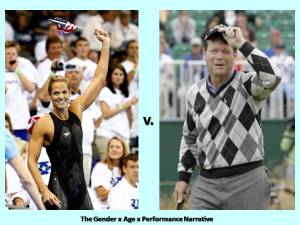
With the near win of Tom Watson at this year’s British Open, much talk arose around his age (59!) and his potential to win his 6th title at Turnberry. It reminded me of similar age x performance dialogue around then 41 year-old Dara Torres in the 2008 Beijing Olympics. Both athletes have accomplished much in their respective sports: Watson (8 major championships, 6th on the list of total major championship victories, and the oldest male golfer to almost win the British Open or any other major championship), Torres (first-ever 5 time US female Olympic swimmer, 10 medals- 4 gold, oldest female swimmer to make the Olympic Team after an 8-year hiatus). Both have accomplished feats when most opine them “too old”. Kudos!

Torres v. WatsonBut what I find interesting is how differently the media constructs the gender x age x performance narrative of Watson and Torres. Here are a few thoughts:

1. The media portrayed that fans WANTED Watson to win and were sad when he didn’t. For Torres the message was people would be surprised if Torres won, and could claim “I knew it” when she didn’t.

2. There was nary a mention that Watson was a father (he has two biological children, and three stepchildren) during the British Open, but we heard NON-STOP that Torres was a mother of one.

3. Also missing from Watson’s British Open run was talk of if he was “competing fairly” or on performance enhancing drugs (although we did hear this drum beat about Lance Armstrong in the past, not for the 2009 Tour de France…yet. Wait until/if he wins then we can discuss.). Torres had to endure (and still does) constant questions about this issue.

4. The media was all-over Watson’s fairy tale near-win, but barely covered Torres’ 50 Free win earlier in the month at the US Swimming National Championships. With that win Torres will compete with the U.S. World Championship Team in Rome in late July-early August.

5. I did not see one picture of Tom Watson posed “sexily” and showing off his AARP body, while we did see picture after picture of Dara Torres in sexy, glammed up poses. Just type ‘Dara Torres’ into Google and hit “images” if you don’t know what I’m talking about.

The take-home messages for these common patterns in the media’s portrayals of female athletes….a near win for a man is valued more than a win for a woman; motherhood defines female athletes but fatherhood is seldom mentioned for male athletes; “old” competitive, winning female athletes are under suspicion as “cheaters” while when “old” men are in the hunt because they are hard working, talented and wily; the bodies of even “old” female athletes can be exploited and sexualized…and regardless, a male athlete’s performance will always be more media worthy than his female counterpart regardless of age. Come to think of it there are even gendered differences about how “old” is defined and constructed. “Old” for a male athlete is ~60 years while “old” for a female athlete is 40…

But don’t give up all hope…Dara Torres does have Tom Watson on one thing….she’s Got Milk?.

Thoughts on Bras, (Soccer) Balls, & Bikes

A few random things to think about over the weekend:

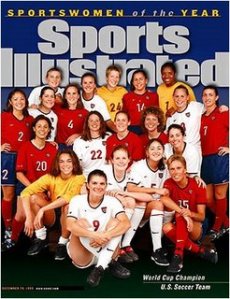
SICover_1999 world cup team1. As the 10th Anniversary of the 1999 Women’s World Cup in upon us, pay attention to how the media constructs this historic event. Will the focus be on a) the US win and competitive achievement, b) Brandi Chastain’s offing-the-soccer jersey to expose her Nike sports-bra (see the NCAA Double-A Zone), c) the “girls of summer” (i.e., the wholesome, attractive, All-American darlings that everyone fell in love with) many of whom are now mothers, d) how the historic event gave notice that people DO like to watch women’s sports (especially when it is promoted in the media and marketed) (see Christine Brennan’s USA Today column, e) how the team provided role models for young boys and girls, or f) spawned two women’s professional soccer leagues (see WPS) …..or perhaps some of all of the above? I’ll be curious to see what dominant messages arise.

women cycling2. The Tour de France is underway! Will Lance Armstrong really win it yet again? It got me thinking…why don’t women ride in the Tour de France? I did a little sleuthing and found no real answers but there IS a race called Le Grand Boucle (“the great loop”) which is been held off and on roughly over the last 15 years. The women’s race is shorter, has varied in the number of stages (the men’s race has 21), and the 2009 race will be just four days long “due to organizational difficulties” (according to Wikipedia..take it for what you will). If you know French, you can see the official website of Le Grand Boucle…je parlez un peu francais. It makes me think that the exclusion of women in the Tour de France is arbitrary, and the shorter “lesser than” women’s race, serves to perpetuate existing and historical gender hierarchies in sport that privilege male athletes.

Women Coaching Sports: A New Educational Series

Currently I am working on developing the first Women Coaching Sports workshop. Research shows female athletes who have never been coached by a female often believe that male coaches are more competent than female coaches. In the absence of female coaches and role models, female athletes may devalue their own abilities, accept negative stereotypes, fail to realize their potential, or consider coaching as a viable career path. In addition, research indicates that coaches cite formalized mentoring as the most important factor in their acquisition and development of coaching knowledge and expertise. Less than 20% of all youth sport coaches are female, and many female coaches face personal, familial and structural barriers that prevent or impede them from entering and remaining in coaching.

U of M coachTo help address these barriers, I’m developing an educational series for women who coach sports at the youth and interscholastic levels. Some of the curriculum utilizes ideas from youth sport mother-coaches I interviewed as part of a research initiative. The series mirrors the NACWAA/HERS Institute for collegiate coaches and administrators.

The purpose of the Women Coaching Sports workshop series is threefold:
1. To provide cutting-edge, research-based educational workshops for females who coach at the interscholastic and youth levels
2. To provide an opportunity for female coaches to build community, network, and develop on-going support for each other throughout their coaching tenures
3. To attract, develop, retain and empower diverse female coaches

The series is a collaborative outreach project of two entities at the University of Minnesota—the Tucker Center for Research on Girls & Women in Sport and the Minnesota Youth Sport Research Consortium.

I would love to hear your ideas about content to include in the workshop series or ideas you may have. Stay tuned for more information about this exciting venture!

Serena’s Shirt Exposes Wimbledon Sexism

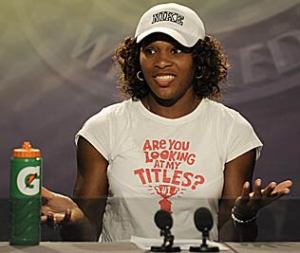
If you haven’t seen the t-shirt Serena Williams sported in her post-match Wimbledon press conference, then you are missing out.Titles2_serena Given the attention to attractiveness, court assignments, body parts (i.e., “back packs”) sex sells women’s tennis controversy at Wimbledon, Williams clearly has the last say. Perhaps it was in jest, but the point of the t-shirt which contrasts her athletic achievements (11 Grand Slam Titles) with a primary focus on her body, mocks the attention given to the feminine, attractive, sexualized nature of the dialogue surrounding her (and other female athletes) play over the fortnight. To hammer this point home….Just think if Roger Federer wore shorts to his press conference with print on the front asking “Are you looking at my trophy?”

For more critique, read the NPR piece “The Nation: Sexism On Centre Court” written by Dave Zirin in which Tucker Center Director Mary Jo Kane is quoted.

Serena Williams “Oversized Back Pack” Critiqued

When I read this column about Serena Williams by sportswriter Jason Whitlock, I had to include it in the blog for obvious reasons. The column wasn’t about Serena’s third Wimbledon Championship or 11th Grand Slam title, but a critique of how good she could be if she would rid of her “unsightly layer of thick, muscled blubber, a byproduct of her unwillingness to commit to a training regimen and diet that would have her at the top of her game year-round”. Whitlock couches his comments by saying he is really a big Serena fan, that she “has limitless potential” and that people are going to accuse him of being sexist…but really he just has her best interest in mind.

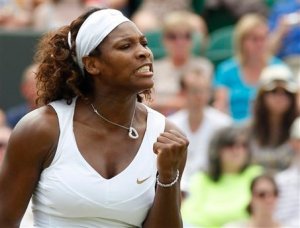
Britain Wimbledon TennisUsing flattery and sham transparency (I know you’ll call me sexist, so I’ll do it first, but I’ll say it anyway) to buffer sexist (or racist, misogynistic, homophobic) remarks is a classic diffusing technique used by those who make them. A real “fan” would not make such remarks as research demonstrates that sexist remarks have negative implications for the target’s (i.e. Serena) well-being and can lead to self-objectification. A real fan, let alone a sportswriter, would not focus on Serena’s “back pack” no matter how big or small it is perceived to be, and no matter how much it is perceived to help or hinder her play. The problem here is that instead of focusing on Serena Williams’ play and accomplishment, Whitlock is trivializing both. Whitlock uses his personal views to prescribe what he thinks is “hot and attractive”, perpetuates a narrow conception of beauty, reinforces the idea that only “in shape” women are attractive, and in the end proclaims that only attractive female athletes are worthy of being watched during prime time TV on Centre Court.

When you read about a sportswriter discussing the “back pack” of a highly accomplished male athlete and the writer’s preference for the “size” of the male athlete’s back pack let me know…Nike_BackPack_LARGE

UPDATE: Listen to Dave Zirin’s Edge of Sports radio spot in which Zirin rails Jason Whitlock’s column.