
Silent Sidelines: A Band Aid Approach To Controlling Youth Sport Parents

sideline parents arm around_iStock_000002126386XSmallMany strategies are commonly discussed to help change parental behavior on youth sport sidelines. Such strategies include: developing and enforcing a code of conduct; appointing a volunteer sideline monitor; leveling fines for inappropriate spectator behaviors; restricting spectator interaction with athletes (e.g., fans are required to sit on the opposite side of the soccer field from the coaches and team); restricting attendance (e.g., parents are not allowed to attend competitions or practices), and/or encouraging parents to suck on a lollipop if they feel like screaming at the referee or coaching from the sidelines.

Another strategy that gets quite a bit of attention is restricting spectator behaviors—i.e., “Silent Sidelines” or “Silent Sundays” (see the 2009 Toronto Star article or the 2004 NYT article). After reading yet another article lauding Silent Sidelines I felt compelled to give a critique of this and other strategies. In short, putative parental strategies are a terrible idea and provide a Band Aid solution to a deeper internal, chronic wound—the problems which arise on sidelines as youth sport becomes increasingly professionalized (Note: poor sport behavior of parents is not a new phenomena. For a balanced historical account, read Until It Hurts: America’s Obsession With Youth Sports by Mark Hyman and read his blog on youth sport parents). While reversing the professionalization of youth sport is beyond my capabilities (for now at least!), changing parental sideline behaviors IS possible.

BandAidsMany of these Band Aid strategies are employed without any research-based evidence of effectiveness or consultation from the sport science community. For example, barring parents from competition is not an optimal or effective solution because research indicates that a majority of children and adolescents enjoy when parents attend and watch competitions and parents are a vital source of support for children. The mere act of signing a “code of conduct” does not change behavior because it does not address the underlying or preceding feelings or thoughts of parents. To change behavior, parents must be provided with evidence of how their sideline behaviors—what a colleague and I call “background anger”—affects not only their child, but everyone else in the sport landscape. This information can provide motivation that increases the likelihood of behavioral change. Research seems to indicate that potential negative outcomes from exposure to youth sport background anger may include—anxiety, stress, decreased performance, loss of focus due to distraction by parents, confusion, embarrassment, frustration, less enjoyment, burnout and perhaps even dropout of sport altogether.

The important point here is that a Band Aid approach to changing the climate of youth sport sidelines addresses only the behavior (i.e., don’t yell = complete silence or silence by lollipop). An effective strategy promotes change through education and provides parents with research-based information as to what triggers angry parental responses, why it is important for example, not to yell on the sidelines, and how this behavior can affect everyone. For an exemplar educational program visit the University of Notre Dame’s Play Like a Champion Educational Series website and stay tuned for new research on the emotional experiences of sport parents and background anger from myself and colleagues of the Minnesota Youth Sport Research Consortium.

Thoughts on Bras, (Soccer) Balls, & Bikes

A few random things to think about over the weekend:

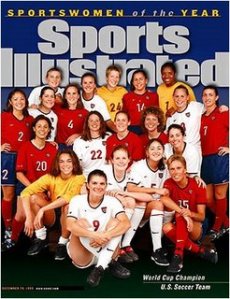
SICover_1999 world cup team1. As the 10th Anniversary of the 1999 Women’s World Cup in upon us, pay attention to how the media constructs this historic event. Will the focus be on a) the US win and competitive achievement, b) Brandi Chastain’s offing-the-soccer jersey to expose her Nike sports-bra (see the NCAA Double-A Zone), c) the “girls of summer” (i.e., the wholesome, attractive, All-American darlings that everyone fell in love with) many of whom are now mothers, d) how the historic event gave notice that people DO like to watch women’s sports (especially when it is promoted in the media and marketed) (see Christine Brennan’s USA Today column, e) how the team provided role models for young boys and girls, or f) spawned two women’s professional soccer leagues (see WPS) …..or perhaps some of all of the above? I’ll be curious to see what dominant messages arise.

women cycling2. The Tour de France is underway! Will Lance Armstrong really win it yet again? It got me thinking…why don’t women ride in the Tour de France? I did a little sleuthing and found no real answers but there IS a race called Le Grand Boucle (“the great loop”) which is been held off and on roughly over the last 15 years. The women’s race is shorter, has varied in the number of stages (the men’s race has 21), and the 2009 race will be just four days long “due to organizational difficulties” (according to Wikipedia..take it for what you will). If you know French, you can see the official website of Le Grand Boucle…je parlez un peu francais. It makes me think that the exclusion of women in the Tour de France is arbitrary, and the shorter “lesser than” women’s race, serves to perpetuate existing and historical gender hierarchies in sport that privilege male athletes.

Women Coaching Sports: A New Educational Series

Currently I am working on developing the first Women Coaching Sports workshop. Research shows female athletes who have never been coached by a female often believe that male coaches are more competent than female coaches. In the absence of female coaches and role models, female athletes may devalue their own abilities, accept negative stereotypes, fail to realize their potential, or consider coaching as a viable career path. In addition, research indicates that coaches cite formalized mentoring as the most important factor in their acquisition and development of coaching knowledge and expertise. Less than 20% of all youth sport coaches are female, and many female coaches face personal, familial and structural barriers that prevent or impede them from entering and remaining in coaching.

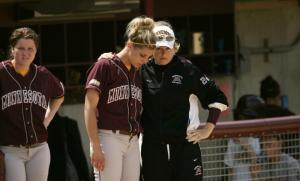
U of M coachTo help address these barriers, I’m developing an educational series for women who coach sports at the youth and interscholastic levels. Some of the curriculum utilizes ideas from youth sport mother-coaches I interviewed as part of a research initiative. The series mirrors the NACWAA/HERS Institute for collegiate coaches and administrators.

The purpose of the Women Coaching Sports workshop series is threefold:
1. To provide cutting-edge, research-based educational workshops for females who coach at the interscholastic and youth levels
2. To provide an opportunity for female coaches to build community, network, and develop on-going support for each other throughout their coaching tenures
3. To attract, develop, retain and empower diverse female coaches

The series is a collaborative outreach project of two entities at the University of Minnesota—the Tucker Center for Research on Girls & Women in Sport and the Minnesota Youth Sport Research Consortium.
I would love to hear your ideas about content to include in the workshop series or ideas you may have. Stay tuned for more information about this exciting venture!

Serena’s Shirt Exposes Wimbledon Sexism

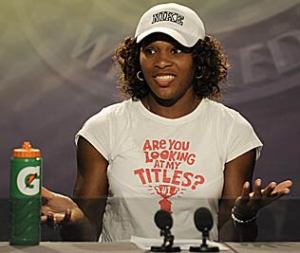
If you haven’t seen the t-shirt Serena Williams sported in her post-match Wimbledon press conference, then you are missing out.Titles2_serena Given the attention to attractiveness, court assignments, body parts (i.e., “back packs”) sex sells women’s tennis controversy at Wimbledon, Williams clearly has the last say. Perhaps it was in jest, but the point of the t-shirt which contrasts her athletic achievements (11 Grand Slam Titles) with a primary focus on her body, mocks the attention given to the feminine, attractive, sexualized nature of the dialogue surrounding her (and other female athletes) play over the fortnight. To hammer this point home….Just think if Roger Federer wore shorts to his press conference with print on the front asking “Are you looking at my trophy?”

For more critique, read the NPR piece “The Nation: Sexism On Centre Court” written by Dave Zirin in which Tucker Center Director Mary Jo Kane is quoted.

Serena Williams “Oversized Back Pack” Critiqued

When I read this column about Serena Williams by sportswriter Jason Whitlock, I had to include it in the blog for obvious reasons. The column wasn’t about Serena’s third Wimbledon Championship or 11th Grand Slam title, but a critique of how good she could be if she would rid of her “unsightly layer of thick, muscled blubber, a byproduct of her unwillingness to commit to a training regimen and diet that would have her at the top of her game year-round”. Whitlock couches his comments by saying he is really a big Serena fan, that she “has limitless potential” and that people are going to accuse him of being sexist…but really he just has her best interest in mind.

Britain Wimbledon TennisUsing flattery and sham transparency (I know you’ll call me sexist, so I’ll do it first, but I’ll say it anyway) to buffer sexist (or racist, misogynistic, homophobic) remarks is a classic diffusing technique used by those who make them. A real “fan” would not make such remarks as research demonstrates that sexist remarks have negative implications for the target’s (i.e. Serena) well-being and can lead to self-objectification. A real fan, let alone a sportswriter, would not focus on Serena’s “back pack” no matter how big or small it is perceived to be, and no matter how much it is perceived to help or hinder her play. The problem here is that instead of focusing on Serena Williams’ play and accomplishment, Whitlock is trivializing both. Whitlock uses his personal views to prescribe what he thinks is “hot and attractive”, perpetuates a narrow conception of beauty, reinforces the idea that only “in shape” women are attractive, and in the end proclaims that only attractive female athletes are worthy of being watched during prime time TV on Centre Court.

When you read about a sportswriter discussing the “back pack” of a highly accomplished male athlete and the writer’s preference for the “size” of the male athlete’s back pack let me know…Nike_BackPack_LARGE

UPDATE: Listen to Dave Zirin’s Edge of Sports radio spot in which Zirin rails Jason Whitlock’s column.

A Good Built Environment Increases Children’s Physical Activity

baseball in a small townThe American Academy of Pediatrics recently released a policy statement about the role of the built environment on children’s health. The built environment is overall structure of the physical environment of a child’s community (e.g., safe sidewalks, accessible parks, existence of bike paths) including spaces such as buildings and streets that are deliberately constructed as well as outdoor spaces that are altered in some way by human activity.

Emerging research indicates that the built environment limits or promotes opportunities for physical activity, in turn affecting child health—including obesity. A July 2009 report “F is for Fat: How Obesity Policies are Failing in America” released by the Robert Wood Johnson Foundation and the Trust for America’s Health indicated that in 30 states the percentage of obese and overweight children is at or above 30 percent. Obesity is a gendered and racialized issue as it is more prevalent in girls than boys, and girls of color have higher rates of overweight and obesity than do their White peers. (Note that the sign indicates “baseball diamond”… a game that girls have historically been excluded from. The sign does not say “ball fields” which could perhaps include softball assuming a softball field exists. To read more about girls and baseball read Jennifer Ring’s 2009 book Stolen Bases: Why American Girls Don’t Play Baseball)

In many communities across the US, the built environment unfortunately does not reflect the image depicted here…the existence of a safe community baseball field that youth can easily find, have access to, and may perhaps walk or bike to and from. The American Academy of Pediatrics report published in Pediatrics outlines a number of policies that can help create and increase the existence of health-promoting built environments.

Wimbledon’s Centre Court = Babe Central?

While I was out of town participating in the Up2Us Regional Sports-based Youth Development Conference hosted by the LA84 Foundation, a graduate student forwarded me an article link I felt compelled to share (thanks EH!).

A nydailynews.com article ran yesterday titled “Wimbledon turns Centre Court into Babe Central, giving players spotlight based on looks, not talent” which outlines that “hot, attractive” lower-ranked players were scheduled to play on Centre Count, and top-ranked players like Serena Williams were relegated to play on less prestigious courts. In the article All England Club spokesman Johnny Perkins was quoted as saying “good looks are a factor” when scheduling matches on Centre Court, in large part it seems due to television coverage.

Wimbledon Thought Process2

Greg Couch writes more about the “babe factor in tennis” on his blog where he states, “A few days ago, Maria Sharapova played Gisela Dulko, and on Wimbledon’s official website, the report of the match said, “As Sharapova and Dulko ran and stretched and lunged, most of the male spectators could not have cared less about their topspin forehands and would no more have recognized a western grip from a western movie — this match was about hormones, pure and simple.”

Unfortunately, it is also “pure and simple” another example of sport media and women’s sport promoting “sexy” athletes (which you could also read as White, feminine, & ponytailed) over athletic competence–which reinforces notions of what matters, what sells, and what is valued. If you want to read a new book out about this issue see D. Daniels (2009) “Polygendered and Ponytailed:The Dilemma of Femininity and the Female Athlete”.

Highest Paid v. Hottest Athletes

msftMSN.com recently posted two articles that represent a perfect example of gender inequality and sexist and marginalizing media coverage of female athletes. The articles speak for themselves….

First visit MSN Sports Hottest 30 Sportswomen , posted on June 23, 2009. (I looked for a companion piece on “The 30 Hottest SportsMEN”… to no avail)

Next visit the story posted June 21, 2009 on MSN titled World’s Highest-Paid Athletes (no female athletes here!)

Title IX Turns 37!

Title IX is a federal law passed in 1972 that requires gender equity for boys and girls in every educational program that receives federal funding. Many argue it is one of the most influential laws in recent history. In the realm of sport it has resulted in an explosion of sport participation for girls at all levels including youth interscholastic, and intercollegiate. In 1972 1 in 27 girls played high school sport, today that number is around 1 in 2.5! The Director of the Tucker Center for Research on Girls & Women in Sport at the University of Minnesota, Dr. Mary Jo Kane, is often quoted, “In one generation we’ve gone from girls hoping there was a team, to girls hoping they’d make the team.”

On June 23, 2009 as Title IX turns 37, we can celebrate the many gains made in all educational contexts for girls but we all need to commit to ensuring the law remains viable for the next 37 years and more!

Here are two of my favorite websites I turn to for information on Title IX:
Title IX
The National Women’s Law Center