Speechless Over Serena

I just got word via the BBC that “Serena Williams has been fined and given a suspended three-year ban from the US Open for her tirade at a line judge”

I really hope this is a bad joke. Three years? That seems a bit harsh doesn’t it? Would a male players be fined and suspended the same amount? I think players who have tested positive for an illegal substance, say steroids, have been banned for less time!

What does this say about the intersections of class, race and gender in the game of tennis in the 21st century? Who plays and under what conditions? Who is punished (or not) and for what transgressions? Who decides, under what conditions, using what criteria to determine “major offence of aggravated behaviour”. I’m speechless.

The LFL Sells Sex, Not Sport

During the recent sport sociology conference (NASSS) I heard inspired critiques of  sport and had many great conversations about sport media and female athletes. Ironically, I returned home today to this tweet by the Lingerie Football League.

RT @MyLFL: “THE LINGERIE FOOTBALL LEAGUE’S OFFICIAL WEBSITE WWW.LFLUS.COM IS OFFICIALLY ONE OF THE FASTEST GROWING WEBSITEShttp://bit.ly/2YQYvj”

As you know, I’ve written previously about the LFL and I’ve been keeping an eye on what is happening with the league. At the NASSS conference I heard some great audience reception research on why sex does not sell women’s sport, sex sells sex. More specifically, sexy images and sexy female athletes sell sex to young male consumers ages 18-35. I would be really interested to see the market research—who are the consumers and fans of the LFL? (any guesses?)

The LFL is a perfect example of how sex can and does sell sex. The numbers prove it. Arguably, the LFL is not sport it is a dramatic spectacle aimed at entertainment and consumption of the female body.  No where in any of the promotional materials is the athletic competence of LFL “athletes” highlighted or portrayed in any serious way. The  sexualization of the LFL women is overt and aimed at appealing to male sexual fantasy. In fact their website promotes the LFL as “True Fantasy Football” which merges two primary desires and interests of many (not all) US men— football and sex.

If you watch the many videos of LFL games posted on the website, you will see continuous images of women tackling each other, acting violent, and slamming each other to the ground.  Yet one women (New Mexico soccer player Elizabeth Lambert) acts aggressive and pulls a ponytail and we have a national outcry (see the video and read examples of indicative responses on Perez Hilton’s blog).  Male athletes act aggressively and unsportsmanlike all the time (remember Zidane’s head butt in the World Cup? or Florida football team member Brandon Spikes fingers through the face mask? , both of which were similarly caught on national TV). Yet, the sanctions for Lambert were severe and quick (permanent dismissal from the team), while Zindane and Spikes punishments were much less in scope and severity.

What is our take home? Females can act aggressively as long as they are sexy, but if a real female athlete acts outside of the rules in real sport, she will be met with quick and severe sanctions…not only within her sport but will be berated by the public…while male athletes can “act like men” with comparatively less fanfare.

What is most interesting to me is the societal discussion and the media’s construction of Lambert’s transgression, rather then the event itself.

Social Media for Female Athletes as Contested Terrain

imblanced scaleCurrently I’m at the North American Society for the Sociology of Sport (NASSS) in Ottawa. I’ve heard A LOT of great research and ideas that much head is spinning a bit.  I was in a session today that crystallized some thoughts about social media and women’s sports, and the dialogue that is occuring. Social media is a contested terrain-meaning that it is a site where struggle is occurring on many levels. Some of the issues that have arisen during the dialogue happening in many places (like here, here, and here) encompasses such questions as:  Who will control social media? Who decides? Is social media good or bad for women’s sports? I have some additional thoughts, albeit jumbled, I’ll add here to add to the conversation.

Social media is both good and bad, both positive and negative. It challenges and reproduces gender stereotypes. It allows female athletes and advocates of women’s sport to control the message and it is also a residual of traditional media (meaning social media has converged with traditional sport media…like ESPN channel and its social media correlate ESPN.com so therefore it really is not different). Social media is a space to promote women’s sport in the abasence of traditional media coverage and it is a site of unedited and unmediated backlash towards women’s sports. It is a powerful tool to promte women’s sports and also a tool that can hinder its progress.

Discussing social media in binary terms of good/bad erases the fact that women’s sports are forced to turn to and use social media as a way to promote themselves and their sport because of the lack of coverage in mainstream media. I think that is the bigger issue.  How can we tap into more progressive notions and mobilize ourselves to create social change–both in mainstream and social media.

However, this notion is predicated on the idea that everyone involved in women’s sports is on the same page. This is just not true. Diverse viewpoints  fosters rich dialogue and how issues are taken up varies,  for example: “Serena on the cover of ESPN magazine is beautiful” to “Serena is setting back women’s sport”.

Here is my question: Is it possible to create social change and challenge the system if we’re not all on the same page? Who’s page counts? Who decides?

What do you think?

Things That Make You Go Hmmmm…More on Social Media & Women’s Sport

Following the  Tucker Center lecture and new blog about the impact of social media and women’s sport, it didn’t take too long for me to be in the middle of a real life example. Life works in ironic ways sometimes, doesn’t it? This example is meant to continue the conversation about this emerging and important topic.

9uwom0322w.lOn Tuesday I was at my computer and looked over the TweetDeck and saw that WNBA player Janel McCarville was live on her UStream channel JMACTV. I’d heard about Candace Parker using UStream but hadn’t checked it out yet, so clicked on the link and….ta dah!…there was Janel. As a Minnesotan, two-time Gopher Alum and now Gopher faculty, huge fan of women’s basketball, and advocate/scholar of women’s sport, I’ve been a long time fan of Janel McCarville (no hate Janel, only love!). Who can forget the Whalen/McCarville dynasty in The Barn!

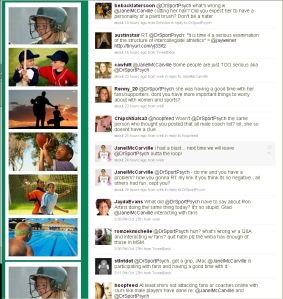
Janel !I thought, “This is really cool… instant access to an elite female athlete“, as I watched her looking at and responding to the comments and questions from the 60+ fans watching her. I shouted through my office door to my two graduate students to “check this out”. Then I took a harder look and wrinkled my brow, “Is she in the bathroom?” I asked them, “and is she really cutting her own hair?” (see screen shot)  Somehow I was a bit disturbed by this. I immediately wasn’t so sure this was cool anymore—or good for women’s sports. So given this subject has been top of mind, I tweeted about it—twice (see screen shot below).mccarville tweets

I continued to watch for about 10mns, and then shut down for the day. I continued to think about it over the next day or so.  In the course of “doing my warm up activities” for the day (aka surfing), I looked at my @ replies on Twitter and saw that my tweets had incited quite a bit of outrage, and a direct response from Janel herself! (see screen shot right, it will enlarge if you click on it).mccarville tweet responses The tone of the responses was “lighten up, this is just silly and fun and everyone but YOU thinks this is great”. Fair enough. I responded to Janel via Twitter:  “@JanelMcCarville No anger, just continuing conversation re: women’s sport & social media, both pro/con. See http://bit.ly/352s8T“. But I felt badly for criticizing her and it bothered me.
I learned a few valuable lessons which may be instructive as we all move forward and think about how to use social media effectively to positively promote women’s sports.

First, if social media is truly a two-way conversation, then I should of phrased my tweet “What is your opinion about @JanelMcCarville’s UStream videocast?”

Second, attacking people on Twitter is just in poor taste and not classy. My apologies Janel. This has played out for KC Chiefs NFL player Larry Johnson this week, as he is paying the price literally and in the media and  for using a homophobic slur. It will continue to occur with increased frequency as social media becomes part of the way we communicate.

Third, shortly thereafter I read a great piece by Q McCall of www.swishappeal.com on Feministing.com titled,  Is there a “feminist responsibility” to support women’s sports? It put into context some of the guilt I felt. Why was I attacking a female athlete?  I’m supposed to support women’s sport. But on the other hand, as a feminist, scholar, and advocate of women’s sport  I often feel I have the responsibility to wave the red flag and point out when I see something that may not be a “good thing”.  Perhaps my role is to raise the issue, provide an alternative viewpoint, and promote respectful discussion.

It also got me thinking about where female athletes and women’s sport might be headed in terms of social media. If everyone  “loves it” (all 66 viewers)—is this our new model of promoting women’s sport? Is that what fans really want to see? Is this how fans want to interact with athletes? Where is the line between “good access” and access that, to borrow from C + C Music Factory,  “Makes You go Hmmmm”? As was pointed out to me,  Ron Artest of the LA Lakers, got his hair cut that same day…which garnered media attention. But if the men do it, should the women follow? Should we always be trying to emulate our male counterparts? (I’m not suggesting that is why Janel chose to UStream, she’d have to tell us the inspiration). Is it possible male athletes use social media differently because of disparate patterns of traditional media coverage? What are the similar and different ways elite male and female athletes use social media? How can female athletes take control and use social media in positive ways to combat sexism, inequalities, and disparities that are well documented in sport contexts? Is this a responsibility they should bear? In conclusion, I highlight Janel not to criticize or judge, but to provide an exemplar real-life issue to promote discussion about social media and women’s sports.

I don’t have the answer, only a lot of questions. What do you think?

Stereotypical Media Representations of Female Athletes Starts Early

boy & girlToday I was preparing for a WeCoach workshop and was looking for some images on IStock.com. Pictured here is a classic example of how the (re)production of gender stereotypes starts early and in ways we might not even notice because they seem so innocuous. Ironically, shortly after I found these images I read the AAUW blog on Why Media Representation Matters which touched upon the newly released The Shriver Report-A Woman’s Nation. So far, I’ve read the Executive Summary of A Woman’s Nation, and in light of the Tucker Center’s Distinguished Lecture on the potential impact  of social media on women’s sport and the story released today by the New York Post suggesting that ESPN encourages “sexual insensitivity”,  I was struck by the assertion that outdated gender stereotypes will only change if women rise within the ranks and launch new media of their own. So what are we waiting for?

Top 5 Take Aways: Social Media & Women’s Sports

Social Media Pic_iStock_000009648196XSmall

On Monday, October 19 I took part in the Tucker Center Distinguished Lecture Series on The Impact of Social Media on Women’s Sports-which you can view in its entirety here. There were so many great ideas  and critical thinking from so many perspectives that I’m still processing, but here are my Top 5 as of now.

1. Women’s sport marketing & promotions have always been viral and no one is really sure how to measure return on investment. Social media should be about building relationships and you can’t always measure the impact of relationship building.  (@DigitalMaxwell, Dr. Heather Maxwell)

2. The success of female sports journalists depends on the success of women’s sports, but half of female sport journalists surveyed don’t feel a responsibility to cover women’s sports. They don’t want to be pigeon-holed.(@mariahardinpsu, Dr. Marie Hardin)

3. Is it fair to place the burden of marketing & promoting women’s sports on the shoulders of the female athletes-especially those in “non-traditional” sports like ice hockey? Is this the new model we are left with as social media envelops traditional sport media (where female athletes get 6-8% of the coverage)? (@angelaruggiero, Angela Ruggiero, US Women’s National Ice Hockey Team)

4. Interest in women’s sport is being measured by “click throughs” in online editions of newspapers & websites. So if people don’t click on women’s sport stories, it is interpreted as “non interest”. Those who support women’s sports have to CLICK the stories that we can find!  (Rachel Blount, Sports Columnist, Star Tribune)

5. Time remains to take control of social media and use it effectively to grow women’s sports, but time is running out (Rachel Blount, Sports Columnist, Star Tribune)

If you watched it what were your thoughts?

3 Letters Make A Big Difference for WNBA’s Taurasi

Does anyone else find it ironic that WNBA player  Diana Taurasi of the Phoenix Mercury went from DUI in July to 2009 WNBA MVP in  September and WNBA Champion in October? Perhaps more interesting is that the DUI was rarely  mentioned at all in the last few weeks of the WNBA playoffs. What are your thoughts on this? I’m mixed. I’d love to hear what you’re thinking.

FINALLY! A Worthy Comparison

wnbaOn the eve of the final WNBA playoff game, I just watched a fantastic video made by a WNBA Intern, that I saw due to a Tweet by Minnesota Lynx player Candice Wiggins (@candicwiggins). In the video, clips featuring similar plays from the NBA and WNBA are shown back-to-back or simultaneously.  What this sets up is that WNBA players are as athletic as, and do exactly the same exciting plays as their NBA counterparts. Female athletes are depicted in action, on the court, in uniform doing what they do best (in contrast to passive, off the court, and NOT in *cough* uniform Serena Williams). Brilliant! Usually when female athletes are compared to male athletes, the male version of the game is constructed as “better than”, more exciting, or the real version. Not in this video!

Advice to the WNBA: HIRE THIS INTERN. Whomever you are Intern, NICE WORK! This is exactly the kind of marketing and fresh thinking the WNBA needs to sustain the league.

Update: I’ve been advised that credit may be due to more than one intern. In that case, hire them all!

A Pattern Has Emerged

I’m not a big fan of ESPN The Magazine, as I’ve written about their cover photos and coverage of women’s sport in a previous blog….or should I say LACK of coverage that focuses on athleticism, rather than being feminine and sexy.

Serena ESPN mag_Oct 2009

Their latest series of 6 covers for the October 19, 2009  “The Body Issue” has Serena Williams posing naked (thanks for the head’s up EH). It seems to me a recent pattern has emerged.

Here is the pattern:

1) A Black female athlete performs well and dominates opponents,

2) During the course of competition she acts outside prescribed gender norms (i.e., looks like a man, yells and argues with a referee),

3) Subsequently she is grilled and sanctioned by the public and the media,

4) Therefore she has to recover by performing versions of the female athlete apologetic by literally apologizing like S. Williams, and/or highlighting heterosexy femininity on the cover of  magazines. I’m talking about first, Caster Semenya and now Serena Williams (see picture here).

Underlying sport media portrayals of highly talented Black female athletes are racism and sexism. I suppose my blog title should really read…A Pattern Has REemerged.

NOTE: If you want to see the making of The Body Issue and gain insight to the ‘issue’ (and see a whole lot naked) click here.

Who Knew Tampons Could Be So Funny?

About a month ago I was watching TV and saw a strange commercial for Always, a feminine pad hygiene product, with the tag line “Have a happy period” with a woman dressed in white pulling a pristine pad out of a box, like as in a magic trick. I couldn’t find that ad but did find a French counterpart in which…well just watch it.

happy period
The themes in the Always ad campaign connote freshness, cleanliness, and relaxation. All words that women think of while menstruating (not).According to a New York Times piece women who use pads versus tampons have a different attitude about their periods. Which leads me to….

Yesterday I was alerted by @mhueter to a TV ad for Tampax in which Serena Williams takes on Mother Nature in a tennis match. When I first saw it, I wasn’t sure if it was hysterically funny and clever or super sexist. After watching it a few times, I’m going with the former. I love this ad! I love it because it uses humor to connect with women, rather than try to sell the idea of sanitary freshness regarding the process of menstruation (a rather mythical idea).

The Tampax ad uses strength, athleticism, physical activity, trash talking, and female athletes to promote a very different message to girls and women, than do the Always ads. The Always ad closely mirrors outdated gender stereotypes which were packaged and sold to women in the 1950’s, while the Tampax ad is a contemporary re-brand that females can do anything…and are not slowed down or marginalized by menstruation. I’m sure others out there find the video offensive, or as one colleague said “insipid”, but I’m sticking with funny. Sometimes one must put her critical lens aside and lighten up. Excuse me while I go watch it again. Game, Set and Match to Tampax 6-0, 6-0.