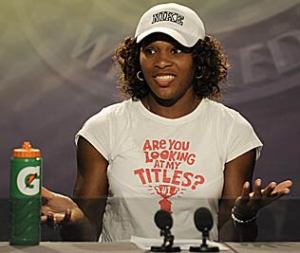
Serena’s Shirt Exposes Wimbledon Sexism

If you haven’t seen the t-shirt Serena Williams sported in her post-match Wimbledon press conference, then you are missing out.Titles2_serena Given the attention to attractiveness, court assignments, body parts (i.e., “back packs”) sex sells women’s tennis controversy at Wimbledon, Williams clearly has the last say. Perhaps it was in jest, but the point of the t-shirt which contrasts her athletic achievements (11 Grand Slam Titles) with a primary focus on her body, mocks the attention given to the feminine, attractive, sexualized nature of the dialogue surrounding her (and other female athletes) play over the fortnight. To hammer this point home….Just think if Roger Federer wore shorts to his press conference with print on the front asking “Are you looking at my trophy?”

For more critique, read the NPR piece “The Nation: Sexism On Centre Court” written by Dave Zirin in which Tucker Center Director Mary Jo Kane is quoted.

A Good Built Environment Increases Children’s Physical Activity

baseball in a small townThe American Academy of Pediatrics recently released a policy statement about the role of the built environment on children’s health. The built environment is overall structure of the physical environment of a child’s community (e.g., safe sidewalks, accessible parks, existence of bike paths) including spaces such as buildings and streets that are deliberately constructed as well as outdoor spaces that are altered in some way by human activity.

Emerging research indicates that the built environment limits or promotes opportunities for physical activity, in turn affecting child health—including obesity. A July 2009 report “F is for Fat: How Obesity Policies are Failing in America” released by the Robert Wood Johnson Foundation and the Trust for America’s Health indicated that in 30 states the percentage of obese and overweight children is at or above 30 percent. Obesity is a gendered and racialized issue as it is more prevalent in girls than boys, and girls of color have higher rates of overweight and obesity than do their White peers. (Note that the sign indicates “baseball diamond”… a game that girls have historically been excluded from. The sign does not say “ball fields” which could perhaps include softball assuming a softball field exists. To read more about girls and baseball read Jennifer Ring’s 2009 book Stolen Bases: Why American Girls Don’t Play Baseball)

In many communities across the US, the built environment unfortunately does not reflect the image depicted here…the existence of a safe community baseball field that youth can easily find, have access to, and may perhaps walk or bike to and from. The American Academy of Pediatrics report published in Pediatrics outlines a number of policies that can help create and increase the existence of health-promoting built environments.

Highest Paid v. Hottest Athletes

msftMSN.com recently posted two articles that represent a perfect example of gender inequality and sexist and marginalizing media coverage of female athletes. The articles speak for themselves….

First visit MSN Sports Hottest 30 Sportswomen , posted on June 23, 2009. (I looked for a companion piece on “The 30 Hottest SportsMEN”… to no avail)

Next visit the story posted June 21, 2009 on MSN titled World’s Highest-Paid Athletes (no female athletes here!)

What if the athletes were boys, not girls?

question_mark_3dIn a previous blog, I wrote about a male soccer coach in Minnesota who had his U12 elite girls’ team throw a game to the U13 girls’ team in the same club (Minnesota Thunder Academy).

A great MN female youth soccer coach I emailed with has a great point about this scenario. She writes,

Could you imagine if a coach had told a team of highly competitive boys to purposely throw a semi-final game to get an invitation to go on to a regional tournament? I believe people would be outraged – I definitely don’t think the sentiment would be “ Let’s move on, we have learned from the mistake.” This team he asked to purposely lose is a hand picked, highly skilled, immensely competitive group of girls and he asked them to bow out of a game – and most people seem to be okay with it! I can pretty much guarantee this would have NEVER happened if this was a boys team. I am not even touching on the fact that this was against any and all spoken/unspoken rules regarding coaching ethics. I am very concerned that a coach of his caliber would have his girls team lose on purpose because it was the “classy thing to do” – I ask myself would he have done this if he was coaching boys? That question hasn’t even come up in the communities because, I am saddened to say, I think most people still look at girls sports on a different level than boys. The playing field definitely does not seem to be level.”

Well said Coach!

How Not to Coach Soccer: A Lesson From Minnesota

iStock_minority girls soccer_XSmallWhen I’m not writing about gender, the other part of my research, teaching and outreach pertains to youth sport—mainly studying and trying to improve sport parent sideline behavior, and helping coaches be more effective. When a story broke last week about a Minnesota club soccer team, many of my colleagues and former students forwarded the story link to me which got quite a bit of press here in Minnesota and around the country.

In short, two of the Minnesota Thunder Academy (MTA) teams played each other in the State Cup final to see who would advance to the Regionals—it was the 12-and-under girls v. the 13-and-under girls. The game ended with penalty kicks, when Coach Abboud asked the younger girls to pass the ball nicely to the opposing keeper, in essence throwing the game to the older U-13 team, instead of taking the penalty kicks to win the game. Chaos, tears, frustration, confusion, emergency meetings at all levels, commentary, opinions, anger, a public apology from Abboud, and parental support for the coach ensued. To read all the details go to, the Inside Minnesota Soccer article, the Star Tribune article, and Coach Mark Abboud’s own contrition on his blog.

Let me put this incident into a broader context of youth sport trends. The MTA is one of the most elite of soccer clubs, for “serious soccer players”, meaning they hand pick the best kids from other clubs around the state. In fact, the MTA girls recently joined the inaugural Eilte Clubs National League…yes, “national” league for 13-year-olds.

Winning_iStock_000005893466XSmallSome would argue this type of sport club is the poster child for everything that is wrong with youth sports-specialization, not developmentally appropriate, a win at all cost philosophy, year-round training, privatization, overuse injuries, burnout due to high stress and anxiety, dropout, overzealous parents, highly paid coaches with big egos, treating children like “mini-professional” athletes, and highly structured and governed adult-run clubs and organizations (to name a few).

red card_iStock_000003976608XSmallSport provides many “teachable moments”. Good coaches teach athletes to give full effort, focus on what they can control, treat opponents with respect regardless of the situation, and accept the outcome with grace. One decision by a coach does have an impact on everyone involved, and this is a cautionary tale of how not to coach because, simply put, it taught the wrong lessons. In soccer terms, this coach deserves a red card, and possibly more severe sanctions.

P.S.-A critical gender note. Notice the Minnesota Thunder Academy that houses both boys’ and girls’ teams is the namesake of the men’s team (the Thunder), and not the women’s team (the Lightening).thunderightning

Sexism & Horse Racing: The Preakness

RAI’m watching the pre-race coverage of the Preakness horse race right now on NBC. I’ve been following the media coverage of this race all week. Drama and debate rage on “should fillies race with stallions” due to the recent success of filly Rachel Alexandra. What strikes me, is that nearly the same arguments arise when female athletes compete or encroach upon male sport…wait…I’m sorry horses are athletes (just look at ESPN’s Top 100 athletes of the century…where there are almost as many horses as female athletes).

Some, including RA’s former owner Harold McCormick, stated that “fillies should race with fillies, and stallions with stallions”. RA’s new owner Jess Jackson said today on NBC that “Champions should race with champions….the best should race against each other…and it isn’t a matter of female or male, she is a good horse.” Sport sociologists have pointed out that separating male and female athletes is arbitrary and serves to reinforce a gender binary that perpetuates male superiority, because if females are not allowed to compete with males, females can never beat males.

RA is bigger and weighs more than Mine That Bird who won the Kentucky Derby, but everyone is talking about how she is “at more risk for injury” (which is another reason why it is argued females should not compete with males, they are fragile and more susceptible for injury). But no commentators are saying that Mine That Bird should not race because he is smaller and weighs less.

Her new trainer just said that “she is a classy filly” and they have just been trying to keep her happy. Classy and happy? Would we say that about a male horse? (maybe we do, I don’t know horse racing well).

One commentator just said RA is a “man running against boys….she’s a freak!” and a former jockey commentator called her “a super filly” (when female athletes are really good and start beating males, they are often called “men” or labeled lesbian. Females are in essence regendered or classified as super-normal, to explain why they excel in sports). Only a “super” filly can beat a male horse! Well let’s see what happens!……

UPDATE: RACHEL ALEXANDRA WINS!!!!!!!!!!!!!!!!! THE FIRST FILLY TO WIN THE PREAKNESS SINCE 1924 and the first horse to win it from the #13 position! Perhaps she IS a super filly. Her jockey Calvin Borel just said, “She is the best horse he’s ever ridden”. (he didn’t say best female horse…best horse). We can only hope the post-race coverage is less sexist and echos that of Borel…she is a great horse. Period.

Selling Sex Does NOT Attract Men to Women’s Sport

I just saw a short video as a result of a Twitter from the WNBA. The power of social media at work for one “opt-in” follower! The video is by Mr. Alex Chambers, a self-proclaimed avid WNBA fan who also Twitters, and blogs. Yes, I said “Mr”!

I’m posting this because Mr. Chambers is a prime example of my previous point that sex does not sell women’s sport, it sells sex (not sport) to young men….and alienates and/or offends female sport fans. If women’s professional sport leagues want attract the coveted demographic–young male sport fans–they have to do a better job of selling athletic competence.

Notice in Mr. Chambers’ video, not once does he mention how attractive, sexy, feminine, or motherly the players are. He loves BASKETBALL and he loves the WNBA. 0908jack-black-wnba200I agree with him there are more male fans out there like him….and more that would likely become women’s sport fans if it was marketed differently or deemed “cool” and acceptable by males in general (like if Jack Black pictured here were at a Sparks game…I’m not sure if he is or isn’t at a WNBA game). Keep up the good work Alex Chambers…I can’t wait to hear more about your “journey” this summer. On similar note, the WNBA is about to fully release their new marketing campaign “Expect Great”. The title sounds promising!

Does Sex Sell Women’s Sport?

I’ve been wanting to write a blog about this topic for awhile and a recent interview given by my colleague and the Director of the Tucker Center for Research on Girls & Women in Sport Professor Mary Jo Kane on the Edge of Sports Radio with Dave Zirin provided me with a perfect opportunity!

In the interview with Zirin she discusses research, conducted with Heather Maxwell (Ph.D.), in which their findings refute the idea that sex sells women’s sports. Kane also discusses how the notion of “sex sells” is related to depictions of motherhood and female athletes—like the magazine covers of Sheryl Swoopes and Candace Parker pictured here, homophobia and Pat Griffin’s idea of The Glass Closet, and her thoughts on the Women’s Final Four sport media coverage. (Note: Motherhood and elite female athletes is a popular blog topic lately..see Maria Hardin’s blog and the Pretty Tough blog)Swoopes and Parker_pregnant

I also think Kane’s interview helps us think through why some female athletes feel it is important to “have it all” (i.e., be sexy, feminine, AND athletic)…which I’ve touched upon in a previous blog about social media.

The interview is less than 5 minutes and well worth your while to hear one of the leading experts on sport media, Title IX, gender, and women’s sports talk critically and share cutting edge research. In the end, as Zirin says, “Sex sells sex“. Sex does NOT sell women’s sports.

Why Mothers Coach

iStock__mom coach soccer_XSmallIn a study where we interviewed mothers who were also youth sport coaches, we wanted to know why they were coaching. A majority of the time the primary focus, including my recent posts on female youth sport coaches, is on the barriers that limit or prevent mothers, and females in general, from coaching. So, in honor of all the mothers everywhere who spend their time and energy coaching their own and other people’s children—Happy Mother’s Day and thank you!

A major reason many mothers coach is because it provides time for them to spend with their child(ren). One mom said, “You know it gave us another chance to spend time together in a different way other than just being at home or being in a social situation, and so I really enjoyed it and she did, too. Even though she was the coach’s daughter it worked out.”

Mothers in our study coached because they saw a need for female coaches and good coaches in general, and felt coaching provided an outlet to share their experience, passion for sport and sport knowledge with their children. Mothers discussed the importance of providing positive role models—particularly for girls—and felt coaching was fun and rewarding.

Thanks to the many women—mothers and non-mothers alike—who coach our children and youth! You are the missing piece of the youth sport puzzle.