A strange day in the world of sport media

You know how people claim “bad things happen in threes” well after the last 24 hours of things I’ve seen and read in the sport media, I believe it!

1. “The Erin Andrews Peep Show” which if you haven’t heard about by now, then you’re not reading or watching the sport media (To read about what happened and the critical analysis “it” go to the Sports, Media, & Society blog, After Atlanta blog, or a post on Feministing.com titled “A long History of Objectifying Erin Andrews”.) Unfortunately as After Atlanta points out, nearly 20 years ago we had the Lisa Olson “incident” in the Patriots’ locker room, which documents a long history of sexual harassment and objectification of female sport journalists who dare to cover and/or write about male athletes. What I found almost as irksome is the public’s reaction to USA Today sport columnist Christine Brennan’s tweets (@cbrennansports) about the issue in which she said female sport journalists shouldn’t “play to the frat boys” but write or respond as if she were talking to a “12 year old girl sitting on her couch.” Brennan’s remarks were misconstrued and she herself was called “sexist”. Anyone who knows or has followed Christine Brennan knows this is ridiculous! But on the flip side, as Marie Hardin (one of the leading experts on media & gender) points out, female sport journalists in her research often play the blame game when a female colleague is discriminated against. However, which ever side you fall, I think much of the public response to Brennan was yet another example of the sanctioning of female sport journalists…in part, the the traffic over both these issues crashed the server at Women Talk Sports! Even that is sad…that BAD and icky news about women’s sport and female sport journalists have people searching those terms and THEN click upon Women Talk Sports.

2. Then I read on the @womentalksports Twitter an unedited USOC headline: “Can an Olympic athlete be a pimp?” The first line of the story reads, “A lot of women will need to have a lot of sex with a lot of men to get Logan Campbell to the 2012 Olympic Games.Yes, you read that right. Campbell, to cut a long story short, is a New Zealand taekwondo athlete who has opened a brothel to finance his ambition of winning an Olympic medal in London…He has more than a dozen women handing over half their earnings to him. It is, in his words, ‘a good moneymaking industry.’ ” I think this story speaks for itself, but the most disturbing part as it pertains to sport media is that the story was ON THE OFFICIAL WEBSITE OF THE U.S. OLYMPIC COMMITTEE.

3. And to round out the trifecta of sexist sport stories, an article about Bernadette Locke Mattox one of only three women in NCAA history to have coached in Division I men’s basketball. “Cool!”, I thought given my research on the dearth of female coaches at all levels….and then I read it. Rick Pitino hired Mattox because “he needed a woman to burnish the image of Kentucky basketball and to emphasize academics, career planning and integrity,” and the assistants reported she smelled good….but “she was just one of the guys.” You leave the article feeling like Pitino hired a pseudo-mother for “his boys” and her pioneering position and obvious skill as a coach were lost. This type of blatant gender bias in sport media is one of the many contributing factors as to why coaching men remains off limits to women at all levels (~2-4% of boys and men are coached by females at every level) and female coaches are routinely perceived as less competent than their male counterparts according to research.

Tomorrow is a new day….
Thoughts on Bras, (Soccer) Balls, & Bikes

A few random things to think about over the weekend:

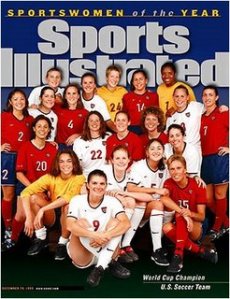
SICover_1999 world cup team1. As the 10th Anniversary of the 1999 Women’s World Cup in upon us, pay attention to how the media constructs this historic event. Will the focus be on a) the US win and competitive achievement, b) Brandi Chastain’s offing-the-soccer jersey to expose her Nike sports-bra (see the NCAA Double-A Zone), c) the “girls of summer” (i.e., the wholesome, attractive, All-American darlings that everyone fell in love with) many of whom are now mothers, d) how the historic event gave notice that people DO like to watch women’s sports (especially when it is promoted in the media and marketed) (see Christine Brennan’s USA Today column, e) how the team provided role models for young boys and girls, or f) spawned two women’s professional soccer leagues (see WPS) …..or perhaps some of all of the above? I’ll be curious to see what dominant messages arise.

women cycling2. The Tour de France is underway! Will Lance Armstrong really win it yet again? It got me thinking…why don’t women ride in the Tour de France? I did a little sleuthing and found no real answers but there IS a race called Le Grand Boucle (“the great loop”) which is been held off and on roughly over the last 15 years. The women’s race is shorter, has varied in the number of stages (the men’s race has 21), and the 2009 race will be just four days long “due to organizational difficulties” (according to Wikipedia..take it for what you will). If you know French, you can see the official website of Le Grand Boucle…je parlez un peu francais. It makes me think that the exclusion of women in the Tour de France is arbitrary, and the shorter “lesser than” women’s race, serves to perpetuate existing and historical gender hierarchies in sport that privilege male athletes.

Serena’s Shirt Exposes Wimbledon Sexism

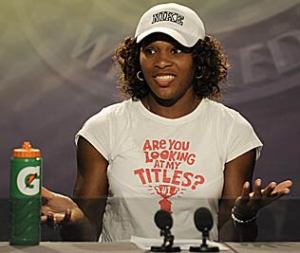
If you haven’t seen the t-shirt Serena Williams sported in her post-match Wimbledon press conference, then you are missing out.Titles2_serena Given the attention to attractiveness, court assignments, body parts (i.e., “back packs”) sex sells women’s tennis controversy at Wimbledon, Williams clearly has the last say. Perhaps it was in jest, but the point of the t-shirt which contrasts her athletic achievements (11 Grand Slam Titles) with a primary focus on her body, mocks the attention given to the feminine, attractive, sexualized nature of the dialogue surrounding her (and other female athletes) play over the fortnight. To hammer this point home….Just think if Roger Federer wore shorts to his press conference with print on the front asking “Are you looking at my trophy?”

For more critique, read the NPR piece “The Nation: Sexism On Centre Court” written by Dave Zirin in which Tucker Center Director Mary Jo Kane is quoted.

Serena Williams “Oversized Back Pack” Critiqued

When I read this column about Serena Williams by sportswriter Jason Whitlock, I had to include it in the blog for obvious reasons. The column wasn’t about Serena’s third Wimbledon Championship or 11th Grand Slam title, but a critique of how good she could be if she would rid of her “unsightly layer of thick, muscled blubber, a byproduct of her unwillingness to commit to a training regimen and diet that would have her at the top of her game year-round”. Whitlock couches his comments by saying he is really a big Serena fan, that she “has limitless potential” and that people are going to accuse him of being sexist…but really he just has her best interest in mind.

Britain Wimbledon TennisUsing flattery and sham transparency (I know you’ll call me sexist, so I’ll do it first, but I’ll say it anyway) to buffer sexist (or racist, misogynistic, homophobic) remarks is a classic diffusing technique used by those who make them. A real “fan” would not make such remarks as research demonstrates that sexist remarks have negative implications for the target’s (i.e. Serena) well-being and can lead to self-objectification. A real fan, let alone a sportswriter, would not focus on Serena’s “back pack” no matter how big or small it is perceived to be, and no matter how much it is perceived to help or hinder her play. The problem here is that instead of focusing on Serena Williams’ play and accomplishment, Whitlock is trivializing both. Whitlock uses his personal views to prescribe what he thinks is “hot and attractive”, perpetuates a narrow conception of beauty, reinforces the idea that only “in shape” women are attractive, and in the end proclaims that only attractive female athletes are worthy of being watched during prime time TV on Centre Court.

When you read about a sportswriter discussing the “back pack” of a highly accomplished male athlete and the writer’s preference for the “size” of the male athlete’s back pack let me know…Nike_BackPack_LARGE

UPDATE: Listen to Dave Zirin’s Edge of Sports radio spot in which Zirin rails Jason Whitlock’s column.

Wimbledon’s Centre Court = Babe Central?

While I was out of town participating in the Up2Us Regional Sports-based Youth Development Conference hosted by the LA84 Foundation, a graduate student forwarded me an article link I felt compelled to share (thanks EH!).

A nydailynews.com article ran yesterday titled “Wimbledon turns Centre Court into Babe Central, giving players spotlight based on looks, not talent” which outlines that “hot, attractive” lower-ranked players were scheduled to play on Centre Count, and top-ranked players like Serena Williams were relegated to play on less prestigious courts. In the article All England Club spokesman Johnny Perkins was quoted as saying “good looks are a factor” when scheduling matches on Centre Court, in large part it seems due to television coverage.

Wimbledon Thought Process2

Greg Couch writes more about the “babe factor in tennis” on his blog where he states, “A few days ago, Maria Sharapova played Gisela Dulko, and on Wimbledon’s official website, the report of the match said, “As Sharapova and Dulko ran and stretched and lunged, most of the male spectators could not have cared less about their topspin forehands and would no more have recognized a western grip from a western movie — this match was about hormones, pure and simple.”

Unfortunately, it is also “pure and simple” another example of sport media and women’s sport promoting “sexy” athletes (which you could also read as White, feminine, & ponytailed) over athletic competence–which reinforces notions of what matters, what sells, and what is valued. If you want to read a new book out about this issue see D. Daniels (2009) “Polygendered and Ponytailed:The Dilemma of Femininity and the Female Athlete”.

Highest Paid v. Hottest Athletes

msftMSN.com recently posted two articles that represent a perfect example of gender inequality and sexist and marginalizing media coverage of female athletes. The articles speak for themselves….

First visit MSN Sports Hottest 30 Sportswomen , posted on June 23, 2009. (I looked for a companion piece on “The 30 Hottest SportsMEN”… to no avail)

Next visit the story posted June 21, 2009 on MSN titled World’s Highest-Paid Athletes (no female athletes here!)

What if the athletes were boys, not girls?

question_mark_3dIn a previous blog, I wrote about a male soccer coach in Minnesota who had his U12 elite girls’ team throw a game to the U13 girls’ team in the same club (Minnesota Thunder Academy).

A great MN female youth soccer coach I emailed with has a great point about this scenario. She writes,

Could you imagine if a coach had told a team of highly competitive boys to purposely throw a semi-final game to get an invitation to go on to a regional tournament? I believe people would be outraged – I definitely don’t think the sentiment would be “ Let’s move on, we have learned from the mistake.” This team he asked to purposely lose is a hand picked, highly skilled, immensely competitive group of girls and he asked them to bow out of a game – and most people seem to be okay with it! I can pretty much guarantee this would have NEVER happened if this was a boys team. I am not even touching on the fact that this was against any and all spoken/unspoken rules regarding coaching ethics. I am very concerned that a coach of his caliber would have his girls team lose on purpose because it was the “classy thing to do” – I ask myself would he have done this if he was coaching boys? That question hasn’t even come up in the communities because, I am saddened to say, I think most people still look at girls sports on a different level than boys. The playing field definitely does not seem to be level.”

Well said Coach!

How Not to Coach Soccer: A Lesson From Minnesota

iStock_minority girls soccer_XSmallWhen I’m not writing about gender, the other part of my research, teaching and outreach pertains to youth sport—mainly studying and trying to improve sport parent sideline behavior, and helping coaches be more effective. When a story broke last week about a Minnesota club soccer team, many of my colleagues and former students forwarded the story link to me which got quite a bit of press here in Minnesota and around the country.

In short, two of the Minnesota Thunder Academy (MTA) teams played each other in the State Cup final to see who would advance to the Regionals—it was the 12-and-under girls v. the 13-and-under girls. The game ended with penalty kicks, when Coach Abboud asked the younger girls to pass the ball nicely to the opposing keeper, in essence throwing the game to the older U-13 team, instead of taking the penalty kicks to win the game. Chaos, tears, frustration, confusion, emergency meetings at all levels, commentary, opinions, anger, a public apology from Abboud, and parental support for the coach ensued. To read all the details go to, the Inside Minnesota Soccer article, the Star Tribune article, and Coach Mark Abboud’s own contrition on his blog.

Let me put this incident into a broader context of youth sport trends. The MTA is one of the most elite of soccer clubs, for “serious soccer players”, meaning they hand pick the best kids from other clubs around the state. In fact, the MTA girls recently joined the inaugural Eilte Clubs National League…yes, “national” league for 13-year-olds.

Winning_iStock_000005893466XSmallSome would argue this type of sport club is the poster child for everything that is wrong with youth sports-specialization, not developmentally appropriate, a win at all cost philosophy, year-round training, privatization, overuse injuries, burnout due to high stress and anxiety, dropout, overzealous parents, highly paid coaches with big egos, treating children like “mini-professional” athletes, and highly structured and governed adult-run clubs and organizations (to name a few).

red card_iStock_000003976608XSmallSport provides many “teachable moments”. Good coaches teach athletes to give full effort, focus on what they can control, treat opponents with respect regardless of the situation, and accept the outcome with grace. One decision by a coach does have an impact on everyone involved, and this is a cautionary tale of how not to coach because, simply put, it taught the wrong lessons. In soccer terms, this coach deserves a red card, and possibly more severe sanctions.

P.S.-A critical gender note. Notice the Minnesota Thunder Academy that houses both boys’ and girls’ teams is the namesake of the men’s team (the Thunder), and not the women’s team (the Lightening).thunderightning