Serena’s Shirt Exposes Wimbledon Sexism

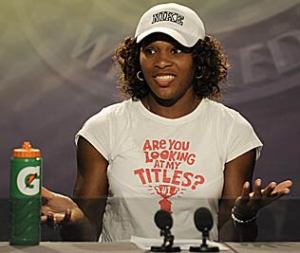
If you haven’t seen the t-shirt Serena Williams sported in her post-match Wimbledon press conference, then you are missing out.Titles2_serena Given the attention to attractiveness, court assignments, body parts (i.e., “back packs”) sex sells women’s tennis controversy at Wimbledon, Williams clearly has the last say. Perhaps it was in jest, but the point of the t-shirt which contrasts her athletic achievements (11 Grand Slam Titles) with a primary focus on her body, mocks the attention given to the feminine, attractive, sexualized nature of the dialogue surrounding her (and other female athletes) play over the fortnight. To hammer this point home….Just think if Roger Federer wore shorts to his press conference with print on the front asking “Are you looking at my trophy?”

For more critique, read the NPR piece “The Nation: Sexism On Centre Court” written by Dave Zirin in which Tucker Center Director Mary Jo Kane is quoted.

Serena Williams “Oversized Back Pack” Critiqued

When I read this column about Serena Williams by sportswriter Jason Whitlock, I had to include it in the blog for obvious reasons. The column wasn’t about Serena’s third Wimbledon Championship or 11th Grand Slam title, but a critique of how good she could be if she would rid of her “unsightly layer of thick, muscled blubber, a byproduct of her unwillingness to commit to a training regimen and diet that would have her at the top of her game year-round”. Whitlock couches his comments by saying he is really a big Serena fan, that she “has limitless potential” and that people are going to accuse him of being sexist…but really he just has her best interest in mind.

Britain Wimbledon TennisUsing flattery and sham transparency (I know you’ll call me sexist, so I’ll do it first, but I’ll say it anyway) to buffer sexist (or racist, misogynistic, homophobic) remarks is a classic diffusing technique used by those who make them. A real “fan” would not make such remarks as research demonstrates that sexist remarks have negative implications for the target’s (i.e. Serena) well-being and can lead to self-objectification. A real fan, let alone a sportswriter, would not focus on Serena’s “back pack” no matter how big or small it is perceived to be, and no matter how much it is perceived to help or hinder her play. The problem here is that instead of focusing on Serena Williams’ play and accomplishment, Whitlock is trivializing both. Whitlock uses his personal views to prescribe what he thinks is “hot and attractive”, perpetuates a narrow conception of beauty, reinforces the idea that only “in shape” women are attractive, and in the end proclaims that only attractive female athletes are worthy of being watched during prime time TV on Centre Court.

When you read about a sportswriter discussing the “back pack” of a highly accomplished male athlete and the writer’s preference for the “size” of the male athlete’s back pack let me know…Nike_BackPack_LARGE

UPDATE: Listen to Dave Zirin’s Edge of Sports radio spot in which Zirin rails Jason Whitlock’s column.

A Good Built Environment Increases Children’s Physical Activity

baseball in a small townThe American Academy of Pediatrics recently released a policy statement about the role of the built environment on children’s health. The built environment is overall structure of the physical environment of a child’s community (e.g., safe sidewalks, accessible parks, existence of bike paths) including spaces such as buildings and streets that are deliberately constructed as well as outdoor spaces that are altered in some way by human activity.

Emerging research indicates that the built environment limits or promotes opportunities for physical activity, in turn affecting child health—including obesity. A July 2009 report “F is for Fat: How Obesity Policies are Failing in America” released by the Robert Wood Johnson Foundation and the Trust for America’s Health indicated that in 30 states the percentage of obese and overweight children is at or above 30 percent. Obesity is a gendered and racialized issue as it is more prevalent in girls than boys, and girls of color have higher rates of overweight and obesity than do their White peers. (Note that the sign indicates “baseball diamond”… a game that girls have historically been excluded from. The sign does not say “ball fields” which could perhaps include softball assuming a softball field exists. To read more about girls and baseball read Jennifer Ring’s 2009 book Stolen Bases: Why American Girls Don’t Play Baseball)

In many communities across the US, the built environment unfortunately does not reflect the image depicted here…the existence of a safe community baseball field that youth can easily find, have access to, and may perhaps walk or bike to and from. The American Academy of Pediatrics report published in Pediatrics outlines a number of policies that can help create and increase the existence of health-promoting built environments.

Wimbledon’s Centre Court = Babe Central?

While I was out of town participating in the Up2Us Regional Sports-based Youth Development Conference hosted by the LA84 Foundation, a graduate student forwarded me an article link I felt compelled to share (thanks EH!).

A nydailynews.com article ran yesterday titled “Wimbledon turns Centre Court into Babe Central, giving players spotlight based on looks, not talent” which outlines that “hot, attractive” lower-ranked players were scheduled to play on Centre Count, and top-ranked players like Serena Williams were relegated to play on less prestigious courts. In the article All England Club spokesman Johnny Perkins was quoted as saying “good looks are a factor” when scheduling matches on Centre Court, in large part it seems due to television coverage.

Wimbledon Thought Process2

Greg Couch writes more about the “babe factor in tennis” on his blog where he states, “A few days ago, Maria Sharapova played Gisela Dulko, and on Wimbledon’s official website, the report of the match said, “As Sharapova and Dulko ran and stretched and lunged, most of the male spectators could not have cared less about their topspin forehands and would no more have recognized a western grip from a western movie — this match was about hormones, pure and simple.”

Unfortunately, it is also “pure and simple” another example of sport media and women’s sport promoting “sexy” athletes (which you could also read as White, feminine, & ponytailed) over athletic competence–which reinforces notions of what matters, what sells, and what is valued. If you want to read a new book out about this issue see D. Daniels (2009) “Polygendered and Ponytailed:The Dilemma of Femininity and the Female Athlete”.

Highest Paid v. Hottest Athletes

msftMSN.com recently posted two articles that represent a perfect example of gender inequality and sexist and marginalizing media coverage of female athletes. The articles speak for themselves….

First visit MSN Sports Hottest 30 Sportswomen , posted on June 23, 2009. (I looked for a companion piece on “The 30 Hottest SportsMEN”… to no avail)

Next visit the story posted June 21, 2009 on MSN titled World’s Highest-Paid Athletes (no female athletes here!)

Title IX Turns 37!

Title IX is a federal law passed in 1972 that requires gender equity for boys and girls in every educational program that receives federal funding. Many argue it is one of the most influential laws in recent history. In the realm of sport it has resulted in an explosion of sport participation for girls at all levels including youth interscholastic, and intercollegiate. In 1972 1 in 27 girls played high school sport, today that number is around 1 in 2.5! The Director of the Tucker Center for Research on Girls & Women in Sport at the University of Minnesota, Dr. Mary Jo Kane, is often quoted, “In one generation we’ve gone from girls hoping there was a team, to girls hoping they’d make the team.”

On June 23, 2009 as Title IX turns 37, we can celebrate the many gains made in all educational contexts for girls but we all need to commit to ensuring the law remains viable for the next 37 years and more!

Here are two of my favorite websites I turn to for information on Title IX:
Title IX
The National Women’s Law Center

A Sign of Things to Come?: Recent Departures in Women’s Basketball

I’ve read about three recent occurrences that have me thinking. While two may be related, all three may be a sign of things to come. departuresI’m talking about the recent departures of two male WNBA Head Coaches “to pursue possibilities in the NBA” and the second-ever early departure of Rutger’s Epiphanny Prince to “play basketball professionally in Europe before entering the 2010 W.N.B.A. draft” (Schuye LaRue was the first-ever woman to leave early from Virginia after her sophomore year in 2001 to go play abroad before getting drafted in the second round by the Los Angeles Sparks in 2003…thanks @hoopfeed!)

Successful Bill Laimbeer left the Detroit Shock after three games, and the not so successful Don Zierden left the Minnesota Lynx three days before their home opener to return to coaching in the NBA. While WNBA league officials and the departing coaches were assuring fans their departures were not a sign of trouble for the league, I’m not so convinced. I hope I’m wrong. What it does signal is that despite your success as a male coach in the WNBA, you can still get “called up” or return to the NBA. Would a successful—or better yet an unsuccessful—female coach ever get the same call? (maybe if your name is Pat Summitt, but I’m pretty sure that one’s gender is not a predictor of effective coaching so in theory many women should get said call)

As for Prince forgoing her senior year of ball at Rutgers to play professionally…One one hand, why not go and start making money immediately?—males have been doing it for years as has been pointed out. Prince states she “plans to buy her mother a house and support an A.A.U. team in Brooklyn”, so the move seems to be primarily financially motivated. On the other hand now that the seal is broken, will droves of other young women follow suit maybe never to return to finish their degrees? (and I’m not saying Prince won’t finish, but highlighting the possibility). Is this a trend we want female athletes to perpetuate? In essence, Prince’s move is no different than those of Laimbeer or Zierden….all three are leaving one basketball team, to pursue what is perceived as a better, bigger, and more lucrative opportunity with another team.

I’m not sure if this collective trend signals a sign of the times or is a sign of things to come….or both. And if it is of things to come….what “things” are we really talking about?

Update: To read more about various perspectives about Laimbeer click here or here.

To read more about what Gina Auriemma says about Prince’s departure, click here or read Altavilla’s blog. The NY Times also weighs in with an article titled “She’s Turning Pro, but Is It Progress?”

To Grunt or Not To Grunt: A Question of Gender Discrimination?

tennis ballDuring the 2009 French Open Tennis Tournament Portuguese teen tennis star Michelle Larcher de Brito made a stir with her elongated “shrieks” when she strikes the ball. Wimbledon officials are now considering making a rule banning loud grunting for female players. While she claims it is just “part of the game” opponents and fans say otherwise.

As a former collegiate tennis player and coach, I get the distracting and annoying nature of loud grunting by an opponent. That is one side of the issue. Another side of this issue is the problematic and gendered nature of this discussion and pending rule.

First, male players on tour also grunt upon impact, therefore a rule should be equally applied to both men and women. However, there has been no parallel discussion of a rule application to the men’s tournament (although Connors, and Agassi were criticized for their noises). Second, the way Larcher de Brito’s grunts are being constructed in the media as “shrieks”,”screams”, and “annoying squeals”… it appears that males players grunts are expected. Third, this isn’t the first time the discussion of a “grunt/shriek rule” for female tennis players has surfaced. If you recall, in the ’90’s Monica Seles was the original purveyor of loud grunting on impact…and while there was much grumbling then, no rules were enacted. Maria Sharapova was also criticized early on for her grunting, but that seemed to subside as she took over the Kournikova mantle as the “poster girl” of the WTA.

Many scholars have documented how female athletes have to constantly negotiate the tension between the movements, noises, muscles, and bodies that are needed to perform optimally and adhering to a narrow ideal of femininity. Clearly, loud shrieking is NOT feminine and therefore is troubling and must be regulated (i.e., “make the offending women act more ladylike so we can enjoy the match!).

Update to post: June 24, 2009: NPR weighs in on issue “Tennis, The Grunting Game?” in which sports journalist Christine Brennan gives her take, and another commentary by Frank Deford “It’s Time For Tennis Players To Make Some Noise”. You can also read Pat Griffin’s take on her blog.

New Twitter research: Help in marketing women’s sport?

A new study from Harvard provides information to those banking on Twitter to help market, promote, and sustain women’s sports. Here are some snippets if you don’t want to read the entire article or the post on Harvard Business Publishing:
1. “Just 10% of Twitter users generate more than 90% of the content”…superchirpthese people are called “super users”. Super Users can now make money through a just launched service called Super Chirp

2. “…very, very few people tweet and the Nielsen data says very, very few people listen consistently.”

3. “Among Twitter users, the median number of lifetime tweets per user is one”

and my favorite bit….Tweet bird

4. “…an average man was almost twice as likely to follow another man than a woman, despite the reverse being true on other social networks. The sort of content that drives men to look at women on other social networks does not exist on Twitter,” said Mr. Heil (one of the researchers). “By that I mean pictures, extended articles and biographical information.”

Twitter may be reaching a certain audience, but probably not males who don’t opt in and follow women’s sport.

Take home message for female athletes and women’s professional sport leagues: Use sexy pictures you download onto TwitPic to garner millions of followers (given the stack of research on how female athletes are sexualized in the sport media, such a picture shouldn’t be hard to find), then start charging your followers money to follow your Tweets. Voila!...instant revenue!

Given Heil’s findings, this may unfortunately lend some credence to the “sex sells” women’s sport debate (for more on this debate click here and here). But… I still contend that sex sells sex, not women’s sport.