The LFL…that stands for The Lingerie Football League

lfl_logoThe LFL…short for The Lingerie Football League…should really be short for “LaFf out Loud”. Please take a look at The LFL website if you haven’t yet. LFLMany of you who read this blog probably already know what my response to this might be. But first you should see some recent practice pictures featured on SportsIllustrated.com. Honestly I don’t even know where to start the critical commentary…the team names, the uniforms, the photo gallery, the concept…..(sigh).

If this league survives and thrives, then I guess we all have more data to help us answer the burning question “Does sex sell women’s sport?” What do YOU think about The LFL?

“Marginalization of women and girls—one of humankind’s oldest problems”

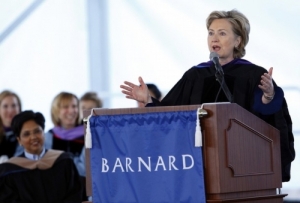
Recently U.S. Secretary of State Hillary Clinton delivered the commencement speech at Barnard College, an all women’s college located in New York City. Her speech had many good points, but there are two excerpts in particular which inspired this blog. First, Clinton states, “Marginalization of women and girls goes on. It is one of humankind’s oldest problems.” Given the dialogue generated around my past blog (and at Women Talk Sports) pertaining to whether Twitter is good or bad for women’s sport and if sex sells women’s sport, Clinton’s remarks about the use of social media are particularly relevant.

In her speech Clinton challenges the women of Barnard, and all of us indirectly, to use social networking tools to better the lives of girls and women. Clinton says, “But now, it [news] is beamed worldwide by satellites, shared on blogs, posted on Twitter, celebrated in gatherings. Today, women are finding their voices, and those voices are being heard far beyond their own narrow circumstances. And here’s what each of you can do. You can visit the website of a nonprofit called Kiva, K-i-v-a, and send a microloan to an entrepreneur like Blanca, who wants to expand her small grocery store in Peru. You can send children’s books to a library in Namibia by purchasing items off an Amazon.com wish list. You can sit in your dorm room, or soon your new apartment, and use the web to plant trees across Africa through Wangari Maathai’s Green Belt movement.

And with these social networking tools that you use every day to tell people you’ve gone to get a latte or you’re going to be running late, you can unite your friends through Facebook to fight human trafficking or child marriage, like the two recent college graduates in Colombia – the country – who organized 14 million people into the largest anti-terrorism demonstration in history, doing as much damage to the FARC terrorist network in a few weeks than had been done in years of military action. (Applause.)Clinton at Barnard

And you can organize through Twitter, like the undergraduates at Northwestern who launched a global fast to bring attention to Iran’s imprisonment of an American journalist. And we have two young women journalists right now in prison in North Korea, and you can get busy on the internet and let the North Koreans know that we find that absolutely unacceptable. (Applause.)

These new tools are available for everyone. They are democratizing diplomacy. So over the next year, we will be creating Virtual Student Foreign Service Internships to partner American students with our embassies abroad to conduct digital diplomacy. And you can learn more about this initiative on the State Department website.This is an opportunity for all of us to ask ourselves: What can I do?….no matter what you’re doing, you can be a citizen activist and a citizen diplomat.”

So while the jury is still out on whether social media is good or bad for women’s sport, how we might train female athletes to use it effectively, if female athletes can “have it all” (i.e., promoting sexy, feminine, yet strong athleticism) or if by doing so they are reproducing the same old gender stereotypes that undermine women’s athletics, or if sex truly does or does not sell women’s sport, we do know a few things.

Girls and women in sport, and unfortunately in many other contexts, continue to be marginalized. I invite everyone—women and men alike—who care deeply about sport and physical activity as a means for female empowerment and positive development, should reflect on Clinton’s remarks. How can we become “citizen diplomats” and use social media for the greater good of helping develop, grow and sustain women’s sports?

Note: As a related aside, when I was coaching Women’s Tennis at Wellesley College (’94-98), an all women’s college and the alma mater of both Secretary Clinton for former Secretary of State Madeleine Albright, the book store had a great t-shirt. On the front it said, “Wellesley trains women to be secretaries”…and on the back it said “Secretary of State”.

(photo credit to Secretary Clinton blog)

A Little Break

I’ll be taking a little break from the blog this week while I spend time at the cabin…a Minnesotan’s favorite place.
IMG_0952

The WNBA Expect Great Campaign: What is Your Opinion?

AAIQ024~Lindsay-Whalen-PostersSince this is a critical commentary on sport, I have to agree with Zalika Green, fellow Women Talk Sports blogger, and her opinion on the new WNBA Expect Great commercials. I really wanted to like them, and the slogan “Expect Great” held great promise. But once I watched them, I was disappointed. I wanted to see the athletes in action, not stills. The WNBA has a lot of great talent, show them doing what they do best!

What do you think? Watch them, vote with this poll and comment here if you feel inclined.

Sexism & Horse Racing: The Preakness

RAI’m watching the pre-race coverage of the Preakness horse race right now on NBC. I’ve been following the media coverage of this race all week. Drama and debate rage on “should fillies race with stallions” due to the recent success of filly Rachel Alexandra. What strikes me, is that nearly the same arguments arise when female athletes compete or encroach upon male sport…wait…I’m sorry horses are athletes (just look at ESPN’s Top 100 athletes of the century…where there are almost as many horses as female athletes).

Some, including RA’s former owner Harold McCormick, stated that “fillies should race with fillies, and stallions with stallions”. RA’s new owner Jess Jackson said today on NBC that “Champions should race with champions….the best should race against each other…and it isn’t a matter of female or male, she is a good horse.” Sport sociologists have pointed out that separating male and female athletes is arbitrary and serves to reinforce a gender binary that perpetuates male superiority, because if females are not allowed to compete with males, females can never beat males.

RA is bigger and weighs more than Mine That Bird who won the Kentucky Derby, but everyone is talking about how she is “at more risk for injury” (which is another reason why it is argued females should not compete with males, they are fragile and more susceptible for injury). But no commentators are saying that Mine That Bird should not race because he is smaller and weighs less.

Her new trainer just said that “she is a classy filly” and they have just been trying to keep her happy. Classy and happy? Would we say that about a male horse? (maybe we do, I don’t know horse racing well).

One commentator just said RA is a “man running against boys….she’s a freak!” and a former jockey commentator called her “a super filly” (when female athletes are really good and start beating males, they are often called “men” or labeled lesbian. Females are in essence regendered or classified as super-normal, to explain why they excel in sports). Only a “super” filly can beat a male horse! Well let’s see what happens!……

UPDATE: RACHEL ALEXANDRA WINS!!!!!!!!!!!!!!!!! THE FIRST FILLY TO WIN THE PREAKNESS SINCE 1924 and the first horse to win it from the #13 position! Perhaps she IS a super filly. Her jockey Calvin Borel just said, “She is the best horse he’s ever ridden”. (he didn’t say best female horse…best horse). We can only hope the post-race coverage is less sexist and echos that of Borel…she is a great horse. Period.

Selling Sex Does NOT Attract Men to Women’s Sport

I just saw a short video as a result of a Twitter from the WNBA. The power of social media at work for one “opt-in” follower! The video is by Mr. Alex Chambers, a self-proclaimed avid WNBA fan who also Twitters, and blogs. Yes, I said “Mr”!

I’m posting this because Mr. Chambers is a prime example of my previous point that sex does not sell women’s sport, it sells sex (not sport) to young men….and alienates and/or offends female sport fans. If women’s professional sport leagues want attract the coveted demographic–young male sport fans–they have to do a better job of selling athletic competence.

Notice in Mr. Chambers’ video, not once does he mention how attractive, sexy, feminine, or motherly the players are. He loves BASKETBALL and he loves the WNBA. 0908jack-black-wnba200I agree with him there are more male fans out there like him….and more that would likely become women’s sport fans if it was marketed differently or deemed “cool” and acceptable by males in general (like if Jack Black pictured here were at a Sparks game…I’m not sure if he is or isn’t at a WNBA game). Keep up the good work Alex Chambers…I can’t wait to hear more about your “journey” this summer. On similar note, the WNBA is about to fully release their new marketing campaign “Expect Great”. The title sounds promising!

Does Sex Sell Women’s Sport?

I’ve been wanting to write a blog about this topic for awhile and a recent interview given by my colleague and the Director of the Tucker Center for Research on Girls & Women in Sport Professor Mary Jo Kane on the Edge of Sports Radio with Dave Zirin provided me with a perfect opportunity!

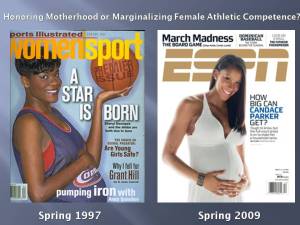
In the interview with Zirin she discusses research, conducted with Heather Maxwell (Ph.D.), in which their findings refute the idea that sex sells women’s sports. Kane also discusses how the notion of “sex sells” is related to depictions of motherhood and female athletes—like the magazine covers of Sheryl Swoopes and Candace Parker pictured here, homophobia and Pat Griffin’s idea of The Glass Closet, and her thoughts on the Women’s Final Four sport media coverage. (Note: Motherhood and elite female athletes is a popular blog topic lately..see Maria Hardin’s blog and the Pretty Tough blog)Swoopes and Parker_pregnant

I also think Kane’s interview helps us think through why some female athletes feel it is important to “have it all” (i.e., be sexy, feminine, AND athletic)…which I’ve touched upon in a previous blog about social media.

The interview is less than 5 minutes and well worth your while to hear one of the leading experts on sport media, Title IX, gender, and women’s sports talk critically and share cutting edge research. In the end, as Zirin says, “Sex sells sex“. Sex does NOT sell women’s sports.

Why Mothers Coach

iStock__mom coach soccer_XSmallIn a study where we interviewed mothers who were also youth sport coaches, we wanted to know why they were coaching. A majority of the time the primary focus, including my recent posts on female youth sport coaches, is on the barriers that limit or prevent mothers, and females in general, from coaching. So, in honor of all the mothers everywhere who spend their time and energy coaching their own and other people’s children—Happy Mother’s Day and thank you!

A major reason many mothers coach is because it provides time for them to spend with their child(ren). One mom said, “You know it gave us another chance to spend time together in a different way other than just being at home or being in a social situation, and so I really enjoyed it and she did, too. Even though she was the coach’s daughter it worked out.”

Mothers in our study coached because they saw a need for female coaches and good coaches in general, and felt coaching provided an outlet to share their experience, passion for sport and sport knowledge with their children. Mothers discussed the importance of providing positive role models—particularly for girls—and felt coaching was fun and rewarding.

Thanks to the many women—mothers and non-mothers alike—who coach our children and youth! You are the missing piece of the youth sport puzzle.

The “success” of Twitter in promoting women’s sports: ‘Show me the money!’

tweet-birdThere seems to be much discussion over Twitter and how it might be “the answer” to successfully marketing and promoting women’s sports. Jayda Evans (Seattle Times columnist & Twitter-er) wrote about it, the Women’s Professional Soccer League is using it, and Megan Hueter, Co-founder of Women Talk Sports, has two recent blogs about the importance of social media for women’s sport (A recent blog is about Twitter and an earlier blog was about Facebook). I responded to Megan’s blog, and she responded back (scroll down on her blog about Facebook to see our exchange). I enjoyed this dialogue and have been thinking about this issue ever since.

I get that social media is a platform to market women’s sports in a saturated market, and it is accessible, current, relevant, provides athlete-generated content etc…I got it. I love social media, really I do, so this is not a critique of social media or those that love it, promote it, and live for it. I have a Blog (obviously), a Facebook page, am connected to colleagues through LinkedIn, and recently conquered my Twitter fascination. However, even with my love for social media I’m reluctant to make claims about the effectiveness of it in promoting female athletes and women’s sports. It is the researcher in me—I’m critical and skeptical until I see the proof (i.e., empirical data).

I have seen ZERO research that demonstrates if, and how, social media tangibly and effectively promotes and markets women’s sports. I queried one of our very smart graduate students who is immersed in this research, and she didn’t know of any either. We will stand corrected if it exists. Just because everyone is all atwitter about Twitter doesn’t mean it “works” or will “save” women’s sports.
twitter-image1Here is what we generally DO know about Twitter and sport:
1. Twitter exists and is rapidly growing in popularity
2. Some people, but not many (~5% of the population), are currently using Twitter
3. Some professional athletes are included in that 5%
4. Many professional sport leagues have a Twitter presence

Here is the $1,000,000 question: Has Twitter lead to an increase in—attendance, ticket sales, merchandise sales, sponsorships, media coverage in mainstream sport media, number of teams in women’s professional leagues, or any measurable interest in or consumption of women’s sports? Right now, Twitter is a good listening tool and provides a way to listen to brand champions of women’s sport (i.e., the core, loyal consumer). But other than that, show me the data. It might be doing some good, but has anyone thought about the flip side?…. that social media might not be good for female athletes or women’s sports? So how might Twitter and other social media (including those not invented yet) be “bad” you ask? Well here are a few things to ponder.

It is a well known fact that female athletes receive only 6-8% of coverage in traditional sport media. This statistic has remained consistent over the last 20 years, despite increases in girls and women participation in sport. When female athletes are covered in traditional sport media, they are often portrayed in ways that marginalize or minimize athletic competence and highlight sexy, hetero, feminine aspects of the female body or identity.

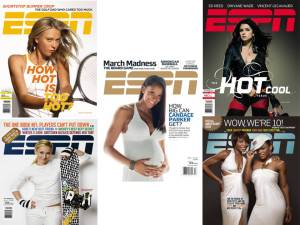
A perfect example of this is the March 23, 2009 ESPN magazine cover of pregnant WNBA Rookie of the Year Candace Parker in which the opening sentence discusses that Parker “…is beautiful. Breathtaking, really, with flawless skin, endless legs and a C cup…” If you want a thorough, and I think well done, sociological critique of this article read this blog which appears in Contexts. I did a little mini investigation after I saw the Parker cover and found: In five years (2004- March 2009) females athletes have appeared on 5 of 168 ESPN covers (3.6%…less than the average) and when they do….well see for yourself.espn-mag-women-covers-5-yrs
While social media is changing the role of sport journalists, sport media scholar Marie Hardin argues this is both good an bad. I add it is good if it changes coverage patterns of female athletes, but I would add it is bad if it becomes expected that female athletes have to be partially or largely responsible for promoting themselves as well-rounded “girls next door” through social media as a way to “save” their leagues or bolster their own “brand”. Why isn’t it just enough for Candace Parker to play basketball to the best of her abilities? The NBA doesn’t ask Kobe Bryant to be more than a great basketball player do they?

Could it be possible that social media, including Twitter, is just another means to replicate the ways in which traditional sport media marginalizes and sexualizes female athletes? Twitter’s existence does nothing to challenge the status quo or existing structural inequalities between men’s and women’s sports…especially since it is an “opt in” platform.

Another point to ponder: How are female athletes and professional leagues presenting themselves on Twitter? Stay tuned for results on cutting edge research two of our graduate students are just completing on this very question—this is cool stuff! In the meantime, I’ll give you one example that occurred on the 2009 WNBA draft day which caught my eye and highlights my previous point. I saved three (of many) Tweets written by draftees, the WNBA, and other attendees who were collectively discussing “how we look and what to wear” rather than “how we play” on Draft Day 2009. 2wnbadraft-day

What everyone should do who cares about this issue and the cause of women’s sport, is think less about hyping social media and more about how social media can be used to create real social change and lead to sustainability (meaning…show me not only the data, but the $$$$) of women’s professional sport leagues…and more importantly, how can we prove and measure “success”?

What Makes Sport Parents “Angry”?

angry-man_istock_000005831286xsmall_croppedToday I spent the day finishing up (well almost) a paper on what makes sport parents angry during their child’s sport events. I alluded in my last blog that snacks cause a fair amount of parent anger…now to the main finding. What percentage of sport parents claim they “never get angry”? If you guessed about one third, you would be correct! Now you might be thinking that seems a bit high…I do. I think that almost all sport parents get angry at something at some point during their child’s sporting endeavors. The other two thirds of (honest) parents that do report getting angry have a variety of things that set them off. What or who do you think is the #1 Anger Culprit? If you guessed the Incompetence of the Referee, you would be correct!Football referee blowing whistle Remember though, it is the parent’s perception of incompetence that makes them angry…we don’t know in reality if the referee is truly incompetent or not.

Given that retaining and recruiting youth sport referees is a MAJOR issue—just ask NASO which estimates a ~35% attrition rate each year—could parental anger over referee incompetence be a contributing factor in the high attrition rate? Needless to say that many youth sport referees are adolescents who take on the “job” for the love of the game and quit in part because of the abuse they take from adults on the sidelines. Obviously, yelling at the referee is not unique to youth sports but it does become a more important issue when children and youth are the indirect (as athletes) and direct (as the referee) recipients of angry yelling. Yelling at the referee is also the #1 most frequent “bad” or “poor” sport behavior on youth sport sidelines reported from the perspective of youth athletes, parents, and coaches alike. What I’ve found interesting in the 4-5 studies I’ve done in the context of youth sport is that the referee ALWAYS comes up as a source of contention. There is a future research question in here somewhere…..but you’d be surprised at how little research has been done on referees or taken the referee perspective into account. More to come in the future on “what makes sport parents angry”…..