Top 5 Take Aways: Social Media & Women’s Sports

Social Media Pic_iStock_000009648196XSmall

On Monday, October 19 I took part in the Tucker Center Distinguished Lecture Series on The Impact of Social Media on Women’s Sports-which you can view in its entirety here. There were so many great ideas  and critical thinking from so many perspectives that I’m still processing, but here are my Top 5 as of now.

1. Women’s sport marketing & promotions have always been viral and no one is really sure how to measure return on investment. Social media should be about building relationships and you can’t always measure the impact of relationship building.  (@DigitalMaxwell, Dr. Heather Maxwell)

2. The success of female sports journalists depends on the success of women’s sports, but half of female sport journalists surveyed don’t feel a responsibility to cover women’s sports. They don’t want to be pigeon-holed.(@mariahardinpsu, Dr. Marie Hardin)

3. Is it fair to place the burden of marketing & promoting women’s sports on the shoulders of the female athletes-especially those in “non-traditional” sports like ice hockey? Is this the new model we are left with as social media envelops traditional sport media (where female athletes get 6-8% of the coverage)? (@angelaruggiero, Angela Ruggiero, US Women’s National Ice Hockey Team)

4. Interest in women’s sport is being measured by “click throughs” in online editions of newspapers & websites. So if people don’t click on women’s sport stories, it is interpreted as “non interest”. Those who support women’s sports have to CLICK the stories that we can find!  (Rachel Blount, Sports Columnist, Star Tribune)

5. Time remains to take control of social media and use it effectively to grow women’s sports, but time is running out (Rachel Blount, Sports Columnist, Star Tribune)

If you watched it what were your thoughts?

Where are the Photographs of Female Coaches?

As part of my research and outreach I’m always trying to track down pictures of female coaches, specifically at the youth level, that don’t look “staged”. I’ve looked in most all the photo websites like IStock Photo, and when you type in “female coaches”…well just try it and see for yourself. The choices are really pathetic—similar to the  image you see here (not from IStock). coach-mom_baseballIn fact, if you only looked at the pictures you can find on these type of sites– or anywhere for that matter— you’d wonder if legitimate female coaches exist at youth or interscholastic levels.

I’ve had my colleagues and graduate students look as well, in case I was missing something or not searching correctly or in the right spots. Same result. When I needed images for the website of my new initiative to increase the number of female coaches, We Coach: Educating & Empowering Through Sport, I had to email female coaching friends  for images of themselves.

This blog was inspired when I got notice today from WordPress.com that I could have access to pictures on PicApp.com, a site I had not previously been aware of. I immediately went to their site and typed in “coaches” and 3,829 images on 64 pages came up. Here is an example of what you will see–male coaches in action, in uniform, on the field looking competent and in charge. [picapp src=”e/5/7/a/Georgia_Southern_v_69ab.jpg?adImageId=5443390&imageId=6769230″ width=”234″ height=”150″ /] [picapp src=”6/1/2/f/Pistons_vs_Hawks_f5db.JPG?adImageId=5556926&imageId=6783389″ width=”234″ height=”159″ /]What you will not see are pictures of female coaches. I gave up looking for a female coach after the 5th page of images (sigh). (NOTE: I wrote this blog last night, and when I went in today the first images are from the Women’s Sport Foundation Annual Salute to Women’s Sport, including a few of Pat Summitt, the most winning-est coach in collegiate basketball. However, the images of Summitt are not in action, on the court, or in coaching attire, which sends a very different message about coaching competence compared to the images of the male coaches on the page)

Next I typed in “female coaches” resulting in 475 images on 8 pages. The first image is picture of Nadal signing autographs—not sure what this picture has to do with female coaches? The second image is this woman, who in my opinion doesn’t exactly look like a coach.
[picapp src=”c/f/b/e/Rafael_Nadal_Pre_41d7.jpg?adImageId=5557660&imageId=5606384″ width=”234″ height=”316″ /] [picapp src=”9/0/3/e/PicImg_Sarah_Gronert_in_f773.JPG?adImageId=5558108&imageId=4527814″ width=”234″ height=”332″ /]
The ironic part is the search for “female coaches” elicited more pictures of male coaches than female coaches, but when you search for “coaches” only pictures of real male coaches in action show up. (Note: the pics of Summitt mentioned previously do NOT appear on the “female coaches” page)

If you have the skills, passion, and time…please take some high resolution, pictures of female coaches in uniform, and “in action”. When I say “in action” I mean in action while coaching. Take pictures of what it looks like to coach in a REAL game, match, meet, or practice. When you do, make them available somewhere and let me know where to find them! Or if you know of a site with good images of female coaches not at the collegiate level, please enlighten me.

The scarcity of images that portray athletic competence of female athletes is well documented and I’ve written about it previously, but the same portrayal pattern exists for female coaches. A lack of legitimate images virtually and literally erases female coaches which is not good for anyone. Where are the pictures of female coaches?

FINALLY! A Worthy Comparison

wnbaOn the eve of the final WNBA playoff game, I just watched a fantastic video made by a WNBA Intern, that I saw due to a Tweet by Minnesota Lynx player Candice Wiggins (@candicwiggins). In the video, clips featuring similar plays from the NBA and WNBA are shown back-to-back or simultaneously.  What this sets up is that WNBA players are as athletic as, and do exactly the same exciting plays as their NBA counterparts. Female athletes are depicted in action, on the court, in uniform doing what they do best (in contrast to passive, off the court, and NOT in *cough* uniform Serena Williams). Brilliant! Usually when female athletes are compared to male athletes, the male version of the game is constructed as “better than”, more exciting, or the real version. Not in this video!

Advice to the WNBA: HIRE THIS INTERN. Whomever you are Intern, NICE WORK! This is exactly the kind of marketing and fresh thinking the WNBA needs to sustain the league.

Update: I’ve been advised that credit may be due to more than one intern. In that case, hire them all!

The ‘New’ Look of Caster Semenya

Much has been written about the controversy regarding the sex verification testing of Caster Semenya following the IAAF Championships in August 2009 (to read more go here, here, here, here, & here).

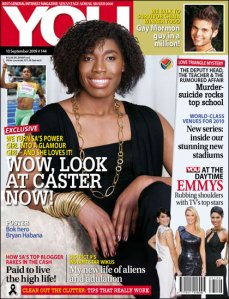
semenya new lookGiven all Semenya has endured, I can’t say I was surprised (albeit saddened) to see an article today titled, “Embattled track star Caster Semenya gets new coach, new look” which also featured the cover of You magazine (pictured here).

It also got me thinking…When a man outperforms his competition by a large margin—such as sprinter Usain Bolt for example—no one asks “Is he really a man?” No one says, “He is so fast, he might be a woman. He should be tested.” But when a woman wins by a lot—such as sprinter Caster Semenya—her sex is immediately questioned, “Is she really a woman?” This appears to be a clear example of marginalizing female athletic performance, homophobia, and sexism. Unfortunately Semenya’s ‘new’ look is not a new phenomenon for female athletes who have fallen under scrutiny as a result of outstanding sport performances.

when you win by a lot

A Curious Catwalk for a Cure

A charity promotion from the Minnesota Lynx (found by ASC) is a perfect example of how gender is constantly (re)constructed in women’s sport. There is so much going on is this ad, it makes your head spin! The juxtaposition of femininity and sport, and influence of homophobia, as some would argue, are painfully evident. The only thing missing from the event is a kiss-cam! What do you think?
Lynx 2009 Cat Walk

Thoughts on Bras, (Soccer) Balls, & Bikes

A few random things to think about over the weekend:

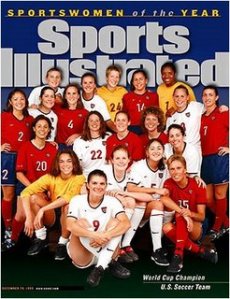
SICover_1999 world cup team1. As the 10th Anniversary of the 1999 Women’s World Cup in upon us, pay attention to how the media constructs this historic event. Will the focus be on a) the US win and competitive achievement, b) Brandi Chastain’s offing-the-soccer jersey to expose her Nike sports-bra (see the NCAA Double-A Zone), c) the “girls of summer” (i.e., the wholesome, attractive, All-American darlings that everyone fell in love with) many of whom are now mothers, d) how the historic event gave notice that people DO like to watch women’s sports (especially when it is promoted in the media and marketed) (see Christine Brennan’s USA Today column, e) how the team provided role models for young boys and girls, or f) spawned two women’s professional soccer leagues (see WPS) …..or perhaps some of all of the above? I’ll be curious to see what dominant messages arise.

women cycling2. The Tour de France is underway! Will Lance Armstrong really win it yet again? It got me thinking…why don’t women ride in the Tour de France? I did a little sleuthing and found no real answers but there IS a race called Le Grand Boucle (“the great loop”) which is been held off and on roughly over the last 15 years. The women’s race is shorter, has varied in the number of stages (the men’s race has 21), and the 2009 race will be just four days long “due to organizational difficulties” (according to Wikipedia..take it for what you will). If you know French, you can see the official website of Le Grand Boucle…je parlez un peu francais. It makes me think that the exclusion of women in the Tour de France is arbitrary, and the shorter “lesser than” women’s race, serves to perpetuate existing and historical gender hierarchies in sport that privilege male athletes.

New Twitter research: Help in marketing women’s sport?

A new study from Harvard provides information to those banking on Twitter to help market, promote, and sustain women’s sports. Here are some snippets if you don’t want to read the entire article or the post on Harvard Business Publishing:
1. “Just 10% of Twitter users generate more than 90% of the content”…superchirpthese people are called “super users”. Super Users can now make money through a just launched service called Super Chirp

2. “…very, very few people tweet and the Nielsen data says very, very few people listen consistently.”

3. “Among Twitter users, the median number of lifetime tweets per user is one”

and my favorite bit….Tweet bird

4. “…an average man was almost twice as likely to follow another man than a woman, despite the reverse being true on other social networks. The sort of content that drives men to look at women on other social networks does not exist on Twitter,” said Mr. Heil (one of the researchers). “By that I mean pictures, extended articles and biographical information.”

Twitter may be reaching a certain audience, but probably not males who don’t opt in and follow women’s sport.

Take home message for female athletes and women’s professional sport leagues: Use sexy pictures you download onto TwitPic to garner millions of followers (given the stack of research on how female athletes are sexualized in the sport media, such a picture shouldn’t be hard to find), then start charging your followers money to follow your Tweets. Voila!...instant revenue!

Given Heil’s findings, this may unfortunately lend some credence to the “sex sells” women’s sport debate (for more on this debate click here and here). But… I still contend that sex sells sex, not women’s sport.

Tweets during sport events: A sport psychology perspective

Carolyn Bivens,the LPGA Tour Commissioner recently stated in an interview, “I’d love it if players Twittered during the middle of a round,” and “encourages” players to use hand held devices to post content on social-media Web sites such as Twitter or Facebook during tournaments, even if it runs counter to golf etiquette. The LPGA is not the first professional women’s sport to enter the world of social media. The WPS has dabbled with tweets during games, and many female athletes, leagues, and coaches have Twitter pages (To see them all visit the Twitter Lounge at Women Talk Sports). sport psychology image 2While the effectiveness of Twitter in marketing and promoting women’s sport is still rages, I’d like to offer a sport psychology perspective on tweeting during competition.

Psychological skills in sport include (but are not limited to) managing energy and anxiety, self-talk, visualization, goal setting, and attentional control. Perhaps tweeting between holes, during halftime or between periods, or if a player is on the bench, might be a good idea but even that is stretching it. If an athlete is tweeting (to interact with fans, give fans what they want, make athletes accessible, make the sport more appealing…or for whatever purpose it is supposed to accomplish), even on the bench, she is not paying attention to relevant information in the game that she might need when called upon. I can see it now…

basketballCoach: “Why did you miss that defensive coverage? She has been doing that same move all night long? I sent you in there for your defense, you’re our stopper!!!”
Athlete:“Sorry Coach, I’ve been busy tweeting while on the bench so that more fans will come watch our games and the league is ‘encouraging’ us do it”
Coach: “No one will come if we are losing games because players off the bench have no clue what is going on!…give me that IPhone!”

In golf, a player must maintain mental focus the entire round. One errant shot, wrong club, mis-read can be the difference between making the cut and making travel plans to the next tournament. Some athletes do have the ability to refocus attention quickly, but some do not. Why take the chance?

golf puttCoach: “What happened on the back nine? All you had to do was to make par all the way in to make the cut!”
Athlete: “On hole 14 I stopped to tweet how I was doing to my tweeples, and then I was rushed for my shot and had to go through my ritual quickly. I lost focus and before I knew it, my second shot was in the water which made me so mad because I knew it was because I had lost focus, which made me more unfocused and angry at myself and it spiraled from there.”

Athletes that are mentally tough (the ability to perform on command regardless of the situation), have developed psychological skills which include highly detailed and systematic rituals that are practiced. These rituals increase the likelihood of optimal performance. Will competitive rituals now include tweeting?

Athlete:(golfer through pre-shot routine) Assess yardage, wind direction and lie. Pick club, take practice swings, repeat cue words, address ball, take a deep breath, see self hitting ball perfectly, see ball flying on right trajectory, exhale, relax shoulders, loosen grip on the club, hit it. Pick up phone to tweet result. Repeat.

Tweeting during competition has nothing to do with optimal performance. Energy and attention focus are limited quantities. The more energy and focus that goes into tweets, the less the athlete has for performing well. If I saw an opponent tweeting during a competition, I would be elated! The excitement around Twitter during games seems to driven by “what the fans want” rather than “what is best for the athletes”. After all, professional athletes are there to compete and perform the best they can on any given day–anything that distracts them from doing so is a bad idea.


The LFL…that stands for The Lingerie Football League

lfl_logoThe LFL…short for The Lingerie Football League…should really be short for “LaFf out Loud”. Please take a look at The LFL website if you haven’t yet. LFLMany of you who read this blog probably already know what my response to this might be. But first you should see some recent practice pictures featured on SportsIllustrated.com. Honestly I don’t even know where to start the critical commentary…the team names, the uniforms, the photo gallery, the concept…..(sigh).

If this league survives and thrives, then I guess we all have more data to help us answer the burning question “Does sex sell women’s sport?” What do YOU think about The LFL?

“Marginalization of women and girls—one of humankind’s oldest problems”

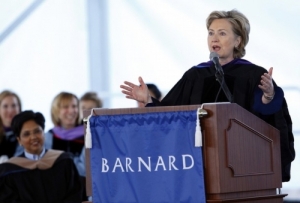
Recently U.S. Secretary of State Hillary Clinton delivered the commencement speech at Barnard College, an all women’s college located in New York City. Her speech had many good points, but there are two excerpts in particular which inspired this blog. First, Clinton states, “Marginalization of women and girls goes on. It is one of humankind’s oldest problems.” Given the dialogue generated around my past blog (and at Women Talk Sports) pertaining to whether Twitter is good or bad for women’s sport and if sex sells women’s sport, Clinton’s remarks about the use of social media are particularly relevant.

In her speech Clinton challenges the women of Barnard, and all of us indirectly, to use social networking tools to better the lives of girls and women. Clinton says, “But now, it [news] is beamed worldwide by satellites, shared on blogs, posted on Twitter, celebrated in gatherings. Today, women are finding their voices, and those voices are being heard far beyond their own narrow circumstances. And here’s what each of you can do. You can visit the website of a nonprofit called Kiva, K-i-v-a, and send a microloan to an entrepreneur like Blanca, who wants to expand her small grocery store in Peru. You can send children’s books to a library in Namibia by purchasing items off an Amazon.com wish list. You can sit in your dorm room, or soon your new apartment, and use the web to plant trees across Africa through Wangari Maathai’s Green Belt movement.

And with these social networking tools that you use every day to tell people you’ve gone to get a latte or you’re going to be running late, you can unite your friends through Facebook to fight human trafficking or child marriage, like the two recent college graduates in Colombia – the country – who organized 14 million people into the largest anti-terrorism demonstration in history, doing as much damage to the FARC terrorist network in a few weeks than had been done in years of military action. (Applause.)Clinton at Barnard

And you can organize through Twitter, like the undergraduates at Northwestern who launched a global fast to bring attention to Iran’s imprisonment of an American journalist. And we have two young women journalists right now in prison in North Korea, and you can get busy on the internet and let the North Koreans know that we find that absolutely unacceptable. (Applause.)

These new tools are available for everyone. They are democratizing diplomacy. So over the next year, we will be creating Virtual Student Foreign Service Internships to partner American students with our embassies abroad to conduct digital diplomacy. And you can learn more about this initiative on the State Department website.This is an opportunity for all of us to ask ourselves: What can I do?….no matter what you’re doing, you can be a citizen activist and a citizen diplomat.”

So while the jury is still out on whether social media is good or bad for women’s sport, how we might train female athletes to use it effectively, if female athletes can “have it all” (i.e., promoting sexy, feminine, yet strong athleticism) or if by doing so they are reproducing the same old gender stereotypes that undermine women’s athletics, or if sex truly does or does not sell women’s sport, we do know a few things.

Girls and women in sport, and unfortunately in many other contexts, continue to be marginalized. I invite everyone—women and men alike—who care deeply about sport and physical activity as a means for female empowerment and positive development, should reflect on Clinton’s remarks. How can we become “citizen diplomats” and use social media for the greater good of helping develop, grow and sustain women’s sports?

Note: As a related aside, when I was coaching Women’s Tennis at Wellesley College (’94-98), an all women’s college and the alma mater of both Secretary Clinton for former Secretary of State Madeleine Albright, the book store had a great t-shirt. On the front it said, “Wellesley trains women to be secretaries”…and on the back it said “Secretary of State”.

(photo credit to Secretary Clinton blog)